
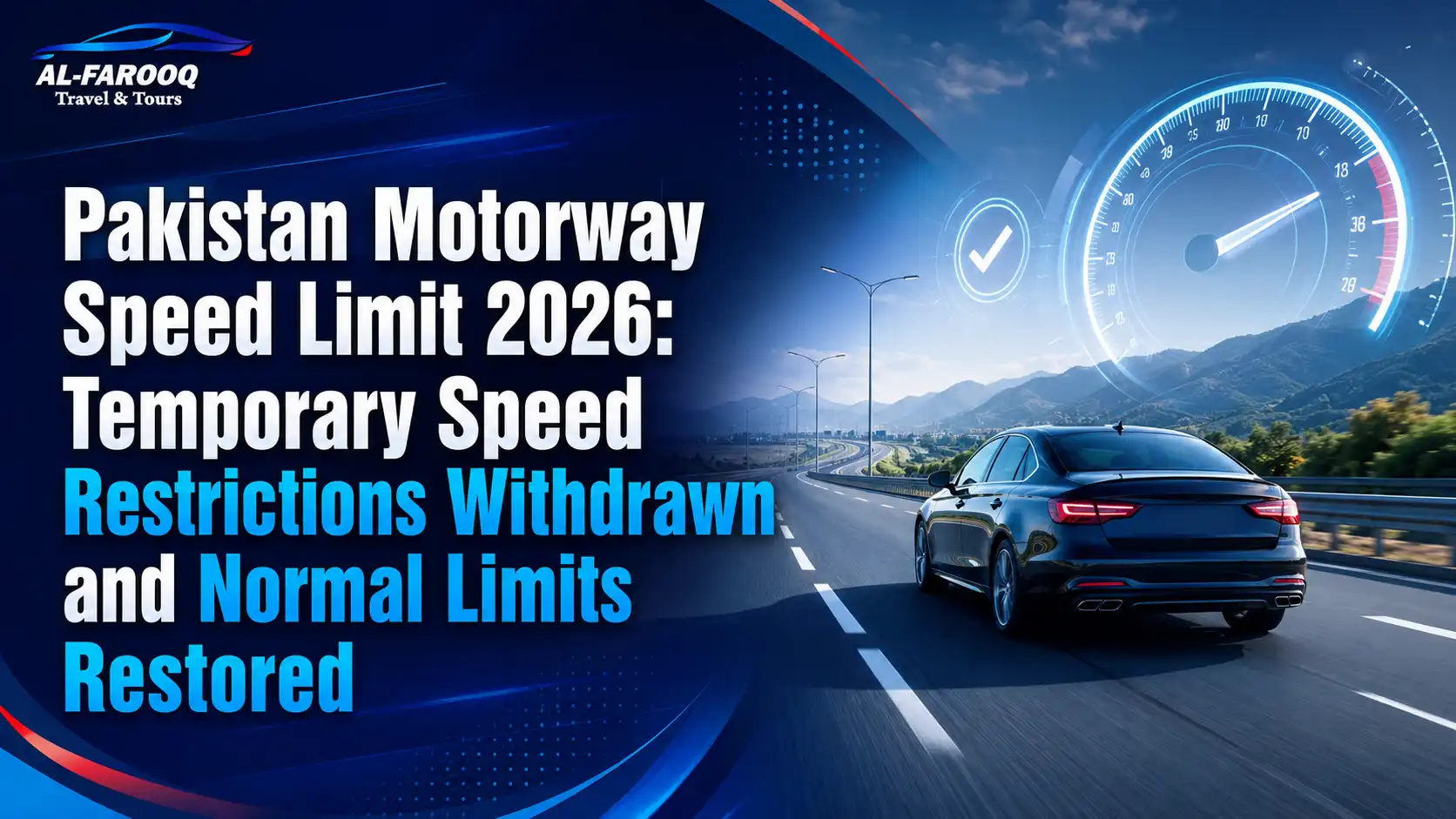
The Pakistan motorway speed limit 2026 has returned to normal after the government withdrew the temporary speed restrictions on motorways and national highways. As of June 2026, the motorway speed limit for cars and light transport vehicles is restored to 120 km/h, while the speed limit for public service vehicles and heavy transport vehicles on motorways has been restored to 110 km/h, according to recent Motorway Police updates reported by national media.
However, drivers should not treat 120 km/h as permission to drive fast in every situation. The legal and safe speed can still change because of rain, fog, roadwork, traffic, diversions, hilly sections, entry/exit areas, and posted speed-limit boards. Therefore, the safest rule is simple: follow the restored limit where allowed, but always obey posted signs and National Highways & Motorway Police instructions.
AI Search Answer: Pakistan Motorway Speed Limit 2026
The Pakistan motorway speed limit 2026 for cars and LTVs has been restored to 120 km/h after the temporary reduction was withdrawn. Meanwhile, the speed limit for PSVs and HTVs on motorways has also been restored to 110 km/h under the latest reported update. On national highways, previous speed limits have also been reinstated. Still, drivers must follow posted road signs, weather advisories, NHMP instructions, and route-specific restrictions.
Temporary Speed Restrictions Withdrawn Across Motorways and Highways
In June 2026, the government withdrew the earlier temporary decision that had reduced speed limits on Pakistan’s motorways and national highways. As a result, normal speed limits were reinstated for different vehicle categories.
Earlier, the speed reduction was introduced as part of fuel-saving and austerity measures. However, after the withdrawal, motorists are again allowed to travel under the previous prescribed limits where conditions permit.
This update matters for:
- daily motorway travellers
- Islamabad to Lahore drivers
- Rawalpindi to Multan travellers
- Lahore to Islamabad commuters
- intercity family trips
- rent-a-car users
- bus and coach passengers
- commercial transport operators
- drivers using M-1, M-2, M-3, M-4, M-5 and other motorway routes
Still, restored limits do not remove the responsibility of safe driving. In fact, speed awareness becomes even more important when drivers return from a lower limit to a higher limit.
Pakistan Motorway Speed Limit 2026: Latest Restored Limits
Here is a practical summary for readers searching motorway speed limit Pakistan, Pakistan motorway speed limit, and speed limits on motorways highways restored.
| Road type | Vehicle category | Restored / commonly referenced speed limit |
|---|---|---|
| Motorways | Cars / LTVs | 120 km/h |
| Motorways | PSVs / HTVs | 110 km/h as reported in latest restoration update |
| National highways | Cars / LTVs | Previous limits restored; commonly referenced as 100 km/h |
| National highways | HTVs | Previous limits restored; commonly referenced as 90 km/h |
| Motorways | Minimum speed | Commonly referenced as 65 km/h |
| Urban / hilly areas | Mixed traffic | Lower limits can apply |
| Schools, hospitals and sensitive areas | All vehicles | Lower posted limits apply |
The important point is that route-specific signs always matter. Therefore, even when the general motorway speed limit is 120 km/h, a posted sign near an interchange, roadwork zone or fog-affected area can require a lower speed.
Motorway Speed Limit for Cars in Pakistan
For most car drivers, the biggest update is the restoration of the 120 km/h motorway speed limit. This applies to cars and light transport vehicles where the full motorway limit is allowed.
However, a car driver should not depend only on the number. Instead, the driver should check three things:
- posted speed-limit sign
- weather and visibility
- road and traffic condition
For example, 120 km/h may be legal on an open, dry and clear motorway section. However, the same speed can be unsafe during rain, fog, tyre weakness, night driving, traffic bunching or road repairs.
Because of this, safe motorway driving means staying within the legal limit and adjusting speed according to conditions.
Motorway Speed Limit for Buses and Heavy Vehicles
The latest restoration update says that the speed limit for public service vehicles and heavy transport vehicles on motorways has been restored to 110 km/h.
This category matters because buses, coaches, trucks and heavy vehicles carry more risk at high speed. They need more braking distance. Also, their control can be affected by load, tyre condition, driver fatigue and road gradient.
Therefore, passengers should also pay attention. If a bus driver is overspeeding, driving aggressively or using the wrong lane, passengers can raise concern and report unsafe behaviour through official channels.
National Highway Speed Limit Pakistan
The update also confirms that previous speed limits on national highways have been restored. However, national highways are different from motorways.
Motorways are controlled-access roads. They have limited entry and exit points, better separation of traffic, and fewer direct interruptions. National highways, on the other hand, often pass near towns, markets, intersections, service roads, villages, animals, pedestrians, motorcycles and slow vehicles.
Therefore, the national highway speed limit Pakistan should never be treated like motorway speed. Even when the posted limit allows faster travel, drivers must slow down near populated areas, schools, crossings, fuel stations, bus stops and turns.
Why Temporary Speed Restrictions Were Introduced Earlier
The temporary speed reduction was introduced to support fuel conservation and austerity measures. At lower speeds, many vehicles can consume less fuel, especially on long motorway routes. As a result, the government had tried to reduce fuel use during a period of wider energy-saving concern.
However, lower limits also created questions for drivers, transporters and frequent motorway users. Many travellers wanted clarity because journey times, logistics schedules and passenger transport planning were affected.
Now that the temporary restrictions have been withdrawn, travel timing may become more predictable again. Still, fuel economy remains a real concern for Pakistani drivers because petrol and diesel costs continue to affect household and business budgets.
Normal Speed Limits Reinstated on Motorways and Highways: What It Means for Drivers
The phrase normal speed limits reinstated on motorways and highways does not mean drivers should simply drive faster. It means the temporary reduction has been removed and previous limits are back.
For drivers, this means:
- cars and LTVs can again travel up to 120 km/h on motorways where allowed
- PSVs and HTVs can follow their restored category limit
- national highway limits return to previous prescribed levels
- route signs remain important
- overspeeding is still illegal
- lane discipline is still required
- road safety rules still apply
- weather advisories can still reduce safe speed
In simple words, the limit has changed back, but the responsibility has not changed.
Motorway Speed Limit Pakistan: Route-Wise Practical Examples
Many people search for route-specific terms such as M2 motorway speed limit, Islamabad Lahore motorway speed limit, and Pakistan motorway speed limit for cars. Although the general car limit is restored to 120 km/h on motorways, drivers should still follow posted signs on each route.
| Route / travel type | Practical speed guidance |
| Islamabad to Lahore M-2 | 120 km/h for cars where posted and safe |
| Islamabad to Peshawar M-1 | 120 km/h for cars where posted and safe |
| Lahore to Multan motorway route | Follow posted motorway limits and advisories |
| Multan to Sukkur M-5 | Follow restored limits and weather alerts |
| Interchange areas | Slow down as posted |
| Service areas | Follow low-speed internal limits |
| Fog zones | Follow NHMP advisory and reduced safe speed |
| Rain or wet road | Drive below maximum if needed |
| Hilly or curve-heavy sections | Reduce speed before turns and slopes |
Moreover, motorway sections can be closed, slowed or controlled during fog, heavy rain, accidents, maintenance or VIP movement. Therefore, checking the latest road advisory before long travel is always a safer choice.
Why 120 km/h Does Not Always Save Much Time
Many drivers think driving at the maximum limit saves a lot of time. However, the real difference can be smaller than expected, especially when stops, toll plazas, traffic, fuel breaks and city entry time are included.
For example:
| Driving style | Possible result |
| Smooth 110–120 km/h | Stable travel, better control, safer braking |
| Aggressive 120+ km/h | Higher challan risk, fuel waste, accident risk |
| Frequent lane changing | More stress, less actual time saving |
| Speeding near traffic | Higher collision risk |
| Maintaining safe distance | Better reaction time |
Therefore, a mature driver does not only chase the highest legal number. Instead, the driver maintains a steady, safe and legal speed.
Fuel Saving After Speed Limits Restored
Although the temporary restrictions have been withdrawn, fuel saving still matters. Driving at 120 km/h can consume more fuel than driving slightly slower, depending on vehicle type, engine size, tyre pressure and load.
For better mileage on motorway routes:
- maintain steady speed
- avoid sudden acceleration
- keep tyres properly inflated
- reduce unnecessary luggage
- use cruise control if safe and available
- avoid aggressive overtaking
- service the vehicle before long trips
- keep windows closed at high speed
- use AC sensibly
- avoid roof racks unless needed
As a result, a driver can stay within the restored speed limit while still controlling fuel cost.
Safe Driving Rules After Motorway Speed Limit Restoration
The most important issue after restoration is driver behaviour. When speed limits go back up, some drivers may become overconfident. However, safe driving depends on discipline.
Follow lane discipline
Use the right lane for overtaking only. After overtaking, return to the appropriate lane. Do not block faster traffic without reason.
Keep safe distance
At 120 km/h, a car covers distance very quickly. Therefore, tailgating is dangerous. Keep enough gap to brake safely.
Avoid sudden lane changes
Sudden lane changes cause panic braking and side collisions. Always check mirrors and blind spots before moving.
Check tyres before travel
Tyre failure at motorway speed can be deadly. Therefore, check tyre pressure, condition, age and spare tyre before leaving.
Take rest breaks
Long motorway drives cause fatigue. Therefore, stop at service areas, drink water and rest when needed.
Do not use mobile phone
Even a few seconds of distraction can become dangerous at high speed. Keep focus on the road.
Who Should Be Most Careful After Speed Limits Restored?
Some drivers need extra caution after the restoration.
| Driver type | Main risk |
| New motorway drivers | Poor speed judgment |
| Family drivers | Distraction and passenger responsibility |
| Night drivers | Reduced visibility and fatigue |
| Bus drivers | Passenger safety and braking distance |
| Truck drivers | Load control and lane discipline |
| Rent-a-car drivers | Client responsibility and route safety |
| Long-route drivers | Tiredness and overconfidence |
| Drivers in rain/fog | Low grip and poor visibility |
Therefore, the restored speed limit should be treated as a maximum allowed speed, not a target for every trip.
What Travellers Should Check Before Long Motorway Trips
Before travelling from Islamabad to Lahore, Rawalpindi to Multan, Lahore to Faisalabad, Islamabad to Peshawar or any long route, travellers should prepare properly.
| Check | Why it matters |
| Tyre pressure | Prevents blowout risk |
| Engine oil | Protects engine on long drive |
| Coolant | Reduces overheating risk |
| Brake condition | Essential at motorway speed |
| Lights | Important for night travel |
| Wipers | Needed during rain |
| Fuel level | Avoids emergency stops |
| CNIC and documents | Needed at checkpoints or assistance |
| Emergency cash | Useful at service areas |
| NHMP advisory | Confirms closures, fog or diversions |
In addition, travellers should keep emergency numbers saved and avoid starting long trips when already tired.
Pakistan Motorway Speed Limit 2026 and Rent-a-Car Travel
For rent-a-car customers, this update is also important. Many families, business travellers and airport passengers use driver-led cars for motorway and highway travel. A professional driver must know the restored limits, route conditions and lane rules.
This matters for:
- airport transfers
- Islamabad to Lahore trips
- Rawalpindi to Faisalabad travel
- Islamabad to Peshawar route
- family tours
- wedding travel
- business meetings
- intercity executive movement
However, customers should also cooperate. They should avoid pressuring drivers to overspeed. A safe arrival is more important than saving a few minutes.
Islamabad, Rawalpindi and Lahore Travel Impact
The restored motorway speed limit Pakistan update is especially relevant for travellers from Islamabad and Rawalpindi because the twin cities connect directly with major motorway routes.
Common routes include:
- Islamabad to Lahore via M-2
- Rawalpindi to Lahore via motorway
- Islamabad to Peshawar via M-1
- Islamabad to Faisalabad via motorway network
- Rawalpindi to Multan via motorway links
- Islamabad Airport to Lahore motorway route
- Bahria Town Rawalpindi to Lahore
- DHA Rawalpindi to Islamabad and motorway access
Similarly, Lahore travellers using M-2, M-3 and other motorway connections should also follow the restored limit only where it is posted and safe.
Al Farooq Rent a Car Relevance for Safe Intercity Travel
When motorway and highway rules change, many travellers prefer a trained driver instead of driving themselves on long routes. This is especially useful for families, overseas Pakistanis, business visitors, wedding guests and airport passengers.
Al Farooq Rent a Car provides driver-led travel options through rent a car in Islamabad and Travel & Tours Islamabad for planned city and intercity movement. Therefore, if a traveller does not want the stress of motorway driving, hiring a car with driver can be a safer and more comfortable choice.
Decision Section: What Should Drivers Do Now?
Drive at 120 km/h only when
- the road is dry
- visibility is clear
- traffic is smooth
- your vehicle is fit
- tyres are in good condition
- the posted limit allows it
- you can keep safe distance
- you are alert and not tired
Drive slower when
- it is raining
- fog or dust reduces visibility
- roadwork is ahead
- traffic is dense
- you are near an interchange
- you are driving at night
- the vehicle is loaded
- tyres or brakes are not perfect
- NHMP issues an advisory
Avoid driving yourself when
- you are tired
- the route is long
- you are travelling with family and luggage
- you do not know the route
- you are uncomfortable at motorway speed
- you need to work or rest during travel
In that case, a professional driver can make the trip easier and safer.
Common Mistakes Drivers Should Avoid
- assuming 120 km/h is safe in every condition
- ignoring posted speed boards
- tailgating at high speed
- using the right lane continuously
- overtaking from the left
- driving with old or weak tyres
- starting long travel without rest
- using mobile phone while driving
- speeding near interchanges
- ignoring fog and rain advisories
- pressuring hired drivers to overspeed
- forgetting that national highways are different from motorways
Motorway Travel Checklist After Speed Limits Restored
| Item | Check before travel |
| Speed limit | Follow restored and posted limits |
| Tyres | Pressure, tread and age |
| Brakes | Pedal feel and stopping response |
| Lights | Headlights, indicators and brake lights |
| Wipers | Working condition |
| Fuel | Enough for route and emergency |
| Documents | CNIC, licence, registration |
| Weather | Rain, fog, heat or dust alert |
| Route | Closures, diversions and toll points |
| Rest | Driver should not be sleepy |
| Emergency contact | Save NHMP helpline 130 |
| Passenger safety | Seat belts for all passengers |
FAQs
What is the Pakistan motorway speed limit 2026?
The Pakistan motorway speed limit 2026 for cars and light transport vehicles has been restored to 120 km/h after the withdrawal of temporary speed restrictions. Drivers should still follow posted signs and NHMP advisories.
What is the motorway speed limit for cars in Pakistan?
The motorway speed limit for cars in Pakistan is restored to 120 km/h on motorway sections where that limit is posted and conditions are safe.
Are speed limits on motorways and highways restored?
Yes, speed limits on motorways and highways have been restored after the temporary reduction was withdrawn in June 2026.
What does temporary speed restrictions withdrawn mean?
It means the earlier reduced speed limits introduced for fuel-saving and austerity reasons have been removed, and the previous prescribed speed limits have been reinstated.
What is the speed limit for buses and heavy vehicles on motorways?
The latest restoration update says the speed limit for PSVs and HTVs on motorways has been restored to 110 km/h. However, drivers should always follow posted category signs and NHMP instructions.
What is the national highway speed limit Pakistan?
National highway speed limits depend on vehicle category, route section and posted signs. Commonly referenced limits include 100 km/h for cars/LTVs and 90 km/h for HTVs, but drivers must follow road-specific boards.
Does 120 km/h apply on every motorway section?
No. The general motorway limit may be 120 km/h for cars, but lower posted limits can apply near interchanges, roadworks, fog zones, service areas, curves, diversions and controlled sections.
Can I get a fine for driving below 120 km/h?
Driving below 120 km/h is not a problem if you are driving safely and not obstructing traffic. However, very slow driving in the wrong lane can create risk. Motorways also have minimum speed rules, so slow vehicles should follow the correct lane and road signs.
Is 120 km/h fuel efficient?
Not always. Many vehicles consume more fuel at higher speeds. Therefore, driving smoothly between safe legal limits, avoiding sudden acceleration and maintaining tyre pressure can improve fuel economy.
What should I check before motorway travel in Pakistan?
Before motorway travel, check tyres, brakes, fuel, lights, wipers, documents, weather, route status and NHMP advisories. Also, make sure the driver is rested and passengers wear seat belts.
Disclaimer
This blog is for general road-safety and travel information only. Speed limits, route restrictions, fines, advisories, closures, weather-related controls and vehicle-category rules can change through National Highways & Motorway Police instructions, posted road signs and government notifications. Always follow the latest NHMP advisories, official signs and traffic officers’ instructions before and during travel.