
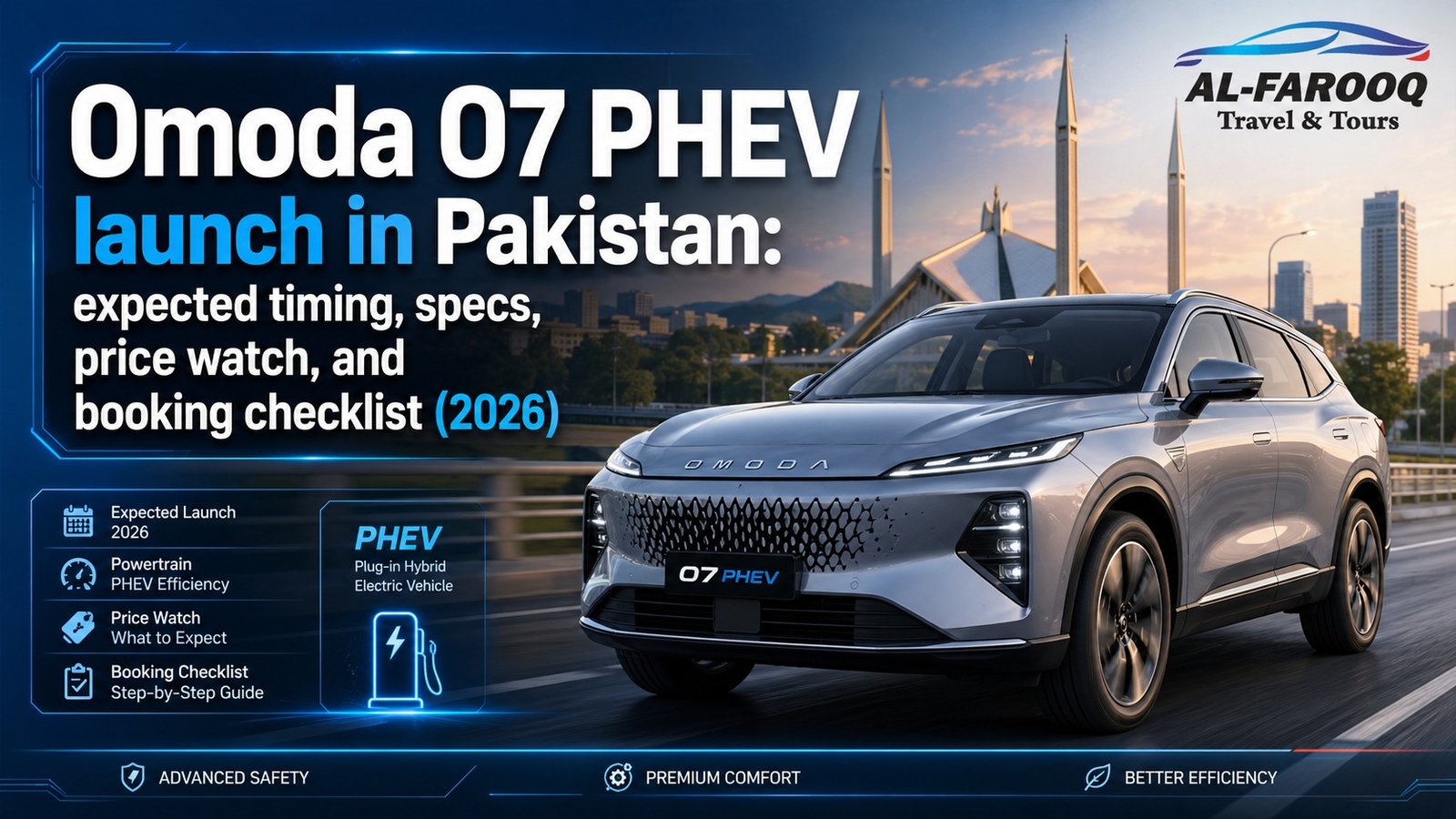
The Omoda O7 PHEV launch in Pakistan is being discussed as a 2026 arrival, but final Pakistan price, booking amount, and delivery month are not officially published yet on a public price sheet. That means this is a “watch-and-verify” launch: treat the timeline as provisional until booking opens with written terms.
What you can prepare today is the practical side: whether a plug-in hybrid (PHEV) fits your routine in Islamabad, Rawalpindi, Lahore, or Karachi. A PHEV gives the most value when you can charge at home/work and your daily travel stays inside the EV portion of the commute.
Internationally, the Omoda 7 PHEV is positioned with a 1.5-litre turbo hybrid powertrain and a battery around 18.4 kWh, with a claimed 56 miles of electric range (market spec varies). Official reference: OMODA 7 SHS-P official specifications.
Updated on: April 28, 2026 (Asia/Karachi)
Omoda O7 vs Omoda 7: the naming you’ll see online
You may see “Omoda O7” and “Omoda 7” used interchangeably. In many markets, the model is marketed as Omoda 7. In Pakistan coverage, “O7” is often used as the show name. For buyers, the practical point is simple: verify the exact model badge and variant on the booking form before paying.
What is confirmed today and what is still pending for Pakistan
This table keeps the launch conversation clean and avoids guesswork.
| Item | Status in Pakistan right now | What counts as “confirmed” |
|---|---|---|
| Ex-factory price in PKR | Not publicly final | Official price circular / official booking form with price |
| Booking amount | Not publicly final | Receipt + booking form showing the exact amount |
| Delivery month | Not publicly final | Written delivery window on booking paperwork |
| Variant(s) and trim names | Not publicly final | Official brochure / trim list for Pakistan |
| Core PHEV direction | Clear internationally | Official spec sheet for the marketed Omoda 7 SHS-P powertrain |
International Omoda 7 PHEV spec snapshot (useful for expectations)
Pakistan spec can differ by market, but the official Omoda 7 SHS-P reference gives a solid expectation of what this PHEV is built to do.
Key powertrain idea
The official model page describes a 1.5T hybrid powertrain and lists 18.4 kWh battery capacity with a claimed 56 miles EV range for the plug-in hybrid configuration.
Table: Omoda 7 PHEV reference points (official listing)
| Spec area | Official reference value (market spec varies) | Why it matters in Pakistan |
|---|---|---|
| Battery capacity | 18.4 kWh | Determines EV-mode usefulness for daily commute |
| EV range (claimed) | 56 miles | Helps estimate whether a normal day can run mostly electric |
| Powertrain format | 1.5T hybrid (plug-in) | Indicates a “charge + petrol backup” pattern rather than pure EV |
| Cabin tech positioning | Large central display and connected features | Matches the tech-forward buyer segment |
Official reference link (single external source): OMODA 7 SHS-P official specifications.
Details section: what a PHEV actually changes for Pakistani driving
A PHEV is not “hybrid marketing.” It’s a simple formula:
- You drive electric-first for short daily routes when the battery is charged.
- When battery drops, the petrol side runs like a hybrid and keeps you moving.
- You still have full long-route ability without waiting for chargers.
Where a PHEV fits best in Pakistan
Islamabad and Rawalpindi
Twin-city routines often include repeated short routes: office runs, school drops, errands, Blue Area visits, Saddar/Bahria/DHA movement. That pattern suits PHEVs because you can use EV mode for the predictable part of the day if charging is available.
Lahore and Karachi
Stop-and-go traffic and long idling make EV-mode value even stronger, but only if you can charge reliably. Without charging, a PHEV still works, but you won’t get the main benefit you’re paying for.
Price watch: the clean way to think about Omoda O7 PHEV price in Pakistan
Because the Pakistan price is not officially published yet, the best approach is to prepare your “decision math” before the booking window opens.
Table: on-road cost components you should request in writing
| Cost component | What it usually includes | Why you should ask for it |
|---|---|---|
| Ex-factory price | Base vehicle price before city registration | This is the number most ads talk about |
| Withholding (filer/non-filer) | Tax depends on status and value band | Can change your payable amount meaningfully |
| Registration & plates | City/province registration charges | On-road differs by city |
| Token tax | Periodic fee | Adds to first-year cost |
| Freight & handling | Delivery and logistics | Sometimes included, sometimes separate |
| Insurance (optional) | Coverage choice | Needs clarity before delivery |
A practical rule that avoids “price shock”
Never compare one brand’s ex-factory to another brand’s on-road. Compare the same layer.
Booking process: what should be written before you pay anything
Avoid verbal promises. A clean booking record should include:
- Exact model name + variant/trim
- Ex-factory price (PKR) and validity date (if introductory)
- Booking amount and next payment milestone
- Estimated delivery window
- Your registration city estimate
- Warranty basics (battery/system coverage vs general vehicle)
If any of those is “later,” treat the booking as riskier.
Ownership readiness checklist (Pakistan reality)
This is the part that decides whether a PHEV feels premium or becomes tiring.
Charging readiness
- A stable home/work charging point matters more than fast charging hype.
- Use safe wiring and proper earthing—PHEVs still draw serious load.
- If you cannot charge most days, your value drops.
Service readiness
- Confirm where diagnostics and warranty handling will be done in your city.
- Confirm the parts pathway for sensors, battery cooling components, and hybrid electronics.
Usage match
- PHEV value is strongest when your daily route is predictable and repeated.
- If your routine is random long routes, a conventional hybrid may feel simpler.
Decision section: who should buy first batch, who should wait, and alternatives
Suitable for
- Buyers with daily city commuting and access to home/work charging
- Families doing twin-city travel with repeated routines
- People who want petrol backup without range anxiety
- Users who value a tech-forward cabin and driver comfort
Who should wait
- Buyers whose top priority is resale stability in the first 3–6 months
- Anyone without a reliable charging setup
- People who cannot tolerate downtime and need guaranteed parts turnaround
- Buyers who need official pricing clarity before committing funds
Practical alternatives
- If charging is uncertain: a conventional hybrid often feels lower-risk.
- If your route is mostly short city travel and you can charge: PHEV fits well.
If you’re waiting for booking clarity or deliveries but still need dependable city movement in the twin cities, a driver-led rental can keep your routine stable. For that, you can use rent a car in Islamabad through Al Farooq Rent a Car as a temporary mobility option while you watch the official launch terms.
FAQs
Omoda O7 PHEV launch in Pakistan: what should confirm the launch date
The launch becomes “confirmed” when booking opens with a written price sheet or booking form that includes the delivery window. Social posts and showroom conversations are not enough for planning money. Ask for the booking form, price validity date (if introductory), and the delivery timeline in writing.
Omoda O7 PHEV price in Pakistan: what should be on the written quote
A clean quote should show ex-factory price, booking amount, registration city estimate, filer/non-filer withholding impact, and any freight/handling line. If the quote only says one total number, you can’t compare properly and you can’t track changes if the price moves before delivery.
What documents are usually required for booking a new vehicle in Pakistan
Most bookings typically require buyer identification details (CNIC) and basic contact information, plus payment through traceable channels. Some dealers also ask for NTN/filer info for tax planning. Requirements can vary by dealership policy, so the safest approach is a written checklist from the booking desk.
Charging question: what makes a PHEV worth it in daily city travel
A PHEV pays back when it is charged regularly and your daily commute stays within the EV part of the routine. The official Omoda 7 SHS-P reference lists an 18.4 kWh battery and 56 miles EV range (market spec varies). Without regular charging, you still get hybrid behavior, but you lose the main value.
Warranty question: what should you check on a PHEV warranty page
Separate the warranty into two parts: (1) battery/hybrid system coverage and (2) general vehicle coverage. Also check exclusions tied to charging setup, accident damage, and unauthorized modifications. Warranty clarity matters more in PHEVs because diagnostics and parts are more specialized.
Process question: what should be written on the delivery timeline
Ask for an estimated month range and the rule that controls it: allocation by city, variant, color, or booking order. If the booking staff cannot write a delivery estimate, treat the booking as higher risk and avoid paying a large amount upfront.
Risk question: what can reduce real-world EV-mode benefit in Pakistan
Heavy AC use, high speed, repeated short trips without charging, and long idling can reduce EV-mode benefit. Heat also increases cooling demand. The safe way to judge is to map your routine: daily distance, charging frequency, and peak traffic time.
Comparison question: PHEV vs HEV for Islamabad and Rawalpindi
A PHEV is stronger when you can charge and want electric-first commuting. A conventional hybrid is simpler when you can’t charge and want lower complexity. For twin cities, a PHEV can fit well if your routine repeats daily and charging is consistent; otherwise, an HEV often feels easier.
Disclaimer
This blog is for general information only. Pakistan launch timing, variants, pricing, booking amount, taxes, and delivery timelines can change through official updates and allocation. International specifications may differ from Pakistan-spec trims. Confirm written booking terms, warranty scope, and on-road breakup before payment. PHEV efficiency and EV-mode range vary by traffic, temperature, AC use, speed, load, and charging habits.