
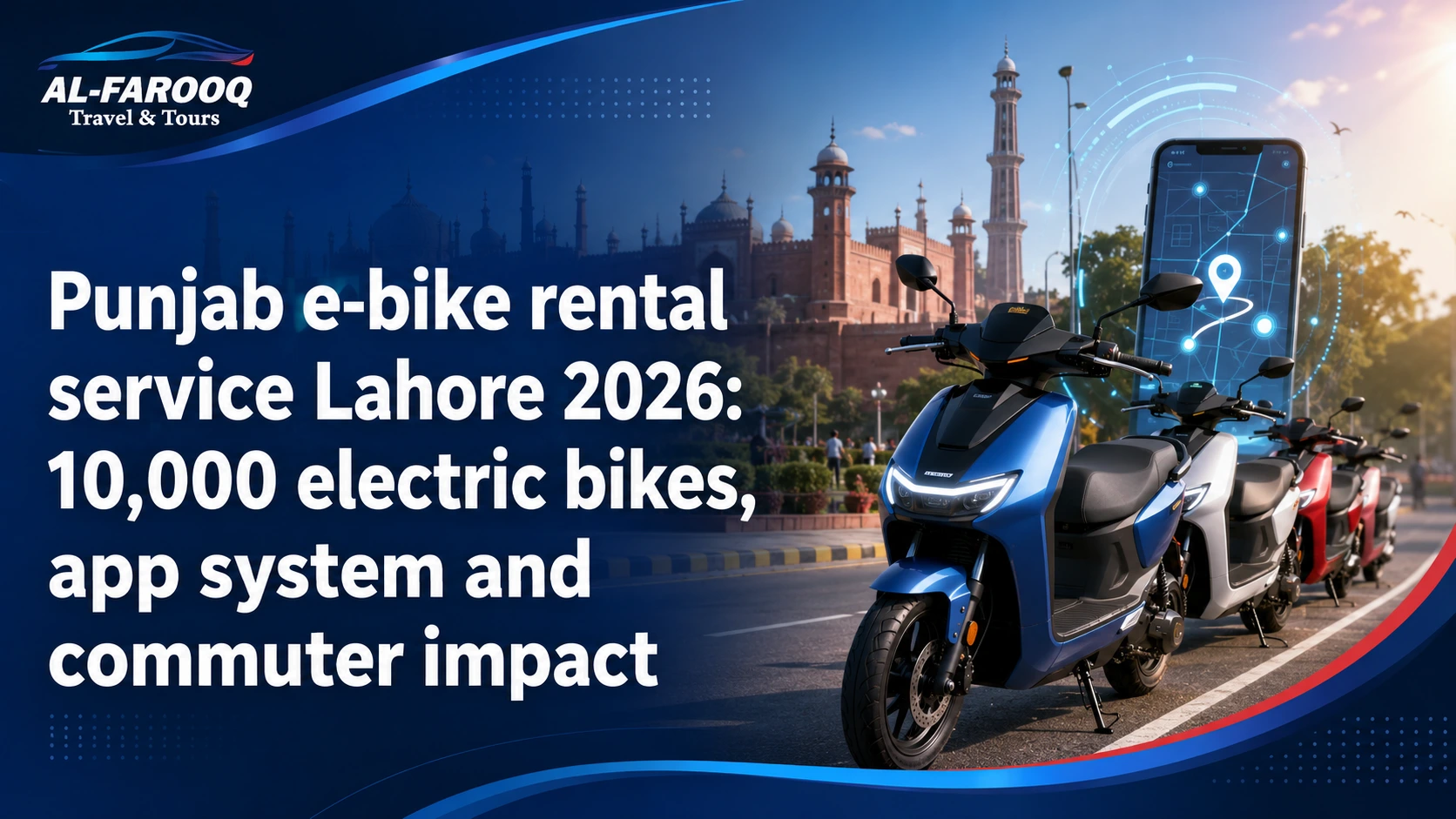
The Punjab e-bike rental service Lahore 2026 plan will bring 10,000 electric bikes and 300 docking and charging stations to Lahore in the first phase. The service is designed as an app-based rental system, allowing eligible users to rent an electric bike for short city trips through a mobile application. Part of Punjab’s Green Mobility Programme, the project aims to solve Lahore’s last-mile transport problem, reduce fuel use, cut short-distance petrol bike trips and support cleaner city mobility. The service has not been formally launched yet and final approval is still required before operations begin.
Punjab plans 10,000 e-bike rental service for Lahore
Lahore is one of Pakistan’s busiest cities, and short-distance travel is often more difficult than long-distance travel. Many people can reach a metro station, bus stop, office area or market, but the last few kilometres become expensive, slow or inconvenient. The Punjab government’s planned electric bike rental service is designed for that gap. Instead of buying a motorcycle, waiting for a ride‑hailing bike or using a rickshaw for every small trip, users may be able to rent an electric bike from a nearby docking station and return it after use.
- City: Lahore
- Vehicle type: Electric bikes
- First phase fleet: 10,000 e‑bikes
- Docking / charging stations: 300 stations
- Access method: Dedicated mobile app
- Main goal: Last‑mile connectivity and cleaner mobility
- Launch status: Final approval still required
- Minor registration: Minors will not be allowed to register
According to a news article, final approval is still pending.
This project signals a shift from vehicle ownership toward shared electric mobility in Punjab.
Why Lahore needs an e-bike rental system
Lahore’s transport problem is not only about traffic volume; it is also about short, repeated daily trips. Many people travel from home to office, office to market, bus stop to workplace, university to hostel and metro station to final destination. These short trips often create a bigger burden than expected. A person may spend more on the last 2–3 kilometres than on the main bus or metro route. A student may waste time waiting for a rickshaw. An office worker may depend on ride‑hailing every day. A daily‑wage worker may lose part of their income only on short transport. An app‑based electric bike rental system can help if the stations are placed correctly.
What last-mile connectivity means
Last‑mile connectivity refers to the small distance between a public transport point and the user’s actual destination. In Lahore, this can mean:
- metro station to office
- bus stop to university
- parking area to market
- residential block to main road
- hospital gate to nearby area
- commercial zone to workplace
- college to hostel
- train station to local destination
Public transport works better when people can easily complete this final part of the journey. Without last‑mile support, many users return to private bikes, cars, rickshaws or ride‑hailing.
App‑based e-bike rental: expected user flow
The project is planned around a mobile application. The final app details are not public yet, but the expected flow can look like this:
- User registers on the app and verifies eligibility.
- The app shows nearby e‑bike stations.
- The user selects an available bike.
- The app unlocks the bike.
- The user rides to their destination.
- The bike is returned at a docking station.
- Payment is charged through the app.
The success of the system will depend heavily on app reliability. If the app is slow, payment fails, bikes do not unlock or stations show wrong availability, users will lose trust quickly.
300 docking and charging stations: why placement matters
The plan includes 300 docking and charging stations across Lahore. This is the real backbone of the project. The number of bikes matters, but the placement of stations matters even more. A station should be close to places where people naturally start or end short trips. The best station locations can include:
- metro stations
- bus terminals
- university areas
- commercial markets
- hospital zones
- government office areas
- business districts
- residential clusters
- parking points
- railway station access points
If stations are placed too far from daily routes, the service will not feel convenient. A rental bike works only when it is nearby, charged, safe and easy to return.
Who will benefit most from the Lahore e-bike rental service
The biggest users are likely to be people who make short daily trips and do not want the cost or responsibility of owning another vehicle:
- Students: Lower‑cost short travel between campus, hostel and public transport.
- Office commuters: Easier movement from metro/bus stops to offices.
- Daily‑wage workers: Lower pressure from repeated fuel or rickshaw costs.
- Market visitors: Short movement inside commercial areas.
- Public transport users: Better connection to main transit points.
- Delivery or service workers: Possible short‑route support if allowed under terms.
- Residents without personal transport: Flexible travel without owning a bike.
The service will be useful only if pricing is affordable. If rental rates become too close to ride‑hailing fares, daily users may not shift.
E-bike rental vs bike taxi vs rickshaw
The planned e‑bike rental service is different from bike taxi and rickshaw services because the user rides the vehicle personally:
- E‑bike rental: Best for short independent trips, but it needs nearby stations and reliable app access.
- Bike taxi: Provides a fast point‑to‑point ride, but there is less privacy and repeated fare cost.
- Rickshaw: Suitable for short local family or luggage trips but can be expensive in busy areas.
- Metro or bus: Good for main route travel, but the last‑mile gap remains.
- Own motorcycle: Gives daily freedom but comes with fuel, maintenance, registration and parking costs.
The e‑bike rental model works best when used with public transport: a person can take metro or bus for the main journey and use a rented e‑bike for the last part.
Environmental impact: can e-bike rentals reduce pollution?
Lahore faces serious air quality pressure, especially during smog season. Electric bikes will not solve the entire pollution problem alone, but they can reduce some short petrol‑powered trips if people use them regularly. Possible benefits include:
- fewer short petrol bike trips
- lower fuel use for small‑distance travel
- less noise pollution
- reduced pressure on congested roads
- better connection with public transport
- lower emissions from daily short commutes
The real impact will depend on usage: if thousands of users shift daily short trips from petrol bikes and rickshaws to electric bikes, the benefit can become visible over time. If usage stays low, the environmental impact will remain limited.
Safety rules must be clear before launch
An e‑bike rental system needs strict safety rules from day one. Since minors will not be allowed to register, age control is already part of the plan, but that alone is not enough. The final system should clearly explain:
- Minimum age: Who can register.
- CNIC verification: How identity will be checked.
- Helmet rule: Whether a helmet is mandatory and provided.
- Speed limit: Maximum speed of rental e‑bikes.
- Riding zones: Where bikes can be used.
- Parking rules: Where bikes can be returned.
- Damage liability: Who pays for damage.
- Accident process: What the user must do after an incident.
- Theft control: App, GPS and station tracking.
- Women user safety: Lighting, station placement and app security.
Without clear safety rules, the project can face misuse, accidents, theft and public criticism.
Pricing will decide public adoption
The service can fail if pricing is wrong. Lahore users already compare every short trip with rickshaw, bus, metro, bike taxi and petrol cost. The rental fee must feel cheaper or more convenient than the alternatives. Possible pricing models may include:
- unlock fee plus per‑minute rate
- fixed short‑trip package
- hourly rental
- student package
- monthly commuter package
- metro‑linked discount
- low‑income user subsidy
A strong pricing model should reward regular users, not only one‑time riders. If office workers and students use the system daily, the project will have stronger public value.
What can go wrong if the rollout is weak
A large e‑bike network sounds impressive, but execution matters. Common risks include:
- bikes not charged
- broken bikes not repaired quickly
- app failure during peak hours
- stations too far from users
- bikes parked wrongly
- theft or misuse
- unclear accident responsibility
- poor customer support
- high rental fees
- lack of public awareness
The Punjab government should treat operations as seriously as launch publicity. A clean launch is not enough; the system must work daily.
Lahore areas where e-bike rental can make sense
The first phase should focus on high‑demand corridors where short‑distance movement is frequent. Potential high‑use areas can include:
- Metrobus‑linked routes
- Orange Line stations
- Gulberg commercial zones
- Johar Town
- Model Town
- DHA commercial areas
- Liberty Market
- Mall Road and nearby offices
- educational institutions
- hospital clusters
- railway station access routes
- major parking zones
Stations should be placed where users already need short transport. Random station placement will reduce adoption.
Can this model expand beyond Lahore?
If Lahore’s system works, other Punjab cities may ask for similar services. Faisalabad, Rawalpindi, Multan, Gujranwala and Sialkot can also benefit from shared electric mobility in selected urban zones. However, expansion should happen only after Lahore proves:
- app stability
- affordable pricing
- strong maintenance
- safety control
- theft prevention
- charging reliability
- station planning
- user demand
A weak Lahore pilot would make expansion difficult. A strong Lahore rollout can become a model for other cities.
E‑bike rental and Pakistan’s wider EV shift
Pakistan’s mobility sector is slowly moving toward electric options. Electric cars, e‑bikes, e‑scooters and EV buses are becoming part of public discussion. But mass EV adoption needs more than vehicle announcements. It needs:
- charging infrastructure
- clear safety rules
- affordable pricing
- reliable batteries
- after‑sales support
- electricity load planning
- user education
- government policy stability
The Lahore e‑bike rental plan can support EV awareness because many people may experience electric mobility for the first time through a rental bike, not a private EV car.
Decision section: who should use the Lahore e-bike rental service?
Good fit for
- students with short campus or hostel routes
- office workers using public transport
- users who travel short distances daily
- people who do not want to buy a motorcycle
- commuters trying to reduce petrol spending
- residents near docking stations
- people comfortable with app‑based payments
Not ideal for
- minors
- people without app or digital payment access
- long‑distance commuters
- families travelling together
- users carrying heavy luggage
- people who need door‑to‑door comfort
- routes without nearby stations
- users uncomfortable riding in traffic
Better alternatives
For longer travel, airport pickups, family movement and intercity routes, a car with driver remains more practical. E‑bikes are best for short solo trips. They are not a replacement for every travel need.
Relevance for Al Farooq Rent a Car users
The Lahore e‑bike rental plan is good for short solo urban movement, but it does not replace driver‑led car travel for families, airport routes, business meetings, luggage, events or intercity travel. For users who need comfortable travel with a driver, Al Farooq Rent a Car provides planned mobility through rent a car Lahore and rent a car Islamabad services. E‑bikes can support last‑mile travel, while cars with drivers remain better for formal, family and long‑distance trips.
Common mistakes users should avoid after launch
- registering without reading user rules
- riding without safety gear
- assuming every area has a docking station
- taking an e‑bike for long‑distance travel
- ignoring battery level before the ride
- parking outside allowed zones
- sharing account access with minors
- using the bike in unsafe traffic conditions
- depending on e‑bike rental for urgent airport travel
- ignoring app charges and penalty rules
What the government should publish before launch
Before formal launch, Punjab should clearly publish:
- Launch date: Users need clarity
- Rental charges: Pricing decides adoption
- App name: Avoids fake apps
- Station map: Helps route planning
- User eligibility: Prevents misuse
- Helmet policy: Supports safety
- Penalty rules: Reduces wrong parking
- Battery range: Helps trip planning
- Customer support: Builds trust
- Complaint system: Protects users
Clear public information will reduce confusion and improve confidence.
FAQs
Punjab e-bike rental service Lahore 2026: what is the plan?
Punjab plans to introduce an app‑based electric bike rental service in Lahore with 10,000 e‑bikes and 300 docking and charging stations in the first phase. The project is part of the Green Mobility Programme and still needs final approval before formal launch.
How many e-bikes will be launched in Lahore?
The first phase is planned with 10,000 electric bikes across Lahore. These bikes are expected to be placed through a network of docking and charging stations.
How many charging stations are planned?
The plan includes 300 docking and charging stations in Lahore. These stations are expected to be placed near residential areas, commercial zones and public transport hubs.
Will users rent e-bikes through an app?
Yes, the service is being designed as an app‑based rental system. Users are expected to find, rent and unlock bikes through a dedicated mobile application once the system becomes operational.
Can minors use the Lahore e-bike rental service?
No. The current project details say minors will not be allowed to register on the app. The final eligibility rules should be checked when the official launch details are released.
When will the Lahore e-bike rental service start?
The project has been announced and is under development, but it has not been formally launched yet. Final approval is still required before operations begin.
Will e-bike rental reduce Lahore traffic?
It can reduce pressure on short‑distance travel if people use it regularly for last‑mile trips instead of petrol bikes, rickshaws or short car rides. The impact depends on pricing, station placement, app reliability and user adoption.
Is an e-bike rental better than buying a motorcycle?
It can be better for people who need short trips but do not want ownership cost, fuel cost, maintenance or parking responsibility. Buying a motorcycle is still better for users who need daily long‑distance travel and complete route freedom.
Disclaimer
This blog is for general information only. The Punjab e‑bike rental service is still subject to final approval and official launch details. Fleet size, station locations, pricing, app name, eligibility rules, safety requirements, launch date and operational terms can change through government updates. Users should verify final details from official Punjab government channels before registration or payment.