

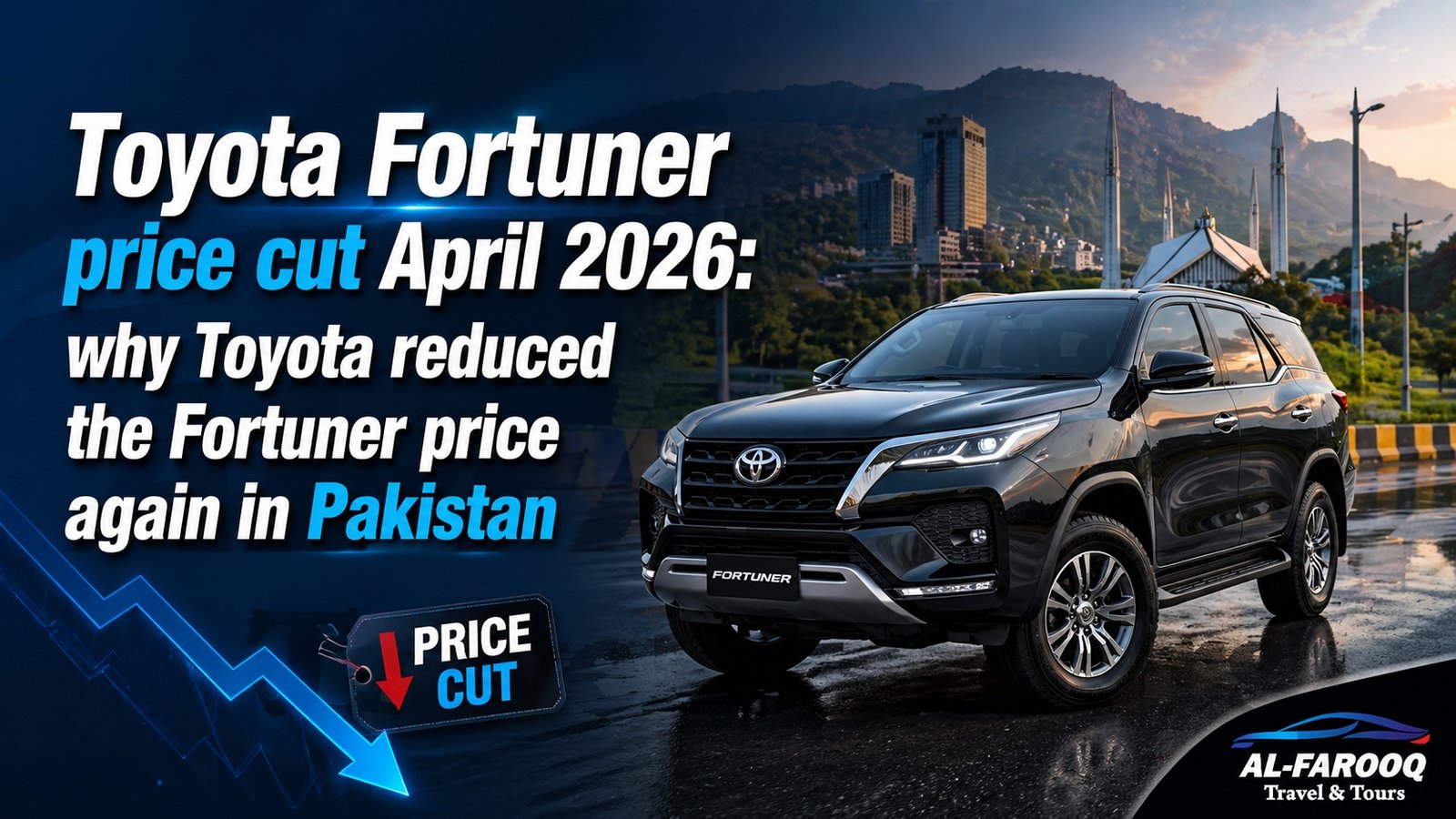
The Toyota Fortuner price cut April 2026 is best explained as a demand and mix correction, not a sudden “cheap Fortuner era.” Toyota’s official channels show the petrol Fortuner variants at noticeably lower prices than the earlier listed figures on Toyota’s own finance/pricing tooling, while diesel variants stay positioned as the higher-demand side of the lineup.
In Pakistan’s 2026 market, three forces make a petrol-SUV price cut more likely: (1) running-cost pressure for large petrol SUVs, (2) buyers shifting to diesel/hybrid alternatives in the same budget, and (3) manufacturers protecting volume and plant utilization by using time-bound offers on slower-moving variants.
If you are deciding whether to buy now, the best move is to treat the discount as variant-specific (petrol) and check the full on-road math (filer/non-filer taxes, registration city, insurance) before locking a booking.
Updated on: April 2026 (PKT)
What changed: the numbers that matter
Toyota’s own pricing references show two things at the same time:
- Current displayed pricing for petrol Fortuner variants is lower than the earlier listed figures.
- The earlier listed figures for Fortuner G and V (petrol) were higher, which makes the size of the cut clear even if you ignore commentary and focus only on Toyota sources.
Table: Fortuner petrol variants — earlier listed vs current displayed (Toyota sources)
| Variant (petrol) | Earlier listed price (PKR) | Current displayed price (PKR) | Difference (PKR) |
|---|---|---|---|
| Fortuner G | 14,939,000 | 12,435,000 | 2,504,000 |
| Fortuner V | 17,509,000 | 14,935,000 | 2,574,000 |
These are the kinds of numbers you usually see when a brand is trying to move a specific stock mix quickly (petrol) while keeping the stronger demand mix (often diesel) steady.
Why Toyota reduced the Fortuner price again: the practical reasons that fit Pakistan’s 2026 market
1) Petrol Fortuner demand weakens first when running costs become the decision point
In Pakistan, big petrol SUVs are the first to feel demand pressure when buyers start making “monthly running cost” their top filter. Even people who can afford the purchase often slow down when they calculate fuel spend over 12–24 months.
That’s exactly where a petrol Fortuner can face resistance: the product is premium, but the ownership behavior becomes cost-sensitive. When enough buyers delay, the manufacturer has two options—accept slower volume or push an offer to restart the pipeline.
2) Variant mix problem: diesel stays the pull, petrol becomes the push
A very common pattern in Pakistan’s SUV market is this: diesel and hybrid trims hold demand better for large SUVs, while petrol trims become harder to justify at the same price level.
When a brand selectively cuts petrol variants but doesn’t aggressively cut diesel, it’s usually a signal that the company is solving a mix imbalance—not that the entire model line suddenly became cheaper to build.
3) Competition pressure is now “feature + powertrain,” not only brand name
Fortuner historically relied on brand trust and resale. In 2026, the pressure is different: buyers compare “what am I getting for this money” more aggressively, especially with more feature-rich new entrants and electrified options in the market.
When competitive alternatives look modern inside the cabin and offer better efficiency, the petrol Fortuner needs either a stronger value story or a pricing correction to keep its place in shortlists.
4) Inventory and booking cycle: a discount can protect volume without rewriting the long-term price ladder
Toyota has a reputation for price discipline. A permanent price reset can damage that image.
A time-bound offer (or a repeated limited campaign) is the “middle path”: it moves inventory, protects dealership activity, and keeps the official ladder intact for the long run.
5) Cost side factors can improve, but they rarely explain a cut this big alone
Exchange-rate movement, import cost swings, and localization progress can reduce cost over time. Indus Motor’s own reporting has historically discussed how cost movements and input changes affect pricing revisions across cycles.
However, a multi-million rupee cut on a premium SUV usually can’t be explained by cost alone. In practice, it’s more consistent with demand/mix correction plus tactical margin strategy.
What this price cut means for buyers in Pakistan (Islamabad, Rawalpindi, Lahore, Karachi)
If you are buying for family use in the twin cities
In Islamabad and Rawalpindi, the Fortuner is often bought for height, road presence, and family practicality. The price cut can make the petrol variants look like “value again.”
But the decision shouldn’t be only purchase price. Your real decision is: do you accept petrol running cost for the next 2–3 years, or do you want a powertrain that feels less painful in stop-go traffic?
If you are buying for resale value
Repeated deep discounts can shake buyer confidence because they reset expectations: “maybe it gets cheaper again.”
That doesn’t mean the Fortuner suddenly has no resale—Toyota still carries strong market trust—but it can change the psychology of timing. If you’re a resale-first buyer, your safest approach is to buy only when the price is stable long enough that the market stops expecting another cut.
If you are buying on financing
When rates are high, financing demand for big-ticket vehicles becomes fragile. A discount can bring the monthly installment down enough to convert “interested” buyers into “booked” buyers.
If you’re financing, ask for a clean written breakup: vehicle price, withholding tax (filer vs non-filer), registration estimate for your city, and insurance.
Table: decision guide based on your usage
| Your main usage | Petrol Fortuner at the reduced price makes sense when… | Consider waiting or choosing another powertrain when… |
|---|---|---|
| City driving (daily Islamabad/Rawalpindi) | you drive limited daily distance and accept fuel spend | you drive heavy daily traffic and want efficiency priority |
| Mixed city + weekend travel | you value comfort, size, and occasional long trips | you want lower running cost and plan frequent long routes |
| Long intercity routes | you prefer petrol smoothness and can bear running cost | you want stronger efficiency under load and long distance |
| Resale-first buyer | you can buy and hold longer (not flipping quickly) | you plan short holding time and price stability matters most |
| Financing buyer | discount meaningfully improves your monthly installment | monthly plan still strains your budget after full on-road math |
What to check before you book (money + process + risk)
Money checks
- Confirm the ex-factory / displayed price and the on-road number separately (registration city changes the total).
- Confirm filer/non-filer impact and withholding tax.
- Ask whether the offer is time-bound or stock-bound (it changes delivery expectations).
Process checks
- Ask for a written booking confirmation: variant, color, tentative delivery window.
- Confirm what happens if pricing changes before delivery (price at delivery time is often treated as final in Pakistan).
Risk checks
- Compare your real monthly fuel spend against your budget.
- If you’re buying with resale in mind, plan a longer hold so a short-term pricing wave doesn’t force you to sell in a weak moment.
A Pakistan-practical view: what Toyota is protecting with this move
A repeated Fortuner petrol price cut can look surprising because Fortuner is a prestige SUV. But from a market perspective, it protects three things:
- booking momentum
- dealership activity
- model relevance in a segment where buyers are increasingly powertrain-sensitive
In other words, Toyota is not only selling a Fortuner; it’s protecting the Fortuner’s position as a “default premium SUV option” in Pakistan’s buyer mind.
One relevant official reference to keep handy
For the most reliable, manufacturer-side reference point, use Toyota Indus’ official Fortuner page for model positioning and pricing context: Toyota Fortuner (Toyota Indus official page).
Where Al Farooq Rent a Car fits (one practical mention)
If you’re comparing big-SUV comfort and road feel before committing to a purchase decision, many buyers prefer using the same category for a few days on their real routes (twin-city movement, motorway runs, family travel). For that, you can review availability and categories on Our Cars & Rates through Al Farooq Rent a Car, especially for Islamabad and Rawalpindi travel.
FAQs
Toyota Fortuner price cut April 2026: is this a permanent price reset
Treat it as a tactical correction on specific variants unless Toyota clearly publishes a long-term revised ladder. In Pakistan, large discounts are often used to move a particular stock mix and revive booking momentum. Before you decide, confirm if the offer is time-bound and whether price at delivery time is treated as final.
Toyota Fortuner price cut April 2026: which variants are most affected
The strongest movement is typically seen on the petrol trims, where demand becomes more sensitive to running cost. If your shortlist includes diesel or higher-demand trims, compare carefully because the pricing behavior can differ by variant. Always confirm the exact variant price and the full on-road total for your city.
Does this price cut mean Fortuner resale value is finished
No, but it can change buyer timing behavior. A deep cut can hurt short-term resale for recent buyers of the same variant. Over a longer hold period, Toyota’s brand trust still supports resale better than many alternatives. If resale is your top priority, avoid short holding periods after a major price swing.
Should a buyer in Islamabad or Rawalpindi buy now or wait
Buy now if your budget fits the full on-road total and your monthly fuel spend stays comfortable. Waiting makes sense if you expect further pricing swings or you want a more efficient powertrain for heavy daily city traffic. Your route pattern should decide the timing more than social hype.
What paperwork should be written before booking
Get a written booking confirmation with the exact variant, price reference, booking amount, tentative delivery window, and your registration city estimate. This prevents confusion when delivery timelines move or when taxes and registration costs shift your on-road total.
Disclaimer
This blog is for general information only. Vehicle prices, offers, taxes, registration charges, and delivery timelines can change without notice based on company policy and government rules. Always confirm the final ex-factory and on-road price in writing from the authorized channel before paying, and calculate running costs based on your real monthly usage.