
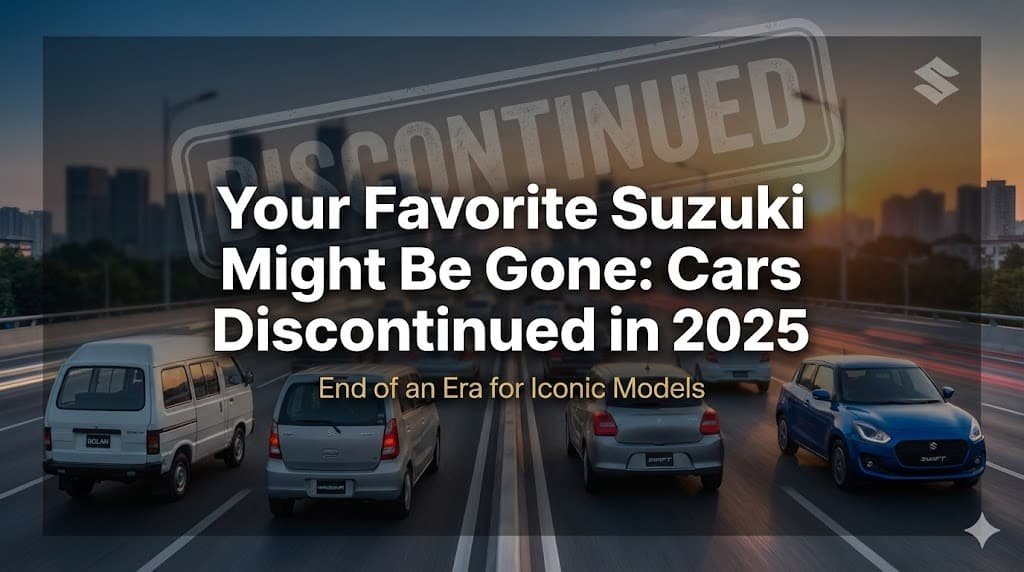
The list of Suzuki cars discontinued in Pakistan 2025 has reshaped the local automotive landscape more than many buyers expected. For years, Suzuki models dominated city roads, family garages, and commercial use across Islamabad, Rawalpindi, and other major cities. Rising costs, tightening emission requirements, and changing consumer preferences have now pushed several familiar nameplates out of production.
This shift is not about a single decision or one weak model. It reflects a broader realignment in Pakistan’s auto market, where affordability, fuel efficiency, and compliance with modern standards are increasingly difficult to balance. Understanding which Suzuki vehicles have been discontinued, and why, matters not only to current owners but also to buyers planning future purchases or evaluating resale value.
Why Suzuki Discontinued Multiple Models in 2025
Suzuki’s decisions in 2025 are tied to structural changes rather than short-term sales drops. Several pressures converged at once.
Production costs have increased sharply due to currency volatility, higher import duties on parts, and rising logistics expenses. Entry-level models, once profitable through volume, became harder to sustain under these conditions.
Regulatory compliance also played a role. Older platforms struggled to meet evolving safety expectations and emission benchmarks without major reengineering. Updating legacy models would have required heavy investment, often without a clear return.
Consumer demand has also shifted. Buyers increasingly compare features, transmission options, and cabin comfort across brands. Models that once sold on price alone faced pressure from newer alternatives offering better specifications within similar budgets.
Suzuki Alto Variants No Longer in Production
While the Suzuki Alto remains a key player in the hatchback segment, not all variants survived into 2025.
Manual-only trims with minimal safety equipment were phased out as demand moved toward better-equipped versions. Buyers showed a clear preference for variants offering airbags, improved braking systems, and automatic transmission options for urban driving in cities like Islamabad and Rawalpindi.
The decision reflects Suzuki’s attempt to simplify its lineup rather than an exit from the small-car category altogether.
Suzuki Cultus Exit from the Market
The Suzuki Cultus quietly exited production in 2025, ending a long run as a mid-range hatchback positioned between the Alto and Swift.
Cultus faced sustained pressure from both sides. On one end, buyers compared it unfavorably with smaller cars offering better fuel economy. On the other, slightly higher budgets opened doors to feature-richer alternatives from competing brands.
Rising prices eroded the Cultus’s original value proposition. Without a platform update or hybrid transition, continuing production no longer made economic sense.
Suzuki Wagon R Phased Out
The Suzuki Wagon R, once popular for its tall seating position and interior space, was another casualty of 2025.
Urban buyers increasingly favored compact crossovers or hatchbacks with modern styling and improved infotainment. Fleet and commercial buyers, who previously supported Wagon R sales, shifted toward alternatives offering lower running costs or better resale margins.
Despite its practicality, Wagon R’s aging design and limited feature updates could not justify further investment.
Suzuki Bolan and Ravi: End of an Era
Among the most impactful decisions was the discontinuation of Suzuki Bolan and Suzuki Ravi.
These models served small businesses, transport operators, and rural markets for decades. However, they were built on platforms that no longer aligned with safety or emission requirements. Updating them would have required a complete redesign rather than incremental changes.
Their exit marks a significant moment in Pakistan’s commercial vehicle segment, pushing buyers to consider newer platforms or alternative manufacturers.
Suzuki Every and the Import-Driven Shift
The Suzuki Every, introduced as a compact van solution, also saw limited continuation.
Imported or semi-assembled models faced inconsistent availability and pricing. Buyers seeking reliability and long-term support hesitated due to uncertainty around parts and after-sales service.
This reflects a wider pattern where imported niche vehicles struggle to maintain consistent demand without strong localization.
Impact on Used Car Market and Resale Values
The discontinuation of multiple Suzuki models has had mixed effects on the used car market.
Some vehicles, particularly well-maintained Cultus and Wagon R units, retained value due to parts availability and brand familiarity. Others experienced price volatility as buyers reassessed long-term maintenance prospects.
In Islamabad and Rawalpindi, demand remained stronger for discontinued models with automatic transmissions or lower mileage, while commercial variants faced steeper depreciation.
Parts Availability and Maintenance Outlook
A common concern after discontinuation is spare parts availability.
Suzuki’s local presence and established supply chain mean that routine parts are expected to remain accessible for several years. However, availability may gradually narrow for body panels and specific trim components.
Owners planning to keep discontinued models long-term should prioritize preventive maintenance and timely servicing to avoid future shortages.
What Suzuki’s Strategy Signals for the Future
Suzuki’s 2025 decisions suggest a clearer focus on fewer models with stronger margins and better compliance potential.
Rather than maintaining a wide lineup, the brand appears to be concentrating on vehicles that can adapt to evolving regulations and consumer expectations. Hybrid development, safety enhancements, and platform consolidation are likely to shape future offerings.
This strategy mirrors broader industry trends across Pakistan’s auto sector.
Practical Mobility Alternatives for Buyers
With several familiar Suzuki models no longer available, buyers are exploring multiple mobility options.
Some households are upgrading to newer hatchbacks or compact sedans. Others, particularly families and professionals in Islamabad and Rawalpindi, are opting for short-term vehicle use instead of ownership.
For city travel, airport transfers, or intercity routes, services such as Al Farooq Rent a Car provide access to modern vehicles without long-term ownership commitments, offering flexibility during this transition phase in the market.
You can review available vehicle options directly on the Al Farooq Rent a Car, especially if you prefer avoiding resale uncertainty during market shifts.
FAQs
Which Suzuki cars were discontinued in Pakistan in 2025?
Models such as Suzuki Cultus, Wagon R, Bolan, Ravi, and certain Alto variants were discontinued due to cost, compliance, and demand factors.
Will spare parts remain available for discontinued Suzuki cars?
Routine maintenance parts are expected to remain available for several years, though specific components may become limited over time.
Did Suzuki discontinue all small cars in 2025?
No. Suzuki streamlined its lineup but continues to offer selected small cars that meet updated market and regulatory requirements.
How does discontinuation affect resale value?
Resale impact varies by model condition, mileage, and variant. Automatic and well-maintained units tend to hold value better.
Are rental options practical after these discontinuations?
Yes. Many buyers temporarily prefer rentals for city and intercity travel until the market stabilizes.
Disclaimer
This blog is published for informational purposes only. Vehicle availability, specifications, discontinuation status, and market conditions may change based on manufacturer decisions and regulatory updates. Readers are advised to verify details through official manufacturer announcements and authorized dealerships before making any purchase or ownership decisions. The website holds no responsibility for decisions made based on this content.