
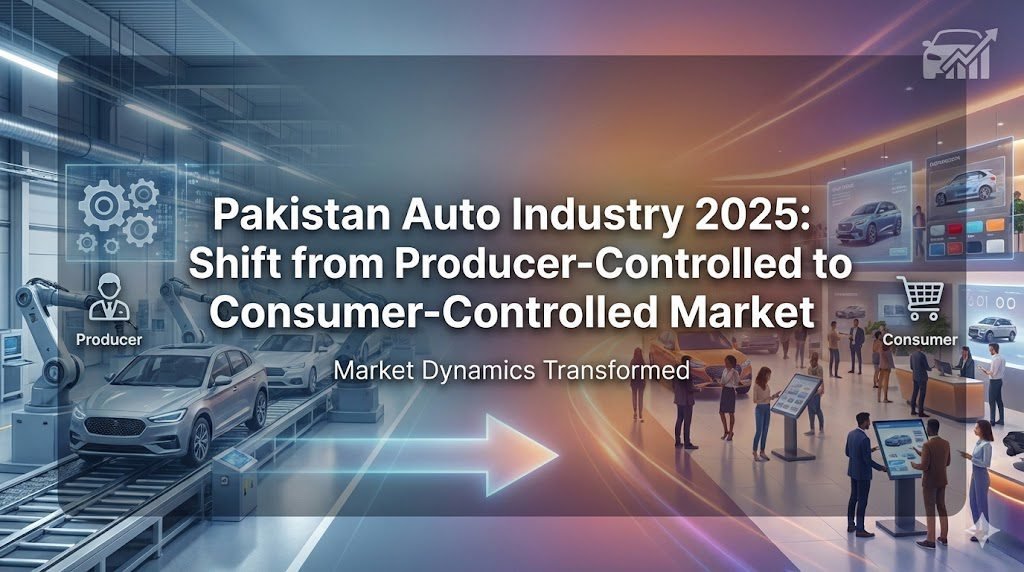
For many years, the Pakistan auto market looked predictable from the outside: a few dominant brands, long waiting times, premiums (own), and prices that seemed to move in one direction. In 2025, however, the picture is different. The Pakistan auto industry 2025 is gradually shifting from a producer-controlled structure toward a market where consumer preferences, competition and policies carry more weight.
This change is not overnight and not uniform across every segment, but the direction is clear. More variety, tariff reforms, new entrants, and changing financing conditions are all pushing manufacturers to think beyond supply shortages and focus more on value, features and long-term ownership costs for Pakistani buyers in cities like Islamabad, Rawalpindi, Lahore, Faisalabad and Karachi.
1. From limited choice to a wider market: background of Pakistan’s auto sector
1.1 The era of producer dominance
For decades, the local auto market was centred on a handful of assemblers. Suzuki, Toyota and Honda shaped most of the passenger car segment, while a few commercial brands covered pickups, vans and trucks. Imports were restricted through high duties and complex rules, so most households had limited realistic options.
In that environment:
- Waiting periods were common, especially for popular models.
- Own/premium culture flourished, where buyers paid extra to receive a vehicle sooner.
- Price revisions often came with short notice, driven by currency swings or policy changes.
Because supply was constrained and variety was limited, manufacturers and dealers held a strong position. Many buyers accepted compromises on features, safety and fuel economy simply because alternatives were scarce.
1.2 Gradual change in expectations
As internet access grew and more Pakistanis started comparing specifications online, expectations changed. Even before 2025, buyers in Islamabad, Rawalpindi and other major cities were already asking for:
- Better safety equipment (airbags, ABS, stability control).
- Improved fuel efficiency for daily commuting and intercity travel.
- Modern infotainment, connectivity and comfort features.
The Pakistan auto industry 2025 is the result of these earlier shifts combined with stronger policy signals and greater competitive pressure.
2. Pakistan auto industry 2025: forces behind the shift
2.1 Tariff reforms and new policy direction
Recent federal budgets, including 2025–26, indicate a medium-term plan to simplify and rationalise automotive tariffs. Policy discussions have highlighted goals such as:
- Reducing the number of customs duty slabs and moving toward a smaller set of clearer categories.
- Gradually lowering average tariff levels on automotive imports by the end of the decade.
- Phasing down some surcharges on used vehicles over several years.
In parallel, a new auto policy framework for 2026–31 is under preparation, with themes that emphasise competition, export potential and a more transparent duty regime, rather than pure import substitution.
For manufacturers, this signals an environment where:
- Reliance on protection alone becomes harder to justify.
- Product planning must account for potential foreign competition.
- Price and value positioning will be scrutinised more closely by buyers.
2.2 New entrants and broader product variety
Another driver of change in the Pakistan auto industry 2025 is the presence of additional brands and models across segments:
- Korean and Chinese assemblers now offer sedans, hatchbacks, crossovers and SUVs.
- New nameplates have entered the mid-size and compact SUV space, an area once dominated by a narrow group of models.
- Grey- and white-channel imports have exposed buyers to different design languages and equipment levels.
For the average driver in Islamabad, Rawalpindi or Lahore, this translates into something that was rare a decade ago: genuine cross-shopping between multiple brands at similar price levels. When a family can compare a compact sedan from one maker against a crossover from another at a comparable instalment and fuel cost, manufacturers must respond with stronger product packages.
2.3 Sales recovery and the role of financing
After several tough years marked by high interest rates, currency volatility and import restrictions, sales began to recover as:
- Policy rates moved lower from previous peaks.
- Some supply bottlenecks eased.
- Households regained confidence to commit to longer-term instalment plans.
Reports for 2025 highlight substantial year-on-year growth in overall vehicle volumes, with a notable rebound in passenger car and light commercial segments. Even though absolute numbers remain below the potential of Pakistan’s population, the direction matters: rising volumes give manufacturers an incentive to compete, not only to protect existing share but also to capture new segments entering the market.
3. From producer-controlled to consumer-controlled dynamics
3.1 Price sensitivity and value-driven decisions
One of the most important features of a consumer-driven market is price awareness. In the Pakistan auto industry 2025, buyers:
- Track ex-factory price changes almost in real time.
- Compare “on-road” costs including registration, withholding tax and insurance.
- Evaluate monthly instalments under different financing scenarios.
Because inflation and fuel costs remain a concern, many households treat a car as a multi-year financial commitment rather than a discretionary purchase. This means:
- A model with weak fuel consumption or limited resale appeal faces resistance, even if the brand is strong.
- Feature deletions or “cost-cutting facelifts” attract criticism instead of quiet acceptance.
- Manufacturers must justify each price bracket through tangible value: safety, reliability, technology or comfort.
3.2 Fuel economy and powertrain choices
The shift is also visible in the engines and fuel types that buyers favour. Across Islamabad, Rawalpindi and other cities:
- Small hatchbacks and compact sedans with frugal engines remain in high demand because of their lower running cost.
- Hybrids and more efficient powertrains attract families that drive long distances between cities.
- Buyers compare official fuel averages and real-world user reports before committing.
This preference feedback already affects product planning. Companies introducing new models must consider not only purchase price but also the total cost of ownership over five to eight years.
3.3 Transparency and information flow
Social media, automotive forums and online marketplaces have fundamentally altered the information balance. While some sources are opinion-driven, the broader effect is clear:
- Customers share their service centre experiences and issues openly.
- Comparisons between local and foreign-market variants highlight differences in safety kits and features.
- Early adopters of new models provide feedback on build quality, suspension tuning and reliability.
As a result, decisions in the Pakistan auto industry 2025 are shaped less by showroom sales pitches and more by peer feedback and public data. That reality pushes manufacturers and dealers to prioritise long-term satisfaction rather than short-term bookings.
4. EVs, hybrids and the direction of future mobility
4.1 Policy background for electric vehicles
Pakistan’s Electric Vehicle Policy 2020–25 offered incentives such as reduced customs duty on certain EV components and lower rates of sales tax for specified categories. The intention was to:
- Encourage import and local assembly of EVs.
- Introduce charging infrastructure gradually.
- Diversify the fuel mix away from conventional petroleum.
While EVs are still a small portion of total volumes, early entrants—ranging from compact urban EVs to premium electric SUVs—have already influenced buyer expectations regarding technology and running costs.
4.2 Practical adoption challenges
For daily life in Islamabad, Rawalpindi and other dense cities, EVs can suit:
- Residents with reliable access to home or office charging.
- Households with predictable urban routes and modest daily mileage.
However, challenges remain:
- Limited fast-charging coverage on major intercity corridors.
- Concerns about resale value as battery technology evolves.
- Uncertainty about long-term policy stability once initial EV frameworks expire or evolve.
Because of these factors, hybrids and efficient petrol vehicles continue to hold a strong position alongside newer EV options.
5. What the shift means for everyday drivers and travellers
5.1 Owning a car versus flexible mobility
In a consumer-controlled market, mobility is not defined only by ownership. For many people:
- A personal car is still important for family responsibilities, school runs and out-of-city trips.
- At the same time, rising prices push some households to weigh the cost of instalments, maintenance and fuel against alternative options.
Some urban professionals no longer rush to buy a new sedan or hatchback as soon as they secure a job. Instead, they mix:
- Ride-hailing services for short urban trips.
- Intercity bus and train options.
- Occasional rented cars for family holidays, weddings or airport transfers.
5.2 Role of rent-a-car services in Islamabad and Rawalpindi
In this environment, organised rental companies fill an important gap. Rather than stretching budgets for a depreciating asset, a family can:
- Use a rent a car in Islamabad with driver for a full-day trip around the twin cities or a weekend journey to northern areas.
- Arrange airport pick-and-drop services when relatives travel through Islamabad International Airport.
- Book larger vehicles, such as seven-seaters, only when required, instead of owning them year-round.
Services like rent a car in Islamabad offered by Al Farooq Rent a Car provide that flexibility for residents of Islamabad and Rawalpindi who want professional chauffeurs, predictable pricing and maintained vehicles without long-term financial commitments.
This combination of ownership and on-demand mobility is an important part of a modern, consumer-linked auto ecosystem.
6. Challenges inside a more consumer-driven Pakistan auto industry
6.1 Currency risk and taxation
Even in 2025, the industry still operates under:
- Exchange-rate risk that can influence the cost of imported components and completely built units.
- Tax structures that include customs duties, sales tax and various levies.
While tariff reforms seek to simplify and gradually lower certain rates, the short-term outcome may still include volatility. Buyers must remain cautious about timing purchases, and manufacturers need robust risk management to avoid abrupt price shocks.
6.2 After-sales support and quality control
As the model range expands, after-sales capacity must catch up:
- Workshops need training for newer technologies, including hybrids and EV systems.
- Parts availability must align with the growing presence of recently introduced brands.
- Warranty policies and goodwill practices shape public opinion and resale outcomes.
A consumer-controlled environment punishes weak support more quickly. Word spreads fast when parts are hard to source or when service complaints remain unresolved.
6.3 Regulation, safety and environmental standards
The long-term health of the Pakistan auto industry 2025 and beyond depends on effective regulation. That includes:
- Enforcing safety standards such as minimum airbags and structural crash performance.
- Monitoring emissions and encouraging cleaner technologies.
- Implementing inspection regimes that keep unfit vehicles off the road.
When these frameworks function well, consumers can focus more on choosing the right vehicle for their budget and lifestyle, instead of worrying about hidden quality compromises.
7. Practical checklist before choosing a car in 2025
Choosing a car in a changing market requires structured thinking. Before committing to a purchase in Islamabad, Rawalpindi or any other city, it helps to run through a few grounded steps.
7.1 Clarify usage and route patterns
- Estimate annual kilometres, including city trips and intercity journeys.
- Identify dominant routes such as Islamabad Expressway, Motorway M-1/M-2, or GT Road.
- Consider traffic conditions on daily commutes and parking constraints near home or office.
These points will determine whether a compact hatchback, sedan, crossover or multi-purpose vehicle makes more sense.
7.2 Evaluate total cost of ownership
Instead of focusing only on ex-factory price:
- Compare fuel consumption across shortlisted models.
- Review approximate service intervals and labour/parts costs.
- Factor in tyre replacement, routine wear items and expected insurance premiums.
A slightly higher purchase price may be reasonable if maintenance and fuel savings compensate over a five-year period.
7.3 Review safety and equipment
In the current market, buyers increasingly treat safety as a core requirement:
- Prioritise vehicles with multiple airbags, ABS, stability control and ISOFIX child-seat anchors.
- Compare braking performance, structural rigidity and available driver-assistance features.
- Check lighting quality, visibility and driver ergonomics for long journeys.
7.4 Consider alternatives to full ownership
If your mileage is low or your routine includes extended periods without car use:
- Compare the annual cost of ownership with a combination of rental services and ride-hailing.
- For example, families in Islamabad and Rawalpindi can use Al Farooq Rent a Car for occasional city-to-city travel or airport runs, while relying on smaller forms of transport for daily errands.
This blended approach can be helpful in an era of elevated car prices and evolving product cycles.
8. Future direction of a consumer-driven Pakistan auto market
Looking ahead, the broad outlines of the Pakistan auto industry 2025 transition suggest several patterns:
- Policy reforms are gradually tilting the field toward more competition and transparency.
- EVs and advanced powertrains will gain share, though conventional engines will remain important in the medium term.
- Buyers will continue to weigh fuel economy, safety and resale prospects carefully before making commitments.
- Flexible mobility solutions, including organised city-to-city car rental, will sit alongside traditional ownership.
Manufacturers that respond proactively—with honest pricing, higher safety standards, strong after-sales support and responsible localisation—are likely to build long-term trust. For households, the challenge is to match these evolving choices with their own budgets and travel patterns, whether that means purchasing a compact hatchback, financing a family sedan, or relying on professional rental services when needed.
FAQs
1. What does a consumer-controlled Pakistan auto industry 2025 actually mean?
A consumer-controlled Pakistan auto industry 2025 means that buyer preferences and competitive pressure play a larger role in shaping prices, features and product line-ups. Instead of relying mainly on protection and limited supply, manufacturers must respond to demands for fuel efficiency, safety, equipment and transparent pricing, or risk losing share to rivals and new entrants.
2. How do tariff reforms affect car prices in Pakistan?
Tariff reforms influence the final cost of imported parts and completely built units. As duty structures become simpler and selected rates move downward over several years, pressure grows on manufacturers to reflect these changes in their pricing strategies. However, other factors—such as currency movements, freight costs and taxes—also affect car prices, so the impact is gradual rather than instant.
3. Is it better to choose an EV, hybrid or conventional car in 2025?
The decision depends on your routes, charging access and budget. In major cities such as Islamabad and Rawalpindi, EVs can suit drivers with reliable charging at home or work and predictable daily distances. Hybrids suit users who drive long distances and want reduced fuel consumption without relying on public charging. Conventional petrol models remain common where infrastructure is limited or budgets are tight. Each option should be evaluated on total cost of ownership, not purchase price alone.
4. How can renters benefit from changes in the Pakistan auto market?
As competition rises and model ranges expand, rental fleets can include more efficient hatchbacks, comfortable sedans and spacious SUVs. For customers, this means better choice when booking a rent a car for family travel, intercity trips or airport transfers. In Islamabad and Rawalpindi, organised providers such as Al Farooq Rent a Car offer maintained vehicles with professional drivers, allowing travellers to access modern cars without long-term financing commitments.
5. What should I prioritise when buying a car in Pakistan in 2025?
When considering a purchase, focus on fuel economy, safety features, after-sales support and realistic resale prospects. Align the vehicle size and engine type with your daily routes and family needs. Compare offers from multiple brands, consider financing terms carefully, and always cross-check maintenance costs. This structured approach helps you adapt to the more consumer-linked Pakistan auto industry 2025 while protecting your budget.