
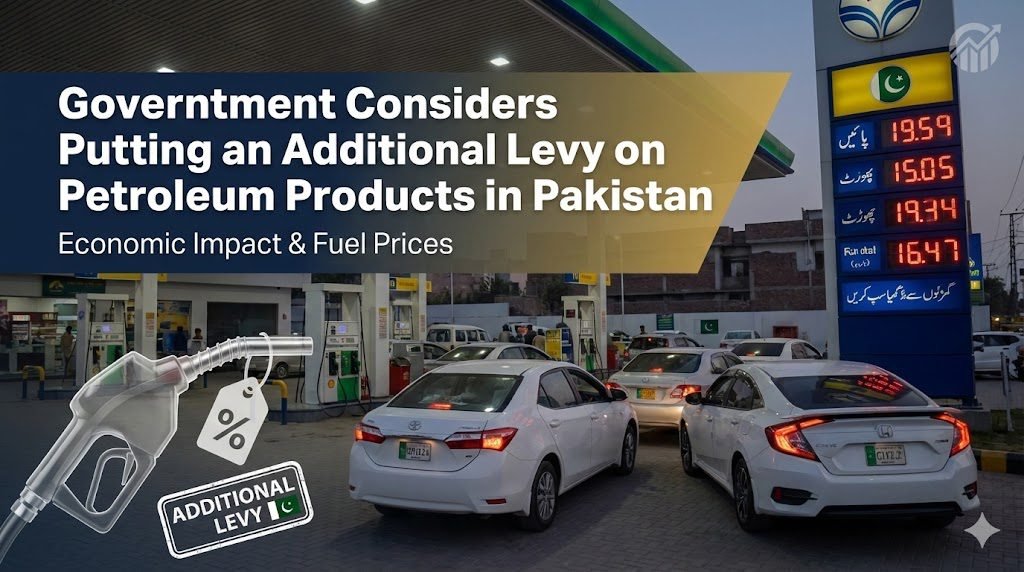
Fuel pricing has always been a sensitive economic and political issue in Pakistan. Any adjustment—whether an increase, decrease, or new tax—directly affects inflation, household budgets, transport costs, and overall business activity. In this context, the news that the government is considering putting an additional levy on petroleum products has drawn widespread attention across Islamabad, Rawalpindi, and other major cities.
The proposal is still under discussion, but its implications are far-reaching. From daily commuters and transporters to industries dependent on logistics, an additional petroleum levy would ripple through multiple layers of the economy. This article examines the proposal in detail, explains how petroleum levies work in Pakistan, and assesses the possible impact on consumers, businesses, and mobility patterns.
Understanding the Petroleum Levy in Pakistan
The petroleum levy is a federal charge imposed on fuel products such as petrol, high-speed diesel, kerosene oil, and light diesel oil. Unlike sales tax, which is shared with provinces under the National Finance Commission (NFC) award, the petroleum levy is retained by the federal government.
Historically, this levy has been used as a flexible fiscal tool. When global oil prices fall, the government often increases the levy to stabilize revenues. When prices rise sharply, the levy may be reduced or capped temporarily to control inflationary pressure.
An additional levy, if introduced, would mean a higher fixed charge per litre, irrespective of international oil market movements.
Why the Government Is Considering an Additional Levy
Fiscal Pressures and Revenue Targets
Pakistan’s federal budget relies heavily on indirect taxation. With limited room to expand the tax base quickly, fuel levies become an attractive option because of their predictable revenue stream. Consumption of petrol and diesel remains relatively inelastic, particularly in urban centers like Islamabad and Rawalpindi, where private and commercial transport demand is constant.
IMF Commitments and Budget Discipline
In recent years, Pakistan’s economic policy has been shaped by commitments made under international financial arrangements. Revenue generation through petroleum levies helps meet fiscal deficit targets without introducing new direct taxes, which are politically harder to implement.
Stabilizing Budget Planning
Fuel levies provide the government with a buffer against volatility in international oil prices. By adjusting the levy, authorities can manage domestic prices while ensuring a steady flow of funds into the federal treasury.
How an Additional Levy Would Affect Fuel Prices
If an extra levy is imposed, its impact on pump prices would be immediate. Even a modest per-litre increase can translate into a noticeable rise for consumers over a month.
For example:
- Daily commuters would face higher monthly fuel expenses.
- Ride-hailing drivers and delivery services would see operating costs rise.
- Intercity transport costs would increase, affecting fares and freight charges.
Since fuel is a core input for transportation, the effect would extend beyond motorists to the prices of goods and services.
Impact on Inflation and Cost of Living
Fuel prices have a direct and indirect relationship with inflation in Pakistan.
Direct Impact
Households that rely on personal vehicles or motorcycles would feel the increase immediately. Public transport operators often pass on fuel cost increases to passengers, leading to higher fares.
Indirect Impact
Higher fuel costs increase the cost of transporting goods. This affects food prices, construction materials, and consumer products, contributing to broader inflationary pressure.
Urban areas such as Islamabad and Rawalpindi, where commuting distances are longer and car usage is higher, are particularly sensitive to fuel price changes.
Effect on Businesses and Logistics
Transport and Freight
Logistics companies operate on tight margins. An additional levy would increase diesel costs, which dominate freight expenses. These costs are typically passed on to manufacturers and retailers.
Small Businesses
Small enterprises that rely on deliveries or frequent travel—such as service providers and traders—would face higher operating expenses, potentially reducing profitability.
Tourism and Travel
Fuel price hikes often discourage discretionary travel. Domestic tourism, especially road trips to northern areas, can slow down when travel costs rise.
For travelers who prefer predictable transport costs, structured mobility options such as booking a rent a car in Islamabad through professional services can offer better planning and cost control compared to fluctuating personal fuel expenses.
Public Response and Political Sensitivity
Fuel pricing decisions often trigger public debate. Any proposal for an additional levy is likely to face scrutiny from opposition parties, transport unions, and consumer groups.
Historically, sudden increases in fuel prices have led to protests and calls for relief measures. The government usually balances levy increases with targeted subsidies or phased implementation to manage public reaction.
Provincial and Regional Considerations
Although the petroleum levy is a federal charge, its impact varies regionally.
- Islamabad and Rawalpindi: High vehicle ownership means households are more exposed to fuel price changes.
- Punjab’s industrial belt: Manufacturing and agriculture logistics are sensitive to diesel costs.
- Remote areas: Higher transport costs can widen price disparities for essential goods.
This uneven impact often fuels debates about equity and regional fairness in fiscal policy.
Possible Mitigation Measures
If the government proceeds with an additional levy, several mitigation strategies could be considered:
Gradual Implementation
Phasing in the levy over multiple pricing cycles can reduce the shock to consumers.
Targeted Relief
Subsidies or cash transfers for low-income households can offset higher transport costs.
Encouraging Fuel Efficiency
Policies promoting fuel-efficient vehicles, hybrids, and shared mobility can help reduce long-term dependence on high fuel consumption.
Supporting Public Transport
Investment in reliable public transport systems can reduce reliance on private vehicles and soften the impact of fuel price increases.
Long-Term Implications for Mobility Choices
Rising fuel costs often influence how people travel. In urban centers, there is a gradual shift toward:
- Carpooling and ride-sharing
- Hybrid and fuel-efficient vehicles
- Short-term vehicle usage instead of ownership
For some users, flexible options such as Al Farooq Rent a Car become practical for specific needs like intercity travel or airport transfers, as they avoid the long-term exposure to fuel price volatility and maintenance costs.
Official Oversight and Transparency
Any change in petroleum levies is subject to federal approval and public notification. Pricing decisions are made after consultations and are announced officially through the Ministry of Finance and related authorities. Updates and policy details are typically published on the official Ministry of Finance Pakistan website, which serves as the authoritative source for fiscal measures.
FAQs
What is an additional petroleum levy?
It is an extra fixed charge per litre imposed by the federal government on fuel products to generate revenue.
Will an additional levy immediately raise petrol and diesel prices?
Yes, any new levy would directly increase pump prices unless offset by reductions elsewhere.
Why does the government rely on fuel levies?
Fuel levies provide predictable revenue and are easier to collect compared to expanding direct taxation.
How does a fuel levy affect inflation?
Higher fuel costs raise transport expenses, which increase the prices of goods and services across the economy.
Are fuel levy decisions final once proposed?
No. Proposals require approval and can be revised or delayed based on economic conditions and public response.
Disclaimer
This article is published for general informational purposes only. Policy proposals, fuel levies, and petroleum prices are subject to change based on government decisions, economic conditions, and official notifications. Readers are advised to verify the latest updates from official government sources before making financial or travel-related decisions.