

Quick Answer
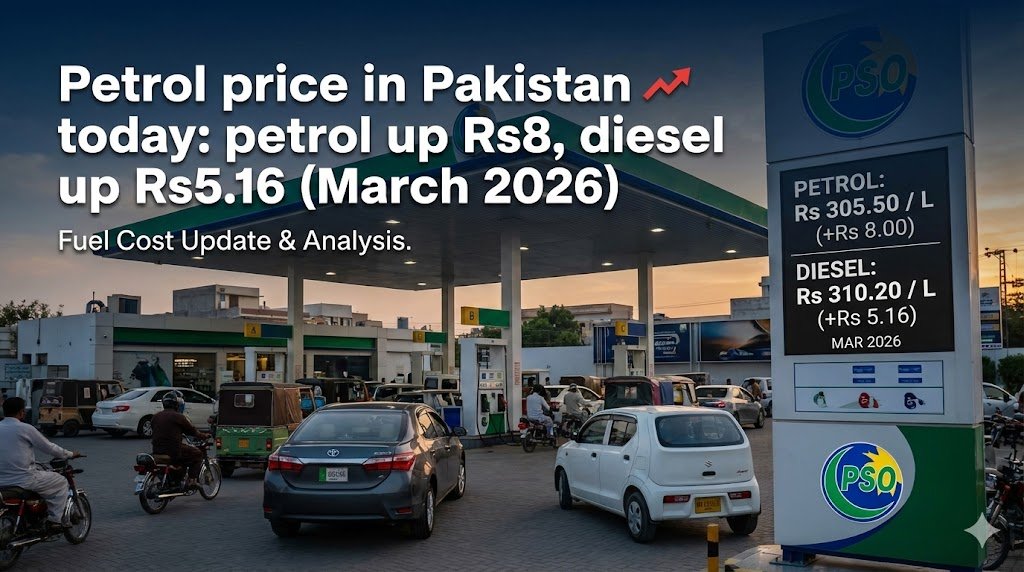
If you’re checking petrol price in Pakistan today, the latest notified revision for the current fortnight sets petrol (MS) at Rs266.17 per litre and high-speed diesel (HSD) at Rs280.86 per litre. This revision increased petrol by Rs8.00/litre (from Rs258.17) and HSD by Rs5.16/litre (from Rs275.70) for the next fortnight.
For most households and businesses, the practical impact shows up immediately in three places: daily commuting budgets, intercity travel planning (Islamabad–Lahore / Islamabad–Faisalabad), and delivery/logistics costs that often respond faster to diesel movements than petrol movements.
Updated on: March 2, 2026 (Asia/Karachi)
Fuel price today in Pakistan: the numbers that matter
Fuel conversations get noisy when prices change, so keep a clean baseline. Here is the current “before vs after” view for the latest fortnightly revision.
| Product | Previous price (Rs/L) | New price (Rs/L) | Change |
|---|---|---|---|
| Petrol price in Pakistan (Motor Spirit) | 258.17 | 266.17 | +8.00 |
| High-speed diesel (HSD) | 275.70 | 280.86 | +5.16 |
These figures come from the latest government update on revised petroleum product prices for the current fortnight.
What usually drives petrol prices in Pakistan
Pakistan reviews fuel prices on a regular cycle and the final notified figure is typically shaped by a mix of:
- international oil market movement (crude and refined products)
- PKR/USD exchange rate pressure on import components
- freight and distribution costs
- taxes and levies applied in the local pricing structure
- supply chain stability and inventory planning
You don’t need to track every component daily to protect your budget. You do need a system for “trip cost” and “weekly cap,” especially when prices jump at the start of a fortnight.
Petrol prices in Pakistan: why diesel increases often feel bigger than petrol increases
Even when petrol rises by more per litre, diesel often creates wider ripple effects because it’s tied to:
- freight movement
- delivery riders and logistics fleets
- intercity transport services
- certain commercial generators and industrial usage
So a diesel move can quietly appear as higher delivery charges, slightly higher supplier transport fees, and higher service costs that depend on transport.
Details section: convert price changes into a travel budget (Islamabad and Rawalpindi focus)
Price changes feel stressful when they’re abstract. They become manageable when you convert them into three things:
- cost per commute day
- cost per intercity trip
- monthly buffer
Step 1: Use “real mileage,” not brochure mileage
For Islamabad and Rawalpindi, real mileage is heavily affected by:
- stop-and-go traffic (signals, U-turns, sector-to-sector movement)
- AC use
- idling during pickups and waiting
- short trips (engine never fully settles into efficient range)
A practical planning range (not a promise) many drivers use:
- Small hatchback: 12–15 km/L in mixed city driving
- Sedan/crossover: 10–13 km/L
- Diesel SUV/MPV: 9–12 km/L
Step 2: Use a per-trip buffer, not just a per-litre buffer
A price move is felt most when you’re doing fixed-timing trips:
- Islamabad airport runs
- hospital visits
- meetings stacked across the day
- intercity travel on tight schedules
In these cases, you want a per-trip buffer because idling time burns fuel even when you’re not covering distance.
Table: quick trip cost estimates using the current notified prices
Below is a “planning table” using the current notified rates (petrol Rs266.17/L, diesel Rs280.86/L).
This is meant for budgeting clarity; your vehicle’s mileage decides the final number.
| Trip type | Typical distance pattern | Example vehicle economy | Fuel used (estimate) | Fuel cost estimate |
|---|---|---|---|---|
| Twin cities daily commute (Islamabad ↔ Rawalpindi) | ~30–50 km/day mixed | 12 km/L petrol | 2.5–4.2 L | Rs665–Rs1,118 |
| Islamabad airport run (round trip) | ~70–100 km + waiting | 10 km/L petrol | 7–10 L | Rs1,863–Rs2,662 |
| Islamabad → Lahore (one way) | ~370–380 km | 12 km/L petrol | ~31–32 L | ~Rs8,250–Rs8,520 |
| Islamabad → Faisalabad (one way) | ~320–340 km | 12 km/L petrol | ~27–28 L | ~Rs7,190–Rs7,460 |
| Commercial diesel route day | varies + idling | 10 km/L diesel | depends on km | Use per-route baseline + buffer |
If you travel intercity frequently, budget the return trip as a separate line item. Many people underestimate return fuel and then end up cutting comfort (AC, rest stops) mid-way.
Decision section: what to do with this price hike
This section is about decisions that reduce stress, not about chasing a perfect prediction.
Suitable for
These actions work well for:
- salaried commuters with fixed routes
- ride and delivery workers managing daily fuel spending
- families planning intercity travel on weekends
- businesses that run sales routes or deliveries
Who should avoid “tight-cash” travel planning this fortnight
Avoid planning trips with a zero buffer if:
- you’re driving intercity and your cash plan is exact with no flexibility
- you have a long wait-and-idle schedule (airport pickup, hospital)
- you’re already running close to monthly budget limits
Practical alternatives when timing matters
During a fuel-price jump, timing becomes expensive. If you have a schedule-heavy day (multiple meetings, airport pickup, client visits), many people prefer locking transport rather than improvising between rides.
If you need predictable movement in the capital, you can review rent a car in Islamabad for planned trips where timing is fixed.
If you want a clear idea of vehicle options and rate structure for planning, see Our Cars & Rates.
Al Farooq Rent a Car fits best here as a “schedule control” option—your time stays predictable even when fuel and traffic conditions are moving.
Scenario examples (real Pakistan use cases)
Scenario 1: Office commuter (Islamabad sectors + Rawalpindi errands)
A commuter often does two peaks: morning rush + evening errands. The price rise hits fast because refills are frequent. A working approach is:
- set a weekly fuel cap
- combine errands into one loop
- reduce idle time (avoid long waits with engine on)
Scenario 2: Airport pickup and drop within the same week
Airport trips often look short on distance but long on waiting and AC use. Plan:
- a per-trip buffer (not only distance)
- an “idle allowance” mindset—waiting time costs fuel
Scenario 3: Intercity trip with a family and luggage
Intercity travel costs are not only fuel: tolls, breaks, and route deviations add up. With petrol at Rs266.17/L, trip cost becomes more visible.
A safe approach is to budget fuel for the whole return route before you leave, then treat everything else as separate.
Scenario 4: Small business routes and deliveries
Diesel changes can flow into delivery charges and supplier transport. If you manage deliveries:
- track cost per route (not per litre)
- compare weekly route cost before vs after the revision
- adjust pricing only after you see the pattern, not on day one
Common mistakes people make when fuel prices jump
- budgeting based on best-case mileage instead of real traffic mileage
- treating waiting time as “free”
- planning intercity routes without a return-trip buffer
- making extra “top-up” visits that add distance and time
- reacting to forwarded “price screenshots” instead of using an official notification baseline
FAQs
Petrol price in Pakistan today: what is the current petrol rate for this fortnight
Petrol (Motor Spirit) is notified at Rs266.17 per litre for the current fortnight. The latest revision increased petrol by Rs8.00/litre from Rs258.17.
Fuel price today: what is the current diesel rate in Pakistan
High-speed diesel (HSD) is notified at Rs280.86 per litre for the current fortnight. The latest revision increased HSD by Rs5.16/litre from Rs275.70.
Today petrol price in Pakistan: does the price change daily
Retail notified prices typically follow a scheduled review cycle rather than changing daily at the pump. The notified rate applies for the announced period unless a special revision is issued. For planning, treat the notified rate as your baseline and keep a travel buffer for the next review window.
Petrol price today vs diesel price today: which one impacts household costs more
Petrol affects daily commuting for most small cars and bikes. Diesel often affects broader household costs through freight and deliveries, because commercial transport relies heavily on HSD. A diesel increase can show up indirectly as higher delivery and transport charges even for households that use petrol vehicles.
Oil price today: does global oil instantly change Pakistan fuel prices
Global oil prices influence Pakistan’s pricing inputs, but the pump price is notified through scheduled revisions and local pricing components. For budgeting, it’s safer to use the latest notified local rate as the baseline, then add a buffer for the next revision rather than trying to time global movements.
Disclaimer
This blog is for general information only. Fuel prices can change through official notifications, and actual trip costs depend on route, traffic, idling, vehicle condition, load, and driving style. Confirm the current notified rate before long-distance travel and keep a buffer for schedule-heavy days.