
Quick Answer
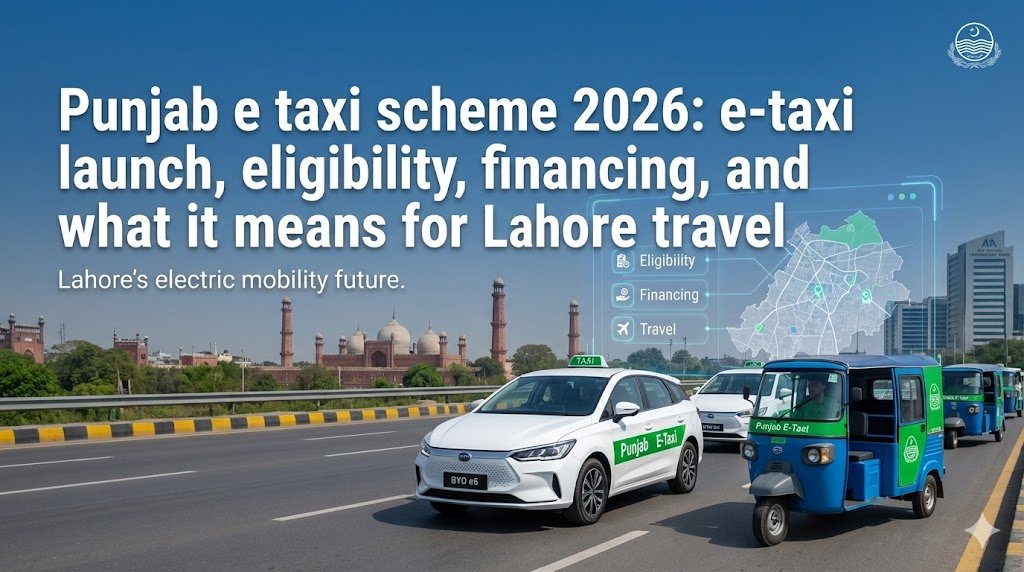
The Punjab e taxi scheme 2026 is a provincial program designed to put electric taxis on the road by supporting drivers and fleet operators with structured financing and a government-backed rollout. The official scheme portal describes it as an effort to promote eco-friendly ride-hailing, support Punjab’s green initiative, create jobs, and include a special quota for women.
For residents of Lahore and other districts, the practical value is direct: lower exposure to petrol and diesel price swings, smoother city mobility, and a new income pathway for drivers who can meet the scheme’s eligibility and operational requirements.
Updated on: Feb 28, 2026 (Asia/Karachi)
What the e-taxi scheme is trying to change in Punjab
Punjab’s urban transport demand is rising faster than road capacity. Lahore in particular sees daily pressure from office commuting, students, hospital visits, and ride-hailing trips that peak during morning and evening rush. A shift to electric taxis aims to tackle multiple problems together:
- Reducing fuel dependency for a segment of daily mobility
- Lowering local tailpipe emissions in dense traffic corridors
- Creating structured earning opportunities for drivers
- Expanding safe, app-linked transport options for passengers, including women
The official scheme portal frames the program around clean mobility, employment generation, and inclusive opportunities (including women-focused participation).
Punjab e taxi scheme 2026: who it is for
The scheme is not only for one type of applicant. The official portal indicates the program supports participation through different operational paths, including fleet-focused participation.
In practical terms, applicants usually fall into two groups:
Individual driver pathway
This is for people who want to operate an e-taxi as a primary income source. For most individuals, the biggest factors are driving eligibility, documentation readiness, and the ability to meet the financing structure.
Fleet owner pathway
The scheme portal highlights a fleet approach, including a “fleet owners” channel with minimum fleet size expectations (the portal references minimum quantities for fleet operators).
For fleet applicants, the main requirements tend to be operational capability: driver management, maintenance planning, charging logistics, and compliance monitoring.
Key features of the scheme that matter to applicants and passengers
Even if you are not applying, these details help you understand what will change on roads in Lahore and other districts.
1) Electric taxis integrated into ride-hailing
The portal describes the scheme as supporting eco-friendly ride-hailing and positioning e-taxis as part of mainstream mobility rather than a limited pilot.
That matters because app-linked operations typically increase transparency around trip records and driver activity, and they make it easier for authorities to supervise service standards.
2) Structured financing with installment planning
The official portal describes ownership support through a structured plan that includes an interest-free financing approach and multi-year installment planning, which reduces the “one-time cash barrier” for drivers and fleet operators.
This is the difference between a symbolic announcement and an adoptable program: a driver can only enter a new vehicle category if the payment structure is workable.
3) Equity contribution model
The portal also references an equity contribution component. In simple terms, that means the applicant is expected to contribute an upfront share while financing covers the remaining amount under the scheme structure.
This matters because applicants often underestimate the importance of having their upfront funds ready before applying.
One table that explains the program in plain terms
This table is built as a quick reference for people who want clarity on how the scheme works and what it requires operationally.
| Area | What the scheme is designed to do | What applicants should plan for |
|---|---|---|
| Mobility goal | Shift some ride-hailing trips to electric taxis | Expect growing visibility in Lahore and expansion to more districts |
| Driver opportunity | Create income pathways and job creation | Plan documentation, driving eligibility, and operational discipline |
| Financing structure | Enable adoption via structured financing and installments | Prepare equity contribution and monthly installment capacity |
| Fleet participation | Support fleet operators under minimum fleet expectations | Plan charging, driver onboarding, and maintenance cycles |
| Inclusion | Promote women participation and inclusive access | Expect specific participation channels and onboarding requirements |
The inclusion and eco-mobility intent is explicitly stated on the official scheme portal.
Details section: how the scheme affects day-to-day travel in Lahore
Lahore’s travel demand is heavily short-trip based: office rides, university runs, medical visits, shopping routes, and airport/terminal connectivity. In this environment, electric taxis can produce practical effects:
Reduced exposure to fuel price volatility for a segment of trips
When fuel prices rise, ride fares typically adjust over time because operating costs increase. A stable cost profile for electric vehicles can reduce pressure on fares for a portion of trips, especially in high-frequency intra-city travel.
Trip reliability improves when fleets plan charging and shift discipline
Electric fleets succeed when operators manage:
- charging cycles
- shift scheduling
- preventative maintenance
- backup planning for peak demand
If fleets treat charging casually, service reliability can drop. So the “quality outcome” depends on operator discipline, not only policy.
Passenger comfort and urban stop-and-go behavior
Electric vehicles often perform smoothly in stop-and-go conditions. In congested corridors, that can improve passenger experience, particularly for short intra-city trips.
Decision section: who should consider applying, who should avoid it, and alternatives
This section is designed for real decisions rather than promotional language.
Suitable for
The scheme is a strong fit for:
- Drivers who already work in ride-hailing or taxi operations and want a structured upgrade path
- Individuals who can manage an equity contribution and can commit to installment discipline
- Fleet operators who can run charging + maintenance operations professionally
- Applicants who prefer income stability through daily trips rather than seasonal work
Who should avoid applying right now
It may be a poor fit if:
- Your documentation or driving eligibility is not ready and you need months to correct it
- You cannot reliably manage monthly installments with a stable income plan
- You do not have a workable charging plan for your operating area
- You are expecting instant delivery without a structured selection or onboarding process
Practical alternatives
If your goal is simply to earn through transport work, alternatives include:
- Joining an existing fleet first (to learn route economics and shift discipline)
- Operating a conventional vehicle temporarily while preparing documentation and financial readiness
- Focusing on high-demand corridors where consistent earnings are more realistic than scattered trips
For business owners and professionals in Lahore who need dependable movement for meetings and planned schedules, a separate option is using a pre-booked car with driver. For example, you can review rent a car in Lahore options for scheduled travel where timing is fixed and trip certainty matters.
Scenario examples (Punjab ground reality)
Scenario 1: Driver switching from petrol ride-hailing to e-taxi
A driver currently spends a large portion of weekly income on fuel. The scheme’s value depends on whether charging is accessible and whether the driver can maintain consistent trip volume to cover installments. The driver should build a weekly plan: average trips per day, average net per trip, charging time, and monthly installment buffer.
Scenario 2: Fleet operator in Lahore targeting high-demand zones
A fleet operator wants to deploy multiple e-taxis. The operator’s biggest risk is operational, not financial: if vehicles are not charged on time or maintenance is delayed, service failure starts immediately. The operator must plan charging bays, shift handover, spare vehicle coverage, and driver compliance monitoring.
Scenario 3: Women driver entry into app-based transport
The portal frames the scheme as inclusive with a women-focused quota intent.
For women applicants, the success factor is the full chain: onboarding, safety protocols, predictable routes, and support channels. A realistic start is day-shift operations on predictable corridors before expanding to late-hour coverage.
Scenario 4: Passenger impact during early rollout
In early stages, passengers may see limited availability by area and time. As fleet size grows and operators stabilize charging routines, availability improves. Passengers benefit most in short intra-city trips where turnaround time is fast.
Common mistakes that weaken outcomes for applicants
These are the patterns that create problems in vehicle schemes and financing-linked mobility programs:
- Applying without a clear equity contribution plan
- Underestimating monthly installment stress during low-demand weeks
- Treating charging as a “daily hassle” instead of a fixed operating cycle
- Selecting operating routes randomly rather than focusing on repeatable demand corridors
- Ignoring maintenance scheduling until a vehicle loses working hours
- Depending on peak-hour income only, without calculating full-day earnings consistency
What to confirm before you commit
Use this short checklist before you move forward:
- You have stable identity and driving documentation
- You can cover the equity contribution without borrowing at high informal rates
- You have a charging plan near your operating corridor
- You have a monthly buffer for low-demand weeks
- You can operate within app-based standards consistently
The official scheme portal is the best single reference point for the scheme’s objectives, structure, and participation channels. You can review details directly on the Punjab e-Taxi scheme official portal.
FAQs
Who can apply for the Punjab e taxi scheme 2026
The scheme is structured to support participation in electric taxi operations in Punjab, including an inclusive approach and a women-focused quota intent. Applicants should prepare documentation, financing readiness, and an operating plan that fits app-based taxi work. The official scheme portal is the best place to confirm the latest participation requirements and channels.
Is the Punjab e taxi scheme 2026 only for Lahore
The scheme is being positioned as part of Punjab’s wider e-mobility direction, with early visibility expected in Lahore and expansion across districts through structured rollout. For applicants, the practical factor is charging access and route economics in the district where they plan to operate, not only the launch city.
What is the difference between an individual applicant and a fleet owner in the scheme
Individual applicants generally operate one vehicle as a primary earning source, while fleet owners manage multiple vehicles and drivers with shared charging and maintenance operations. Fleet participation is highlighted on the scheme portal, including minimum fleet expectations for fleet operators.
What costs should an applicant plan for besides installments
Applicants should plan for the equity contribution, insurance and routine maintenance planning, and operating buffers for low-demand weeks. Electric taxis also require a reliable charging routine, and charging downtime must be treated as part of the work schedule rather than an occasional activity.
Can the e-taxi program reduce the impact of fuel price increases on ride fares
Electric taxis can reduce fuel exposure for that segment of trips because electricity replaces petrol or diesel as the main energy input. Fare outcomes still depend on charging cost, vehicle utilization, and operator discipline. In early rollout phases, availability and route coverage often matter more than price changes.
Disclaimer
This blog is for general information only. Scheme rules, eligibility checks, financing structure, and rollout timelines can change through official updates. Always verify the latest requirements and participation details through the official scheme portal before making financial or operational commitments.