

Quick Answer
The petrol and diesel price increase March 2026 Pakistan conversation is happening because Pakistan revises fuel prices on a regular schedule, and even a small movement in global crude prices, exchange rate, or local levies can move pump prices quickly. The most reliable way to anchor your planning is to start from the latest officially notified petroleum prices and then budget a realistic buffer for the next revision window. You can verify the currently notified rates and notifications on the official Oil and Gas Regulatory Authority (OGRA) page. (OGRA notified petroleum prices)
For people traveling in Islamabad and Rawalpindi, the practical issue is not the headline—it’s the knock-on effect: higher trip cost for airport runs, intercity travel (Islamabad to Lahore, Islamabad to Faisalabad), deliveries, and any booking where fuel is a major component.
Updated on: Feb 27, 2026 (Asia/Karachi)
Petrol and diesel price increase March 2026 Pakistan in one table
Pakistan’s pricing cycle means you can plan with a “current baseline + buffer” approach. The table below shows what you should track each cycle and what it does to your costs.
| What changes | What usually drives it | What it affects first | Fast way to plan |
|---|---|---|---|
| Petrol (MS) retail price | Global crude trend + exchange rate + local levies + freight/margins | Motorbike commuters, small car city travel | Add a per-liter buffer to your weekly fuel budget |
| Diesel (HSD) retail price | Same drivers, often more sensitive to freight/industry demand | Freight, intercity buses, commercial transport, generator fuel | Expect ripple into transport fares and delivery costs |
| Difference between petrol vs diesel | Local policy choices + demand mix | Fleet decisions and trip economics | Choose vehicle type based on route and load |
If you need the official baseline to start from, use the OGRA notified rates page for the current notified prices and the notification history. (OGRA notified petroleum prices)
What “set to rise” should mean for a Pakistan reader
Headlines often feel dramatic, but your real decision is simple: do you need to lock travel plans before the next revision window, or do you need a buffer for daily movement.
This matters most for:
- riders and commuters who fill up frequently (Islamabad/Rawalpindi routine)
- families planning weekend travel (Murree, Taxila, nearby routes)
- businesses running deliveries or sales routes across cities
- people planning airport transfers where timing is fixed
A price revision does not only change the pump. It changes the cost of mobility across the whole chain, especially when diesel moves because it touches freight and delivery.
Details section: how petrol and diesel prices are typically set in Pakistan
This section keeps it grounded and practical. Petrol and diesel retail prices in Pakistan typically reflect:
- international market movement for crude and refined products
- PKR/USD exchange rate impact on imported components
- government levies (which can change based on revenue needs)
- inland freight, distribution costs, and regulated margins
The reason this matters for March is timing: price revision windows mean changes tend to hit on schedule, so expectations rise when international conditions are unstable.
To keep your planning factual, anchor to the latest notified prices and watch the next revision window rather than relying on social posts or forwarded screenshots. The official record for notified prices and notifications is available through OGRA. (OGRA notified petroleum prices)
The cost impact is not “per liter,” it’s per trip
Most readers feel the change when they do the math on a route they actually drive.
A useful trip-cost method
Trip fuel cost roughly equals:
- distance (km) ÷ real-world mileage (km/L) × price per liter
Because real-world mileage depends on traffic, AC use, load, and driving style, a small price move can feel bigger during:
- stop-and-go traffic in Islamabad sectors and Rawalpindi bazaars
- long idling during pickups, school drops, and waiting outside offices
- intercity driving at sustained speeds with full AC and passengers
Table: budgeting buffer for common routes from Islamabad and Rawalpindi
This table helps you budget without pretending to predict the exact new price. It uses a “buffer per liter” approach.
Assumptions for planning only (not a promise):
- Small hatchback city average: 12–15 km/L
- Sedan/crossover mixed average: 10–13 km/L
- Diesel MPV/van mixed average: 9–12 km/L
Your actual mileage can be lower in heavy traffic.
| Route type | Typical pattern | What fuel-price rise changes | Best budgeting move |
|---|---|---|---|
| Islamabad ↔ Rawalpindi daily commute | frequent short trips, traffic signals | weekly spending rises quickly because fill-ups are frequent | set a weekly fuel cap + keep a buffer |
| Islamabad airport transfer | time fixed, AC on, waiting time possible | cost increases even if distance is moderate | plan with a per-trip buffer, not only liters |
| Islamabad → Lahore (intercity) | motorway + city entry traffic | trip cost moves noticeably on both petrol and diesel | lock a buffer for return trip as well |
| Islamabad → Faisalabad (intercity) | longer run, sustained speeds | changes stack up over longer distance | plan a higher buffer than city trips |
| Deliveries and sales routes | multiple stops + idling | diesel rise can also increase supplier delivery fees | track cost per delivery run |
Decision section: who it’s suitable for, who should avoid waiting, and alternatives
Suitable for immediate planning
If any of the following describes you, treat March pricing as a budgeting event:
- daily commute by bike or small car
- intercity travel booked weekly (Islamabad–Lahore, Islamabad–Faisalabad)
- airport transfers for business or family travel
- delivery routes where diesel cost is already a major line item
For these groups, the impact is not theoretical. It hits the weekly budget immediately.
Who should avoid last-minute travel decisions
Avoid planning “tight budget” trips without a buffer if:
- you are traveling long distance with a fixed cash budget
- your business runs on thin delivery margins
- you rely on rented transport where fuel movement affects final billing
A price revision can turn a “just enough” budget into a shortfall.
Practical alternatives for time-sensitive travel
When timing matters more than minimizing cost, many travelers prefer a pre-planned booking rather than improvising rides during a price-change window.
If you need predictable movement in the capital for meetings, family travel, or planned commitments, you can review rent a car in Islamabad options to keep schedules stable.
If your route is largely within the twin cities, rent a car in Rawalpindi can be a practical option for driver-led travel when you want fixed timing and less uncertainty.
Al Farooq Rent a Car is best used here as a scheduling tool: you lock timing and route, then manage fuel-price volatility through budgeting instead of last-minute changes.
Scenario examples (Pakistan reality)
Scenario 1: Office commuter in Islamabad with evening errands in Rawalpindi
A commuter fills the tank or bike frequently. Even a small change per liter becomes visible within days. The better approach is a weekly fuel budget with a buffer rather than reacting at the pump.
Scenario 2: Family airport pickup and drop in the same week
Airport runs often include waiting time and AC use. If fuel prices rise, the “short distance” assumption fails because idle time burns fuel too. Planning with a per-trip buffer protects you from surprise costs.
Scenario 3: Intercity visit to Lahore with a fixed cash budget
A planned weekend visit becomes tighter when fuel rises and motorway food/rest stops also reflect higher transport costs. The safer move is to set a return-trip buffer before you depart.
Scenario 4: Small business with delivery runs
When diesel rises, delivery and freight costs tend to move across the supply chain. A business that tracks only “purchase cost” and ignores transport cost often sees margin pressure in the same month.
Common mistakes that make price changes feel worse
- Budgeting only for distance and ignoring traffic and idling
- Using unrealistic mileage assumptions for Islamabad/Rawalpindi traffic
- Planning intercity travel without a return buffer
- Waiting for a “confirmed leak” instead of budgeting from the notified baseline
- Treating petrol and diesel as interchangeable in cost planning when your vehicle type fixes the outcome
Featured image suggestion
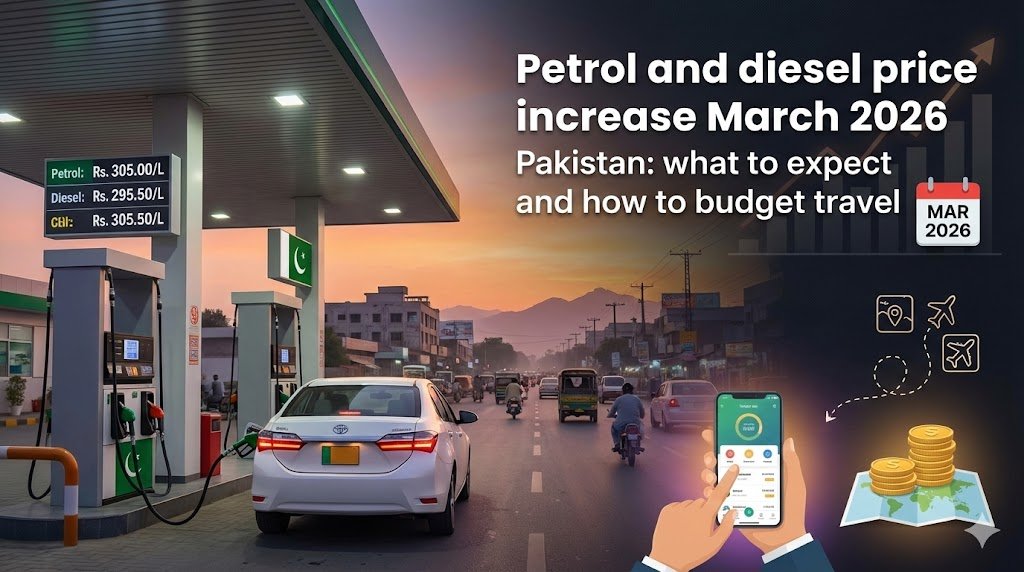
A strong featured image for this topic is a realistic Pakistan fuel station scene with a petrol nozzle and a diesel nozzle in the foreground, plus a small signboard showing “Price revision cycle” (no numbers on the image to avoid fast-dated graphics).
FAQs
Petrol and diesel price increase March 2026 Pakistan: when does it hit trip costs
Trip costs start moving as soon as the new notified rate becomes active because every refill reflects the new per-liter price. The impact feels fastest for daily commuters and delivery routes where refills happen multiple times a week. For intercity travel, the change becomes obvious because it applies across long distance and return planning.
What is the best way to verify the current petrol and diesel notified prices
Use the official notified price record rather than forwarded screenshots. OGRA maintains the notified petroleum prices page, including notifications and the latest notified rates. This gives you a stable baseline for budgeting before the next revision window.
Does a diesel increase affect more than just diesel vehicles
Yes. Diesel is linked to freight, delivery routes, and many commercial transport categories. When diesel rises, delivery and logistics costs can rise too, which can push up prices of transported goods even for people who personally use petrol cars or motorbikes.
Should commuters in Islamabad and Rawalpindi change travel routines during price volatility
Routine changes only help if they reduce idling, traffic time, and unnecessary trips. Combining errands, avoiding peak congestion when possible, and keeping tires properly inflated can reduce fuel burn. The biggest saving usually comes from better trip planning rather than chasing a perfect fill-up day.
Petrol and diesel price increase March 2026 Pakistan: is it better to fill up early
A full-tank fill before a revision can help if you were going to buy that fuel anyway and you will consume it soon. It does not help if it forces cash stress or encourages unnecessary driving. A practical approach is to keep your normal routine and maintain a buffer rather than making a rushed fill decision.
Disclaimer
This blog is for general information only. Fuel prices, levies, and notification timing can change based on official decisions and market conditions. Always verify the latest notified petroleum prices through the official authority and plan budgets with a buffer rather than relying on predictions.