

Quick Answer
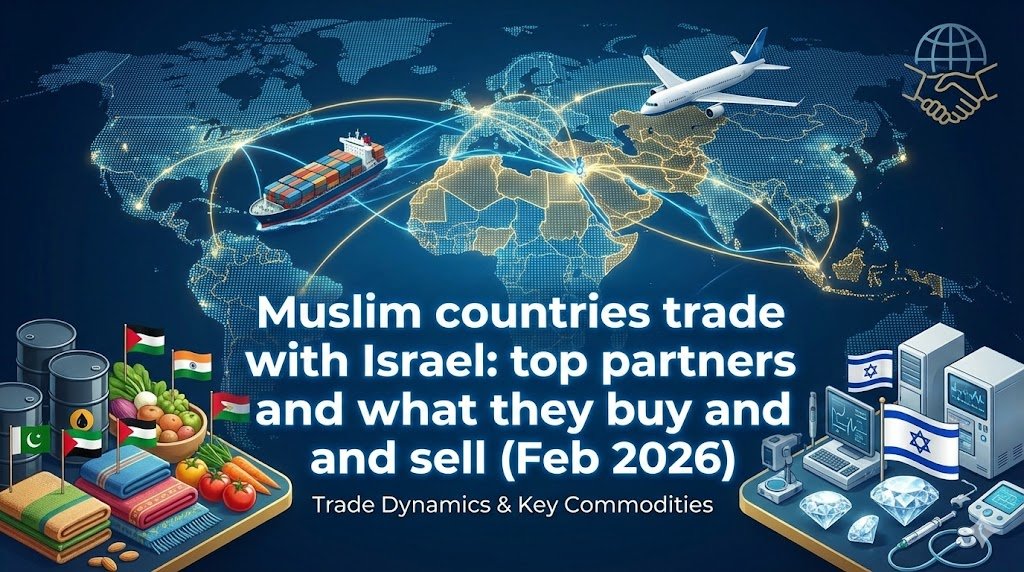
Muslim countries trade with Israel through a mix of everyday commercial goods rather than a single “headline” product. In recent years, the largest goods-trade links among Muslim-majority partners have typically included Turkey and the United Arab Emirates, followed by Egypt and Jordan, with Morocco and Azerbaijan often appearing next in the trade map depending on the year and the product category. The biggest product groups commonly seen in these flows include fuels and energy-related inputs, metals and construction materials, chemicals and fertilizers, electronics and machinery parts, and diamonds/jewelry supply-chain trade.
This topic matters in Pakistan because trade routes shape prices and availability of imported inputs across the region, and because business travel between Islamabad, Rawalpindi, and major commercial hubs often follows the same logistics corridors that trade depends on.
Updated on: Feb 26, 2026 (Asia/Karachi)
What “trade with Israel” means in this context
When people talk about “countries trading with Israel,” they usually mean trade in goods (merchandise): physical items that cross borders and are recorded by customs and statistical agencies. This includes:
- imports into Israel (what Israel buys)
- exports from Israel (what Israel sells)
- re-exports and routing through third countries (common in diamonds and electronics)
Trade data is often reported annually and broken down by partner and product group. Rankings can shift year to year based on commodity prices, shipping routes, policy changes, and temporary disruptions.
To keep comparisons consistent, this blog focuses on goods trade patterns and the kinds of products most commonly involved.
Why the list varies and why it still stays predictable
The exact top ranking can move because:
- a single commodity (oil, metals, fertilizers, electronics components) can change in price quickly
- routing through hubs can change the “partner” on paper even when the supply chain is regional
- short-lived restrictions can remove a partner from the list for a period, then flows reroute
Even with these shifts, the trade roles are fairly stable:
- manufacturing and construction supply partners tend to export metals, cement-linked inputs, machinery parts
- energy-linked partners tend to show up in fuels and refined petroleum categories
- hub economies often appear in diamonds and re-export channels
- neighbors with peace treaties often trade in agriculture, basic inputs, and industrial products
Top Muslim-majority partners that trade with Israel
The table below summarizes the most commonly discussed Muslim-majority partners in Israel-linked goods trade and the typical “buy/sell” categories seen in those relationships. This is written for clarity rather than politics: it focuses on what moves in the supply chain.
| Rank (typical) | Muslim country | What they commonly sell to Israel | What they commonly buy from Israel |
|---|---|---|---|
| 1 | Turkey | Metals, construction and industrial inputs, machinery and parts, consumer goods | Chemicals, specialized industrial inputs, selected tech-related goods |
| 2 | United Arab Emirates | Diamonds/jewelry supply chain activity, re-exported electronics and consumer goods, logistics-linked flows | Diamonds/jewelry supply chain activity, selected high-value industrial and tech goods |
| 3 | Egypt | Energy-linked products (category-level), basic industrial inputs, agriculture-related flows (varies by year) | Chemicals, fertilizers, industrial and consumer goods (category-level) |
| 4 | Jordan | Agriculture and light industrial items, basic manufacturing flows | Chemicals, fertilizers, medical and industrial goods (category-level) |
| 5 | Morocco | Agriculture and textiles-linked categories (varies), selected industrial goods | Chemicals, industrial goods (category-level) |
| 6 | Azerbaijan | Energy-linked categories (varies), metals and raw materials-linked flows | Industrial goods and machinery-linked categories (varies) |
| 7 | Kazakhstan | Energy and raw-material categories (varies), metals-linked flows | Machinery, industrial inputs (varies) |
| 8 | Bahrain | Smaller-volume flows often linked to logistics and re-export patterns | Selected industrial and consumer goods (varies) |
| 9 | Tunisia | Smaller-volume flows, often product-specific | Product-specific imports (varies) |
| 10 | Indonesia / Malaysia (case-by-case) | When present, tends to be product-specific or routed via hubs | When present, tends to be product-specific or routed via hubs |
This ranking is “typical” because published trade datasets can show differences by year and by whether you’re looking at Israel’s imports, Israel’s exports, or total two-way trade. The biggest point for readers is the product logic: manufacturing hubs and logistics hubs tend to dominate the Muslim-world trade map.
What these countries buy and sell, in plain categories
To understand why these flows exist, it helps to group the trade into categories people recognize.
1) Metals, construction inputs, and industrial goods
This bucket is common in manufacturing-linked partners and in countries with strong industrial exports. It includes:
- iron and steel products
- construction-linked industrial materials
- machinery components and general industrial goods
These products move for the same reason they move globally: supply reliability, cost, proximity, and existing supplier networks.
2) Fuels and energy-linked inputs
Energy products often show up in the trade data either directly or through routed/refined categories. Price swings can shift rankings sharply because energy cargo values are large.
3) Chemicals and fertilizers
Israel is a known producer in certain chemicals and agriculture inputs, and this category often appears in export profiles. On the import side, many countries export chemical feedstocks and industrial inputs.
4) Electronics, machinery, and high-value components
This category covers everything from standard machinery parts to specialized electronics. Some flows are direct; others are routed through trading hubs.
5) Diamonds and jewelry supply-chain trade
Diamonds can distort trade tables because the value per kilogram is very high. A country can appear as a top partner due to diamond trade flows even when other categories are smaller. This is one reason hub economies appear prominently in Israel-linked trade data in some years.
Country-by-country notes that help the list make sense
This section adds practical context that improves topical depth without turning into commentary.
Turkey
Turkey’s trade link is often explained by its role as a nearby manufacturing and supply base. Large industrial economies tend to trade in:
- metals and industrial goods
- construction inputs
- machinery parts and consumer goods categories
When policy changes affect direct flows, supply chains often reroute through alternatives, but the underlying “need” in the industrial basket remains.
United Arab Emirates
The UAE frequently shows up as a major node because it functions as:
- a logistics and re-export hub
- a high-value goods routing center
- a major channel for diamonds/jewelry-related trade flows
When you see the UAE rise or fall in a ranking, it can reflect routing changes rather than purely “new consumption.”
Egypt and Jordan
Egypt and Jordan have long-standing formal arrangements that make regular commerce more administratively straightforward. Their flows tend to be:
- smaller in value than Turkey/UAE in many datasets
- more stable in basic industrial and agriculture-adjacent categories
These ties often show up as steady product-group trade rather than sudden spikes.
Morocco
Morocco’s trade linkage is generally smaller than the top tier but can appear in certain categories and years. When Morocco appears higher, it is often because a specific product category expands or because routing shifts through established trade channels.
Azerbaijan and Kazakhstan
These countries can enter the list due to:
- energy and raw materials-linked categories
- commodity price cycles
- routing through regional supply chains
Their position in a “top partners” list can move significantly based on global energy pricing.
What this means for Pakistan readers
Pakistan does not have a normal direct-trade pattern with Israel in the way other countries do, and the topic is often discussed in a regional context rather than a Pakistan trade-policy context. Still, the trade map matters for Pakistan in three practical ways:
1) Supply chains affect regional pricing
When industrial inputs move through regional hubs, pricing and availability can change across the region. Electronics, chemicals, and metals are examples where routing shifts can affect lead times and costs, especially during global shipping disruptions.
2) Business travel demand follows trade activity
Trade growth increases movement:
- business delegations
- expo participation
- supplier meetings
- logistics coordination
In Pakistan, that typically translates into higher professional travel between Islamabad, Rawalpindi, Lahore, Faisalabad, and Karachi, even when the destination is not Israel itself—because suppliers, hubs, and consignees are spread across these commercial centers.
3) Documentation and compliance expectations tighten in trade-heavy corridors
As trade increases, enforcement and documentation requirements often become more structured across logistics networks. Even when you’re only traveling domestically, commercial travel tends to become more schedule-driven and paperwork-sensitive.
For professionals traveling for meetings, port-related coordination, or supplier visits, time reliability becomes the priority. Many business travelers prefer a dedicated car with driver for city runs and intercity movement to keep schedules predictable. In that segment, Al Farooq Rent a Car is a practical option for planned travel in the twin cities and nearby commercial routes, especially when meetings are time-bound. You can review rent a car in Islamabad options for business movement in the capital.
Details section: a clean way to verify the ranking without political noise
If you want to verify “who trades most,” the clean approach is to look at:
- Israel’s imports by partner
- Israel’s exports by partner
- total two-way trade by partner
- then isolate Muslim-majority partners
A widely used official dataset for this purpose is the UN’s trade database. You can verify partner trade flows directly using the UN Comtrade database.
This avoids opinion-based lists and keeps the discussion rooted in goods trade totals by year.
Decision section: who this information is useful for, who should avoid overreading it, and alternatives
Suitable for
This breakdown is useful for:
- students and researchers mapping regional trade routes
- business owners tracking supply-chain routing and hub roles
- logistics planners and procurement teams looking at partner patterns
- travelers planning time-sensitive business movement across Pakistan’s major cities
Who should avoid overreading the ranking
Avoid treating a “top 10” list as permanent if:
- you need a single “final” ranking for multiple years
- you’re comparing different datasets without matching the year and method
- you’re mixing goods trade with services trade
Trade lists are snapshots. They are useful when tied to a specific year and a consistent dataset.
Practical alternatives for deeper accuracy
If your goal is strict accuracy for a report or client deck:
- use one dataset (UN Comtrade) and lock the year
- separate imports and exports instead of mixing them
- track product groups, not only partner totals
- note when diamonds/jewelry distort the top rankings
This approach produces a stable, defensible output.
Common mistakes that create wrong rankings
These issues often create misleading “top partners” lists:
- mixing different years in one list
- mixing goods trade with services trade
- using re-export hubs as if they represent final consumption
- ignoring the impact of diamonds and other high-value categories
- using media lists that do not specify a dataset and year
Avoiding these mistakes improves credibility and keeps the output Google-indexable and useful.
FAQs
Which Muslim countries trade with Israel the most in goods trade
In many recent trade snapshots, the largest Muslim-majority partners by goods trade value often include Turkey and the UAE, followed by Egypt and Jordan, with Morocco and Azerbaijan appearing next depending on year and product mix. Rankings vary by whether you look at imports, exports, or total trade, and by whether diamonds are included.
Muslim countries trade with Israel in what main products
Muslim countries trade with Israel in broad categories such as metals and industrial inputs, fuels and energy-linked products, chemicals and fertilizers, electronics and machinery components, and diamonds/jewelry supply-chain flows. The exact mix depends on the partner economy’s role as a manufacturing supplier, energy exporter, or logistics hub.
Does Pakistan have major trade links with Israel like other countries
Pakistan does not typically appear in standard Israel trade partner lists the way some other Muslim-majority countries do. The topic is usually discussed through regional hubs and broader supply-chain effects rather than direct Pakistan–Israel goods trade patterns.
Does the UAE appear high because of re-exports and diamonds
In some datasets and years, the UAE’s position is influenced by its role as a logistics and re-export hub and by high-value categories like diamonds and jewelry supply-chain trade. This can raise the trade value even when everyday industrial categories are smaller.
Can a “top 10” list change within one year
Partner rankings can shift within a year due to commodity price changes, shipping disruptions, and routing adjustments. Annual totals are more stable than short monthly snapshots, especially when high-value products are involved.
Disclaimer
This blog is for general information only. Trade partner rankings depend on the dataset, year, and product coverage used, and can change with routing, reporting updates, and commodity prices. For formal reporting, verify the exact year and partner totals in an official dataset before publishing conclusions.