

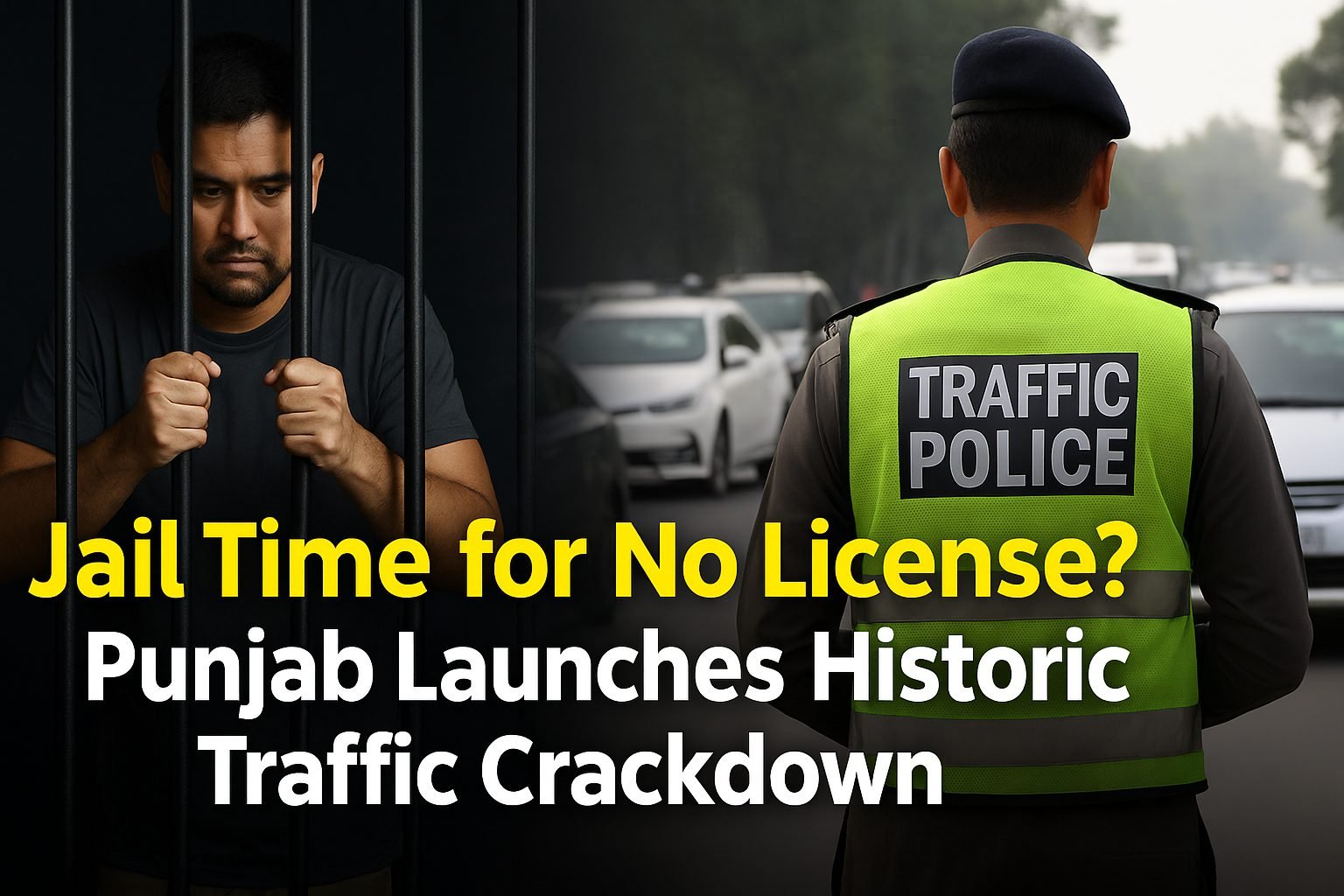
Punjab has begun the most comprehensive refresh of its road-safety framework in more than six decades, rolling out 20 substantive amendments to the provincial traffic regime. The reforms tighten penalties, add point-based enforcement, and close long-standing loopholes that weakened compliance. The provincial leadership has set a 30-day window for visible improvements across major cities, directing agencies to standardize enforcement without exceptions.
This update matters for everyday motorists, commercial fleets, and intercity operators alike. It changes how traffic violations are detected, recorded, penalized, and escalated—especially for repeat offences and violations tied to licensing and vehicle fitness.
Why this new crackdown—and why now?
Punjab’s roads carry heavy daily volumes across Lahore, Rawalpindi, Faisalabad, Multan, Gujranwala, and numerous secondary corridors. Congestion, lane discipline, distracted driving, and helmet/seat-belt non-use continue to strain emergency rooms and police resources. The new ordinance focuses on four outcomes:
- Deterrence with certainty: higher fines, electronic evidence, and automated ticketing systems.
- Escalation for repeat violations: penalty points, suspensions, and impoundment for chronic offenders.
- Clear accountability: vehicle owners and guardians face action for unlicensed and underage driving.
- Safer public spaces: rationalized U-turns, one-way enforcement, and targeted restrictions on high-risk practices.
What changes for you: the core amendments at a glance
1) Fine structure and penalty points
Expect higher fines for overspeeding, red-light violations, dangerous overtakes, wrong-way driving, smoke emissions, illegal parking, and mobile-phone use while driving. The framework also introduces penalty points. Accumulating points across separate challans can trigger license suspension for a defined period. E-challans will continue and expand as camera coverage grows; photographic or video evidence will accompany notices to vehicle owners.
What this means day-to-day: the system is designed so that frequent minor violations begin to carry major consequences. Occasional mistakes can still be costly, but consistently risky behavior now becomes unsustainable.
2) Stronger action against chronic offenders
Authorities can escalate to impoundment, registration suspension, and auctions for vehicles linked to repeated or egregious violations. Notably, government vehicles are not exempt. This closes a gap that previously weakened equal-treatment goals.
Tip for fleet managers: build a driver-scorecard and schedule quarterly compliance refreshers. Penalty points against drivers can upend service delivery if ignored.
3) FIRs and jail time linked to licensing and fitness
Driving without a valid license or vehicle fitness now carries sharper consequences. Owners who enable underage or unlicensed driving face FIRs, imprisonment, and/or license suspension, depending on the final charge framing and the facts of the case. These measures are primarily about deterrence and prevention.
Household angle: parents remain liable if they hand over keys to minors or fail to block access to vehicles. Insurance complications also rise if incidents involve unlicensed drivers.
4) Safety-led restrictions in high-risk zones
- Riding on bus rooftops is explicitly prohibited.
- Motorcycle-rickshaws (Qingqi rickshaws) are barred from five major Lahore corridors to reduce collision risk and improve flow where lane widths and turning radii are tight.
- One-way compliance will be enforced with urgency; U-turns are set for redesign to remove unsafe mid-block turns.
Parking policy: no parking on flyovers, overhead bridges, and specified main highways. Venues such as marriage halls will be held to higher parking-capacity requirements to reduce spillover onto arterials.
5) 30-day enforcement calendar
Traffic police have been given 30 days to demonstrate visible improvements: lane discipline in choke points, helmet/seat-belt compliance, and adherence to one-way flows. Expect periodic zero-tolerance blitzes at high-risk junctions and school zones.
How enforcement will look on the ground
Evidence-first routines
- Automated detection: fixed cameras and mobile enforcement units tie directly to back-office systems for e-challans with timestamped imagery.
- Officer body-cams (where deployed): additional evidence in contested stops.
- Data-led deployments: frequent issues—wrong-way entries, red-light jumps, and bus-lane encroachment—draw rotating patrols.
Escalation pathway
- First notices: standard fines + points.
- Repeat pattern: higher fines + points + potential short-term suspension.
- Chronic violations: impoundment, potential auction, and/or FIR when linked to unlicensed/underage operation or tampering.
Implications for commuters and businesses
Daily motorists in Lahore, Rawalpindi, Faisalabad, Multan, Gujranwala
- Budget for higher penalties if you’re habitually late and rely on risky shortcuts (wrong-way entries, signal jumps).
- Helmet/seat-belt checks intensify. A “short hop” without proper restraints can generate immediate e-challans.
MSMEs and logistics fleets
- Map truck and high-roof van routes around the newly protected corridors to avoid surprise impounds for prohibited stops.
- Maintain smoke-emission compliance. Visible smoke and tampered exhaust are predictable triggers for fines and downtime.
School vans and private buses
- Rooftop riders and door-hanging passengers are now explicit non-starters. Expect targeted checks near campuses and tuition clusters.
City design: one-way rationalization and U-turn redesign
The traffic plan emphasizes predictable flow. Removing ad-hoc U-turns and enforcing one-way segments reduces conflict points. While it may lengthen some routes by a few minutes, it lowers collision frequency and keeps emergency lanes clear.
For businesses, align delivery windows with green waves and updated one-way maps. If you rely on quick customer turnover, clarify legal loading bays with local authorities to prevent paid staff from spending hours contesting challans.
Emissions and technical compliance
Punjab will intensify checks on smoke-emitting vehicles, illegal HID kits, and non-standard number plates. Expect fitness certificate verification to matter more at inspection posts. Vehicles that repeatedly trigger smoke cameras and roadside opacimeters can face grounding until rectified.
Maintenance checklist to stay compliant:
- Fresh air filter, clean injectors/carburation, and healthy catalytic converter/DPF (as applicable).
- Factory-spec number plates with legible fonts and contrast.
- Functional lights and indicators; remove blinding auxiliary lights on city roads.
Planning compliant travel in the twin cities and beyond
For families and corporate teams that can’t afford roadside delays, a driver-operated vehicle with documented compliance is pragmatic. If you need airport runs, embassy appointments, or city-to-city car rental with transparent paperwork:
- Book rent a car in Islamabad with a professional driver to maintain documentation, parking protocols, and lawful stops.
- For mileage-based packages and intercity confirmations—including Islamabad to Lahore rent a car or Islamabad to Faisalabad rent a car—review Our Cars & Rates and lock the itinerary in advance.
These arrangements help households seeking a rent a car for family, visitors searching rent a car near me, and companies needing timely Lahore airport car rental, Islamabad airport car rental, or onward Karachi airport car rental connections with orderly pickup signage and compliant parking.
For drivers: practical ways to avoid penalty points
- Signal discipline: approach ambers as reds; avoid last-second accelerations.
- Phone-free cabin: use a fixed cradle and hands-free; never type in motion.
- Lane respect: no hard-shoulder hopping; use indicators early and hold a lane through junctions.
- Helmet and belts: universal and non-negotiable—even for short inner-neighborhood runs.
- Plates & papers: factory-spec plates, valid license, up-to-date fitness/insurance where relevant.
For parents and vehicle owners: ending underage and unlicensed driving
- Lock keys away; use a separate storage pouch for keyless fobs.
- Keep a hard copy of the license in the vehicle along with a visible reminder sticker on the steering column or dash—“License on you?”.
- If teaching a teen to drive, enroll with a licensed school and confine practice to permitted areas.
The new framework assumes owner responsibility where minors are involved. The legal and financial exposure—plus safety risk—far outweighs any convenience.
How this aligns with broader national goals
Stronger provincial enforcement complements national objectives on road safety and public-health protection (lower trauma admissions, cleaner air). It also dovetails with long-term ambitions to professionalize public transport, rationalize urban freight, and raise insurance discipline. A predictable, even-handed system is better for residents, tourists, and investors.
Frequently Asked Questions
What is the immediate timeline for enforcement?
Authorities have a 30-day directive to demonstrate measurable improvements. Expect sustained operations beyond that window as systems settle into routine.
Will e-challans replace physical tickets?
Both will continue. E-challans expand coverage with photographic evidence. On-the-spot tickets remain in use where officers document violations directly.
Are government vehicles still exempt?
No. The framework applies uniformly. Government vehicles face the same fines, points, and impoundment rules as private vehicles.
What happens if I lend my car to an unlicensed driver?
Owners can face FIRs, imprisonment exposure, and related penalties depending on circumstances. Always verify the driver’s license before handing over the vehicle.
How do businesses avoid impoundment risk?
Maintain fitness, emissions compliance, and plate standards. Train drivers on one-way flows and legal parking. Track challans weekly to catch repeat patterns before escalation.
For time-critical travel—airport slots, embassy windows, medical appointments—organized logistics reduce exposure to roadside delays. A vetted driver and a well-maintained vehicle help you stay within the rules. Plan with rent a car in Islamabad and secure a documented, compliant itinerary.