

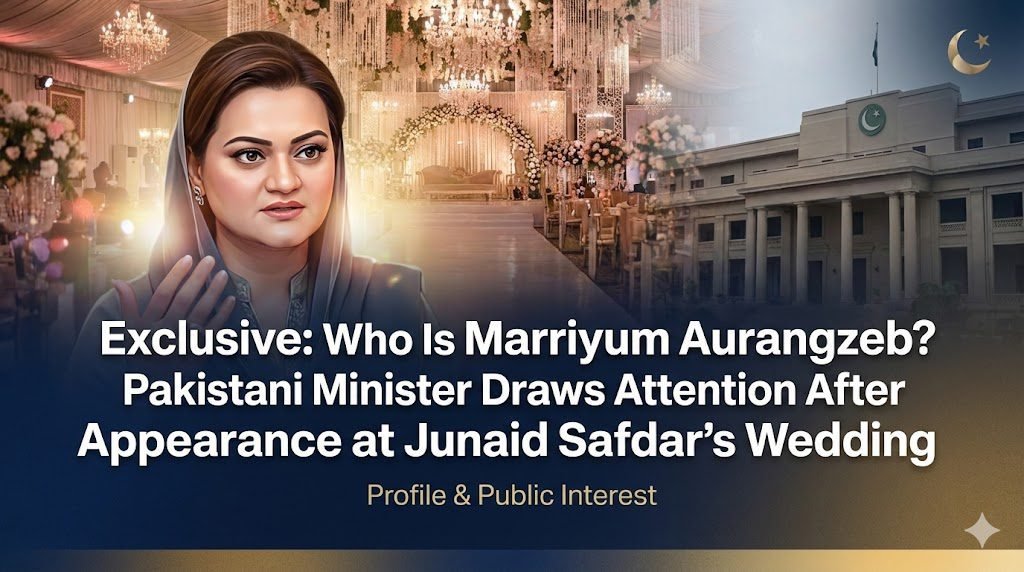
Marriyum Aurangzeb has remained a familiar name in Pakistani politics for years, yet renewed public attention followed her appearance at Junaid Safdar’s wedding, where images and short clips circulated widely across social media platforms. This moment reignited public interest not only in her political career but also in her role within Pakistan’s current governance structure. Beyond viral visuals, the discussion reflects how public figures in Pakistan often re-enter national conversation through social and political intersections.
This article provides a factual, Pakistan-focused profile of Marriyum Aurangzeb, outlining her political background, government roles, public perception, and why her recent appearance sparked fresh interest. The emphasis remains on verified information, political context, and relevance rather than commentary or speculation.
Who Is Marriyum Aurangzeb?
Marriyum Aurangzeb is a senior Pakistani politician affiliated with the Pakistan Muslim League (Nawaz). She has held key federal and provincial positions and is widely recognized for her work in government communication, climate policy, and public representation.
Born in Lahore, she entered politics after a professional career in media and communications. Her background shaped her later role as a government spokesperson, where she became one of the most visible female faces of Pakistan’s political landscape.
Early Career and Entry Into Politics
Before entering active politics, Marriyum Aurangzeb worked in broadcast journalism and media management. This experience helped her develop a strong command over public messaging, which later became a defining feature of her political career.
Her formal political entry came through the Pakistan Muslim League (Nawaz), where she gradually moved from party communications into parliamentary politics. Her rise coincided with an increased emphasis on media engagement within Pakistani political parties.
Parliamentary Journey and Electoral History
Marriyum Aurangzeb has served as a Member of the National Assembly (MNA) and later transitioned into significant roles within provincial governance structures. Her electoral base has remained tied to Lahore, a city that plays a central role in national politics and party organization.
Her parliamentary tenure involved participation in debates related to governance reforms, public service delivery, and policy communication. She has often been assigned responsibilities that required public-facing leadership rather than behind-the-scenes roles.
Role as Federal Minister
One of Marriyum Aurangzeb’s most notable roles was serving as Federal Minister for Information and Broadcasting. In this capacity, she became a central figure during politically charged periods, regularly addressing national media on government positions, opposition narratives, and policy clarifications.
Later, she was appointed Federal Minister for Climate Change, a portfolio that expanded her public role beyond media management into policy advocacy related to environmental risks, climate adaptation, and disaster preparedness.
Climate Change Portfolio and Policy Focus
As Climate Change Minister, Marriyum Aurangzeb worked on issues that directly affect Pakistan, including:
- Flood mitigation and climate resilience
- Coordination with provincial disaster management authorities
- Representation of Pakistan at international climate forums
- Awareness around environmental risks and adaptation strategies
Pakistan’s vulnerability to climate events has made this portfolio increasingly visible, and her role placed her at the intersection of policy, public communication, and international engagement.
Official policy updates and ministry mandates related to climate governance are outlined by the Government of Pakistan’s Climate Change Ministry, which provides public access to regulatory frameworks and national action plans.
Transition to Punjab Government
Following changes in federal administration, Marriyum Aurangzeb assumed responsibilities within the Punjab provincial government, further reinforcing her position as a senior party leader. Her appointment reflected continuity rather than a shift, as she continued working in portfolios aligned with communication, governance coordination, and policy messaging.
Punjab, being Pakistan’s most populous province, amplifies political visibility. Any senior ministerial role within its cabinet naturally carries national relevance.
Why Her Appearance at Junaid Safdar’s Wedding Drew Attention
Junaid Safdar’s wedding attracted attention due to its association with the Sharif political family, whose events often become media focal points. Marriyum Aurangzeb’s presence stood out because:
- She remains a recognizable political figure across party lines
- Her public appearances outside formal settings are relatively limited
- Social media circulation magnified interest beyond traditional news coverage
In Pakistan’s political culture, high-profile weddings often blur the line between private events and public symbolism. Attendance by senior politicians tends to be interpreted through political and social lenses, even when no official statements are involved.
Public Image and Media Presence
Marriyum Aurangzeb is known for a composed and assertive public image. Unlike many politicians who rely heavily on rallies or populist speeches, her visibility has historically come through structured media engagement.
Her communication style is often described as controlled and policy-oriented, which distinguishes her from more confrontational political figures. This approach has earned both support and criticism, depending on political alignment.
Women in Pakistani Politics: Her Broader Significance
Beyond individual roles, Marriyum Aurangzeb represents a broader trend of women occupying visible leadership positions in Pakistani politics. While female political participation still faces structural barriers, figures like her illustrate gradual changes in representation, particularly within major political parties.
Her career demonstrates how media literacy, policy specialization, and consistent party alignment can contribute to sustained political relevance.
Public Interest Beyond Politics
The renewed attention following her appearance at a high-profile wedding reflects how public interest in Pakistan often extends beyond formal governance. Social events, cultural gatherings, and family occasions frequently become extensions of political visibility.
This phenomenon highlights the interconnected nature of social status, political power, and media amplification in Pakistani society.
Why This Moment Matters
The discussion around Marriyum Aurangzeb’s appearance is less about the event itself and more about public memory and recognition. It underscores how political figures remain part of national conversation even when not actively making headlines through policy announcements.
Such moments also reveal how political narratives evolve outside parliamentary sessions, driven by public curiosity and media sharing rather than official discourse.
Conclusion
Marriyum Aurangzeb’s renewed attention following Junaid Safdar’s wedding reflects her established position within Pakistan’s political landscape. Her career spans media, federal governance, climate policy, and provincial leadership, making her a consistent presence in public affairs.
While the event that triggered recent discussion was social rather than political, the reaction highlights how deeply intertwined public life and politics remain in Pakistan. Understanding who Marriyum Aurangzeb is requires looking beyond viral images and toward her sustained role in governance and public communication.
FAQs
Who is Marriyum Aurangzeb?
Marriyum Aurangzeb is a senior Pakistani politician affiliated with the Pakistan Muslim League (Nawaz) and a former federal and provincial minister.
What government roles has she held?
She has served as Federal Minister for Information and Broadcasting and Federal Minister for Climate Change, along with senior roles in the Punjab government.
Why did her appearance at Junaid Safdar’s wedding attract attention?
Her presence drew attention due to her political prominence and the public profile of the Sharif family event, amplified by social media.
Is Marriyum Aurangzeb currently active in politics?
Yes, she remains an active political figure within provincial governance and party leadership structures.
Why is she considered a significant political figure?
Her long-standing media presence, ministerial roles, and policy involvement have kept her relevant in Pakistan’s political landscape.
Disclaimer
This article is published for informational purposes only. The content is based on publicly available information, verified government records, and media reporting available at the time of writing. It does not intend to promote or oppose any political party or individual. Readers are advised to consult official government sources for the most accurate and up-to-date information.