
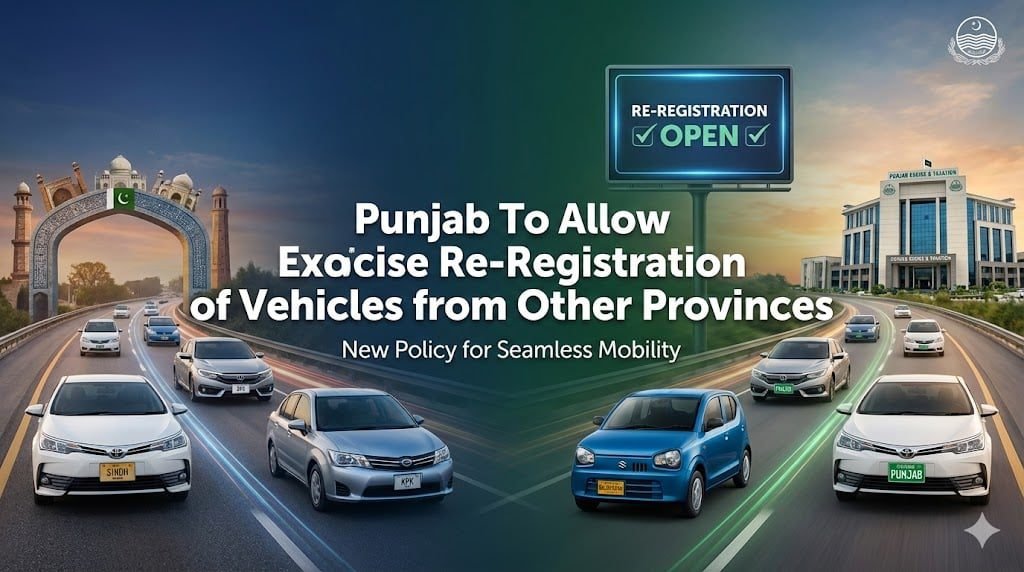
Punjab to allow re-registration of vehicles from other provinces has become a significant policy development for vehicle owners across Pakistan, especially those who have relocated permanently for work, business, or family reasons. For years, inter-provincial vehicle movement created documentation hurdles, duplicate taxation concerns, and enforcement confusion on roads. This proposed change aims to streamline ownership records, improve compliance, and bring uniformity into provincial motor registration systems.
In the first 100 words, it is important to clarify that Punjab to allow re-registration of vehicles from other provinces is a policy move under consideration to simplify the legal transfer and continued use of vehicles originally registered in Sindh, Khyber Pakhtunkhwa, Balochistan, or Islamabad Capital Territory. The policy is particularly relevant for residents of Lahore, Rawalpindi, and Islamabad, where population mobility is high and thousands of vehicles operate daily with non-Punjab number plates.
Background: Why Re-Registration Became a National Issue
Pakistan’s vehicle registration system is provincial by design. Each province issues its own registration numbers, collects motor vehicle tax, and enforces road compliance under its local excise laws. While this structure works for static populations, it creates complications when citizens move across provinces for extended periods.
Over the last decade, Punjab—particularly Rawalpindi and Lahore—has seen a steady influx of professionals, students, and business owners from other provinces. Vehicles registered in Karachi, Peshawar, Quetta, or interior Sindh often remain in Punjab for years without formal re-registration. This situation raised multiple administrative and enforcement challenges.
Traffic authorities struggled to verify ownership details instantly. Excise departments faced revenue leakages. Vehicle owners remained uncertain about legal standing during inspections or resale.
What the New Re-Registration Policy Proposes
Punjab to allow re-registration of vehicles from other provinces means vehicle owners will be permitted to officially transfer their vehicle registration into Punjab while retaining verified ownership records. The proposal focuses on creating a standardized mechanism rather than forcing owners to keep their original registration indefinitely.
Under the expected framework, vehicles already registered with another provincial excise department will be eligible for Punjab registration once ownership, tax history, and vehicle verification are completed. This is not a fresh registration but a conversion process, maintaining the vehicle’s identity while aligning it with Punjab’s motor registry.
Which Vehicles Will Be Eligible
The policy is designed to cover a broad range of privately owned vehicles, including:
Passenger cars
Motorcycles
Commercial vehicles registered for private use
Imported vehicles legally cleared and registered in another province
Government vehicles and special-category registrations may follow separate procedures.
Vehicles involved in theft records, legal disputes, or incomplete documentation will not qualify until issues are resolved.
Key Reasons Punjab Is Moving Toward This Change
Several structural reasons pushed Punjab toward allowing inter-provincial re-registration.
Population Mobility Between Cities
Rawalpindi and Islamabad function as twin cities, with daily vehicle movement between Punjab and ICT. Many residents live in Rawalpindi while working in Islamabad, creating long-term usage of non-Punjab registered vehicles within Punjab territory.
Improved Tax Transparency
Motor vehicle tax is a provincial revenue stream. When a vehicle operates in Punjab for years but pays tax elsewhere, enforcement and revenue alignment become inconsistent. Re-registration allows taxation to match actual vehicle usage.
Law Enforcement and Verification
Punjab traffic police rely on instant database checks. Vehicles registered in other provinces often require manual verification, causing delays and disputes during routine checks. A unified Punjab registry improves response time and accuracy.
Ease in Ownership Transfer
Selling a vehicle registered in another province within Punjab currently involves extra steps, including inter-provincial NOCs and verification delays. Re-registration simplifies resale within Punjab’s used car market.
Expected Documentation Requirements
While final rules will be issued through formal notification, expected documentation may include:
Original registration book or smart card
CNIC of the registered owner
Proof of Punjab residence (utility bill or rental agreement)
Vehicle physical inspection report
Tax clearance certificate from original province
No objection certificate if required
The process is likely to be digitized through Punjab’s excise portals to reduce manual delays.
Impact on Vehicle Owners in Punjab
For vehicle owners residing long-term in Punjab, this policy brings clarity and legal confidence.
Owners will no longer face uncertainty during traffic stops. Insurance renewals and claims processing may also become smoother when vehicle location and registration align. Additionally, resale within Punjab’s market becomes straightforward without involving inter-provincial paperwork.
This change is particularly relevant for families and professionals who relocated years ago but continued driving vehicles registered elsewhere.
Implications for Rawalpindi and Lahore
Rawalpindi stands to benefit significantly due to its proximity to Islamabad and high inflow of vehicles from Khyber Pakhtunkhwa and northern regions. Lahore, being Punjab’s economic center, hosts a large number of vehicles owned by non-native residents working in corporate, education, and industrial sectors.
Allowing re-registration reduces administrative friction in both cities and improves overall road compliance.
How This Affects Intercity and Long-Distance Travel
Vehicles frequently used for intercity travel between Islamabad, Lahore, Faisalabad, and other urban centers often remain stationed in Punjab for extended periods. For individuals who prefer using private vehicles instead of public transport, having a Punjab registration ensures consistent enforcement standards across routes.
For those who occasionally rely on professional travel services or rent a car in Islamabad, the policy indirectly improves market clarity by reducing confusion around documentation and vehicle legality on highways.
Link With Car Rental and Long-Term Mobility Trends
The growing demand for structured vehicle ownership also affects mobility services. Individuals who move cities temporarily may choose rentals over ownership, while permanent movers prefer re-registration.
For residents transitioning into Punjab, options like long-term travel arrangements or vehicle leasing supported by services available on the Al Farooq Rent a Car homepage provide interim solutions until personal vehicle documentation is finalized.
Expected Timeline and Legal Status
Punjab to allow re-registration of vehicles from other provinces is expected to be implemented after issuance of formal rules through provincial notification. Once notified, excise departments across Punjab will begin accepting applications.
Vehicle owners should wait for official implementation before initiating any unofficial transfers to avoid fraud or incomplete processing.
For authoritative updates on vehicle registration laws, citizens can refer to official notifications from the Punjab Excise and Taxation Department website.
Challenges That May Arise During Implementation
Despite its benefits, the policy may face transitional challenges.
Data synchronization between provinces must be accurate to avoid duplicate records. Staff training and system integration will be critical during early stages. There may also be an initial backlog as thousands of vehicle owners apply simultaneously.
Clear public communication will be essential to prevent misinformation and exploitation by agents.
Long-Term Benefits for Pakistan’s Transport System
This move reflects a gradual shift toward harmonized mobility governance in Pakistan. While provinces retain autonomy, interoperability between registries improves efficiency.
In the long run, standardized inter-provincial vehicle management can pave the way for national-level verification systems, benefiting law enforcement, insurers, and consumers alike.
FAQs
What does Punjab to allow re-registration of vehicles from other provinces mean?
It means vehicle owners can convert their vehicle’s registration from another province into Punjab if they reside there long-term and meet documentation requirements.
Will old number plates be replaced with Punjab plates?
Yes, after successful re-registration, vehicles are expected to receive Punjab registration numbers.
Is re-registration mandatory for everyone?
It is likely optional but recommended for owners permanently residing in Punjab to avoid future complications.
Will taxes need to be paid again?
Any unpaid or differential tax may apply based on Punjab’s motor tax structure, subject to final rules.
Does this apply to Islamabad-registered vehicles?
Islamabad vehicles are also expected to be eligible, given the close integration between Rawalpindi and ICT traffic systems.
Disclaimer
This article is for general informational purposes only. Policy details, procedures, eligibility, and tax requirements may change after official notifications by the Government of Punjab. Readers are advised to verify information directly from official government sources before making any legal or financial decisions related to vehicle re-registration.