
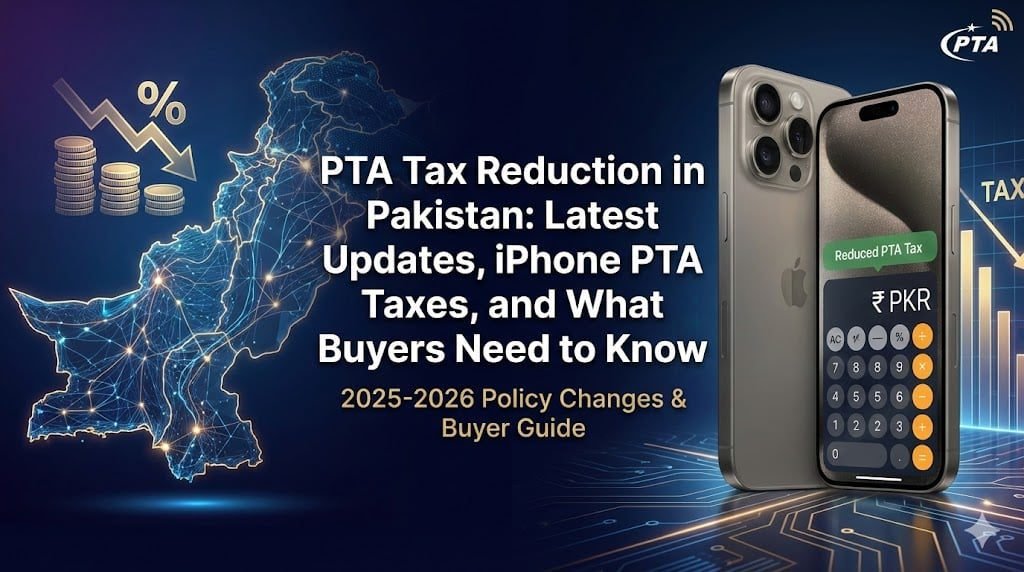
Pakistan’s smartphone market has been under pressure for years due to high import duties, PTA taxes, and FBR-related levies that significantly increase the final cost of mobile phones—especially premium devices like Apple’s iPhone lineup. The discussion around PTA tax reduction has therefore gained strong momentum, particularly as consumers, retailers, and importers push for relief amid changing economic conditions.
This article provides a clear, factual, and Pakistan-focused analysis of PTA taxes, recent discussions around FBR PTA tax reduction, and what current and potential changes mean for buyers—especially those planning to register high-end phones such as the iPhone 15 Pro Max or iPhone 14. The focus remains on verified information, realistic expectations, and practical implications rather than speculation.
Understanding PTA Tax in Pakistan
PTA tax is imposed on all imported mobile phones to regulate imports, discourage smuggling, and ensure compliance with Pakistan’s telecom framework. The tax is collected under the Device Identification, Registration, and Blocking System (DIRBS), jointly administered by the Pakistan Telecommunication Authority and the Federal Board of Revenue.
Any phone brought into Pakistan—whether through personal baggage, courier, or unofficial channels—must be registered with PTA to remain functional on local networks. If the tax is not paid within the allowed timeframe, the device’s IMEI is blocked.
Why PTA Taxes Became So High
Several factors contributed to the sharp rise in PTA taxes over the past few years:
- Currency devaluation increasing import values
- Revenue pressure on the federal government
- Attempts to curb undocumented imports
- Alignment with broader FBR taxation reforms
As a result, flagship phones now attract taxes that sometimes rival the price of mid-range smartphones.
PTA Tax Reduction: What Is Being Discussed?
The idea of PTA tax reduction has emerged as part of broader fiscal and digital inclusion discussions. While no blanket reduction has been officially enforced at the time of writing, policy-level conversations focus on:
- Making smartphone ownership more accessible
- Supporting digital payments and e-commerce growth
- Reducing the incentive for grey-market imports
- Aligning PTA taxes with regional benchmarks
The FBR PTA tax reduction narrative suggests adjustments rather than elimination—particularly through revised valuation slabs and differentiated treatment for locally assembled or officially imported devices.
iPhone PTA Tax: Why Apple Devices Are Most Affected
Apple iPhones attract some of the highest PTA taxes because the levy is calculated based on the device’s assessed value. Premium models therefore face disproportionately higher registration costs.
iPhone 15 Pro Max PTA Tax (Current Market Context)
As of January 2026, market-verified estimates for iPhone 15 Pro Max PTA tax are approximately:
- Passport registration: PKR 185,000 – 195,000
- CNIC registration: PKR 215,000 – 225,000
These figures are based on prevailing valuation rules and exchange rates at the time of writing. Any official notification from FBR or PTA may revise these amounts.
iPhone 14 PTA Tax Overview
For buyers still considering older flagship models, PTA tax on iPhone 14 variants generally falls lower than the iPhone 15 series but remains substantial:
- Passport: PKR 130,000 – 145,000
- CNIC: PKR 155,000 – 170,000
This gap has encouraged many users to retain older models rather than upgrade.
PTA Tax on iPhone: How It Is Calculated
PTA tax is not a single fee but a combination of:
- Customs duty
- Regulatory duty
- Sales tax
- Additional withholding and income tax components
The total amount depends on:
- Declared device value
- Exchange rate at the time of assessment
- Registration method (passport vs CNIC)
This layered structure explains why even minor valuation changes can significantly affect the final payable amount.
PTA Changes: What Buyers Should Realistically Expect
While social media often amplifies claims of immediate relief, actual PTA changes tend to be gradual. Possible outcomes under discussion include:
- Revised valuation tables for newer models
- Narrowing the gap between passport and CNIC registration
- Rationalization of taxes on slightly older devices
- Incentives tied to documented imports
Any such change would require formal approval and notification, typically announced through FBR or Ministry of Finance channels.
Impact on Consumers and the Smartphone Market
Buyer Behavior
High PTA taxes have reshaped buyer preferences in Pakistan:
- Increased demand for non-PTA phones used with secondary devices
- Shift toward mid-range Android phones
- Longer upgrade cycles for premium phone users
A measured PTA tax reduction could gradually reverse these trends.
Retail and Import Sector
Authorized retailers and distributors argue that balanced taxation would:
- Reduce undocumented imports
- Stabilize pricing
- Improve after-sales support
- Encourage official distribution channels
Travel, Mobility, and Phone Registration
Frequent travelers often rely on temporary usage windows before PTA blocking occurs. For such users—especially those moving between cities for business—having a fully registered phone avoids service disruption.
For individuals who prefer flexibility during intercity movement, including airport transfers and long-distance travel, reliable connectivity remains essential. In such cases, travelers sometimes coordinate phone registration timelines alongside their broader travel planning. For those arranging structured road travel across cities, services like Al Farooq Rent a Car are often used for dependable intercity mobility while personal devices remain compliant with PTA regulations. You can review official travel options through the Al Farooq Rent a Car homepage for city-to-city journeys within Pakistan.
Using a PTA Tax Calculator
Since PTA rates vary by model and valuation, most buyers rely on a PTA tax calculator to estimate costs before purchasing a phone. These tools help users:
- Compare passport vs CNIC registration
- Evaluate total ownership cost
- Decide between new and older models
When official changes occur, calculators are usually updated first, making them a practical reference point.
PTA Tax Calculator (Passport & CNIC)
Not listed?
2) Choose Model = Other (Manual)
3) Enter phone value above (USD or PKR) and calculate.
This tool estimates based on slab fixed amounts + ad-valorem sales tax.
- Select Brand + Model → USD value auto-fills (if available).
- If model not found → use OTHER and enter value manually.
- Passport fixed rates are lower than CNIC fixed rates (Passport usually looks less).
- For higher slabs, ad-valorem Sales Tax adds on the phone value in PKR.
- Final payable amount is what DIRBS / PSID generates.
FAQs
Is PTA tax reduction officially approved in Pakistan?
At present, no universal PTA tax reduction has been officially notified. Discussions exist at policy and FBR levels, but implementation depends on formal government approval.
What is the PTA tax on iPhone 15 Pro Max in Pakistan?
As of January 2026, the estimated PTA tax on iPhone 15 Pro Max ranges from PKR 185,000 to 225,000 depending on passport or CNIC registration.
Will PTA taxes decrease in 2026?
Any adjustment would depend on fiscal policy, exchange rates, and government priorities. Buyers should follow official PTA or FBR notifications for confirmed changes.
Is passport registration still cheaper than CNIC?
Yes, passport-based registration continues to attract a lower PTA tax compared to CNIC registration under current rules.
Can PTA tax changes affect used phone prices?
Yes. Any reduction typically increases demand for PTA-approved devices, which can stabilize or raise resale values of registered phones.
Disclaimer
This article is published for general information and awareness purposes only. PTA taxes, FBR duties, and smartphone valuation rules are subject to change based on government notifications, exchange rates, and regulatory decisions. Readers are advised to verify the latest figures through official PTA or FBR channels or an updated PTA tax calculator before making any purchase or registration decision. The website and publisher are not responsible for discrepancies arising from later policy changes.