

Quick Answer
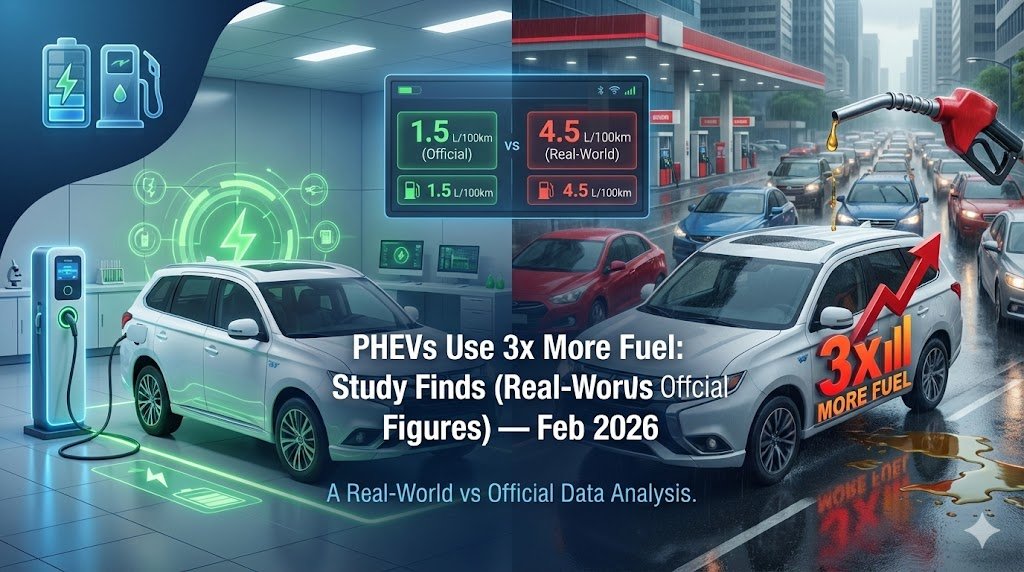
A 2026 analysis based on real-world monitoring data from around one million PHEVs (2021–2023 registrations) found that average real-world fuel consumption is about 5.9 L/100 km, roughly 300% higher than the lab/type-approval values many buyers see in brochures. The biggest reason is that the electric driving share is only about a quarter (around 27–31%), and the combustion engine is used much more than people assume, including in “battery” driving modes.
For car rental customers and fleet owners in Pakistan, the main takeaway is simple: a PHEV only behaves like a low-fuel car when it is charged consistently and driven in the right pattern. If charging is irregular, the PHEV can end up consuming fuel closer to a regular petrol car than expected.
Updated: February 25, 2026
Why this matters for Al Farooq Rent a Car customers
At Al Farooq Rent a Car, most bookings fall into real-world driving patterns where the “lab numbers” don’t matter much:
- Islamabad and Rawalpindi daily travel with traffic stops and short trips
- Airport pickup/drop (Islamabad Airport) with time pressure and luggage load
- City-to-city routes (Islamabad to Lahore, Islamabad to Faisalabad) with higher speeds and long stretches
- Family travel where comfort and AC use are consistent
If a PHEV is being considered for rentals (or a customer is choosing between a PHEV, conventional hybrid, and petrol car), the study’s numbers help set realistic expectations about fuel cost and range behavior in the real world.
What the study measured (real-world, not lab)
The report uses real-world fuel/energy monitoring data (OBFCM-style dataset context) for a very large sample of PHEVs and compares actual fuel consumption to type-approval values. It highlights a major gap between “official” fuel consumption and what happens in daily use.
The core point: PHEVs are highly sensitive to driver behavior and charging frequency, and many drivers do not charge enough (or drive in a way that forces engine assistance), so real-world fuel use rises dramatically.
The headline numbers in plain language
These are the figures that matter most for decision-making:
| Metric (from the report) | Real-world finding | What it means in daily driving |
|---|---|---|
| Average real-world fuel consumption | 5.9 L/100 km | Many PHEVs do not stay in “ultra-low fuel” territory |
| Gap vs type-approval fuel consumption | ~300% higher | The “3x more fuel” headline reflects the size of the mismatch |
| Electric driving share (distance/energy) | ~27–31% | A lot of driving still happens with the engine involved |
| Fuel use in charge-depleting (CD) mode | ~2.8 L/100 km | Even when “battery is being used,” fuel can still be consumed |
| Fuel use in charge-sustaining (CS) mode | ~7.4 L/100 km | Once it behaves like a petrol car, consumption can look normal |
Why PHEVs often use more fuel than expected
This is not a “PHEVs are useless” argument. It’s a usage reality.
1) The engine still turns on in situations many people don’t expect
Even in charge-depleting driving, the combustion engine may engage due to power demand, speed, temperature, battery management, or acceleration. The report emphasizes that engines are not consistently “fully off,” which pushes fuel consumption up.
2) Charging discipline is the difference between “hybrid” and “plug-in hybrid”
A PHEV is only a plug-in hybrid in practice when it is plugged in regularly. If the vehicle is driven for days without charging, it becomes a heavier hybrid that often runs the engine more. That is one reason real-world averages drift upward.
3) Long routes reduce the benefit quickly
For city-to-city travel, the trip distance can exceed the effective EV-heavy portion, pushing the vehicle into charge-sustaining behavior. The report’s higher CS-mode average illustrates why long routes can look similar to conventional fuel consumption.
What this means for rentals in Pakistan (Islamabad, Rawalpindi, intercity)
Pakistan’s rental use cases can amplify the real-world gap because rentals are rarely driven like a “perfect PHEV owner” scenario. Common rental realities:
- Drivers may not have predictable access to charging
- Trips are time-bound (airport transfers, meetings, weddings)
- AC use is steady, especially in warmer months
- Some routes include high-speed segments (Motorway, Expressway)
For a customer booking a car with driver, the question is not “what the brochure says.” It’s:
- Will the vehicle be charged enough for my trip pattern?
- Will my route keep the car in EV-heavy operation?
- What’s the most reliable fuel-cost expectation for my booking?
A decision table for customers choosing between PHEV, hybrid, petrol for rentals
Use this as a practical selection guide.
| Your travel pattern | PHEV outcome (likely) | Better pick for rentals (often) |
|---|---|---|
| Short city rides + guaranteed charging between trips | Lower fuel possible (if charging is consistent) | PHEV can make sense |
| Short city rides but charging uncertain | Engine runs more than expected | Conventional hybrid (HEV) or petrol |
| Airport transfer + mixed speed + luggage | EV share may be limited; engine assistance common | Hybrid/efficient petrol |
| Islamabad to Lahore / Faisalabad (one-way) | CS mode dominates; fuel looks “normal” | Hybrid (HEV) or efficient petrol |
| Family travel with multiple stops, AC always on | EV share depends on charging discipline | Hybrid often simplest |
Quick guidance for Al Farooq fleet planning (practical, not theoretical)
If you’re thinking from a fleet/operator side, the study points to a strong idea: PHEVs reward controlled operations.
PHEVs perform closer to expectations when:
- The operator can enforce charging routines
- The routes are predictable (scheduled daily runs)
- Vehicles return to a base where charging is available
PHEVs perform poorly (fuel-wise) when:
- Cars stay on the road all day with no charging
- Long intercity trips dominate
- Drivers treat it like a petrol car and never plug in
That’s why many rental operations globally lean toward conventional hybrids for simplicity, and use PHEVs selectively where charging control exists.
Real-life scenarios (Pakistan rental context)
Scenario 1: Islamabad city meetings + hotel pickup/drop
A customer books a car with driver for multiple short trips around Islamabad. If the vehicle is charged overnight and returns to a charger during long idle times, EV-heavy driving can increase, improving fuel outcome. If charging is not available, the vehicle behaves closer to normal hybrid/petrol.
Scenario 2: Islamabad Airport pickup then Rawalpindi then back to Islamabad
This pattern includes mixed speeds, waiting time, AC usage, and luggage load. The vehicle may use the engine more than expected because the “easy electric” share can drop in real conditions.
Scenario 3: Islamabad to Lahore rent a car (one-way)
For long routes, the trip typically exceeds the EV-heavy portion and shifts to charge-sustaining behavior. The report’s CS-mode average (~7.4 L/100 km) explains why fuel costs may not match brochure expectations on long-distance travel.
What to ask before renting a PHEV (so expectations stay realistic)
If you specifically want a PHEV for fuel savings, ask these questions up front:
- Will the vehicle be fully charged at pickup time?
- Is there a charging option during the booking (hotel, office, home)?
- What portion of my route is city vs motorway?
- If charging is not possible, should I book a hybrid instead?
This avoids the common misunderstanding where a customer assumes “plug-in hybrid” automatically means “mostly electric.”
FAQs
1) Do PHEVs really use 3x more fuel than advertised?
In this large real-world dataset, the average real-world consumption is about 5.9 L/100 km, roughly 300% above type-approval consumption values, which is where the “3x” statement comes from.
2) Why does a PHEV still consume fuel when the battery is not empty?
The report indicates that engines are not consistently fully off and can engage even in charge-depleting operation, which is why fuel is still used (average ~2.8 L/100 km in CD mode in the dataset).
3) Is a PHEV a good choice for Islamabad to Lahore rent a car?
For long routes, the PHEV often operates in charge-sustaining mode for a significant portion, and the dataset shows CS-mode fuel use around 7.4 L/100 km, which can look similar to regular fuel use.
For rentals, a conventional hybrid is often the simpler and more predictable option for intercity.
4) Is a conventional hybrid better than a PHEV for rent a car with driver?
For many rental patterns where charging cannot be guaranteed, a conventional hybrid can deliver more consistent fuel economy because it does not depend on plugging in. The report’s findings highlight how charging and usage behavior drive the PHEV gap.
5) What’s the safest way to plan fuel cost for a PHEV booking?
Plan based on your real route and charging access, not brochure numbers. If charging is uncertain, expect fuel use closer to typical hybrid/petrol behavior rather than “ultra-low” lab figures.
Disclaimer
This article summarizes findings from a large European real-world dataset. Real-world fuel use varies by model, route mix, charging access, traffic, temperature, and driving style. For rentals in Pakistan, treat PHEVs as charging-dependent vehicles and confirm route suitability before selecting a vehicle type.