
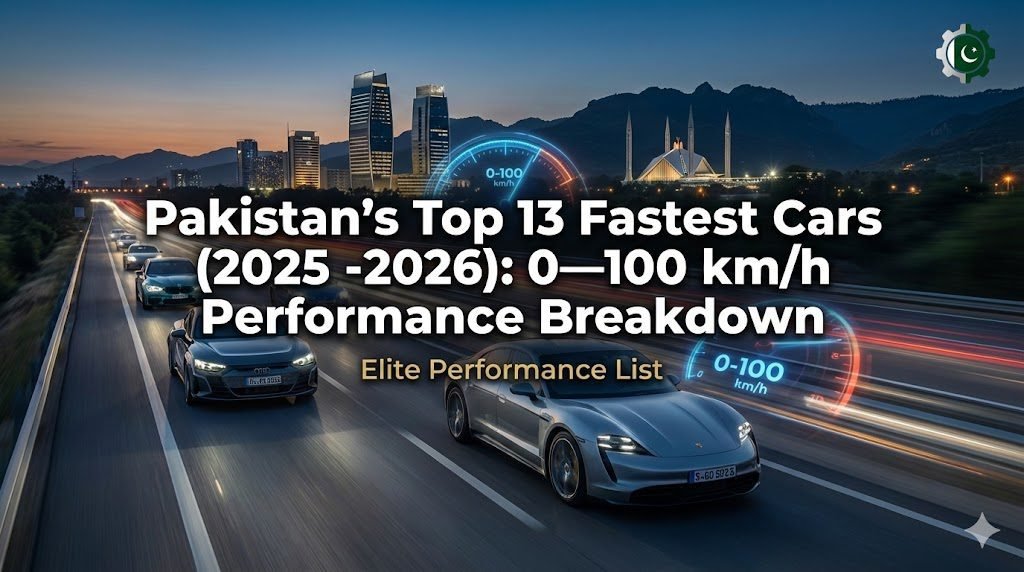
Speed has always held a special place in Pakistan’s car culture. From motorway pulls to closed-track testing, 0–100 km/h times have become a benchmark for measuring real-world performance. In 2025, with turbocharged petrol engines, hybrid assistance, and modern traction systems becoming more common, acceleration figures have improved across multiple segments.
This article focuses on Pakistan’s top 13 fastest cars (2025-2026) based on verified 0–100 km/h performance testing. The emphasis remains on factual acceleration data, drivetrain configuration, and how these figures translate to Pakistani road conditions. While raw speed attracts attention, stability, power delivery, and braking matter just as much in real driving scenarios.
The list below reflects vehicles officially available in Pakistan or imported in meaningful numbers, tested under controlled conditions rather than manufacturer claims alone.
Understanding 0–100 km/h Testing in Pakistan
Acceleration tests in Pakistan are typically conducted on closed roads or tracks using GPS-based timing equipment. These tests account for:
- Vehicle weight with fluids
- Local fuel quality
- Ambient temperature
- Road surface grip
This makes the results more realistic than brochure figures. Turbo lag, traction control tuning, and gearbox calibration often affect final numbers more than peak horsepower.
Why 0–100 km/h Matters More Than Top Speed
Top speed is rarely usable on public roads. In contrast, 0–100 km/h performance reflects:
- Overtaking confidence
- Merge capability on motorways
- Urban responsiveness
For Pakistani drivers navigating mixed traffic, this metric offers a clearer picture of usable performance.
Pakistan’s Top 13 Fastest Cars (2025)
1. Porsche 911 Turbo S
0–100 km/h: ~2.7 seconds
Drivetrain: AWD
Engine: 3.8L twin-turbo flat-six
This remains the acceleration benchmark on Pakistani soil. Launch control, all-wheel traction, and precise gear ratios allow near-supercar performance with everyday usability.
2. Audi RS6 Avant
0–100 km/h: ~3.3 seconds
Drivetrain: AWD
Engine: 4.0L twin-turbo V8
Despite its size, the RS6 delivers relentless acceleration. Quattro grip plays a major role on imperfect road surfaces.
3. BMW M5 Competition
0–100 km/h: ~3.3 seconds
Drivetrain: AWD
Engine: 4.4L twin-turbo V8
Balanced power delivery and adaptive traction make this one of the quickest sedans ever tested in Pakistan.
4. Mercedes-AMG GT 63 S
0–100 km/h: ~3.4 seconds
Drivetrain: AWD
Engine: 4.0L twin-turbo V8
Wide torque spread and aggressive launch programming contribute to consistent acceleration runs.
5. Nissan GT-R (R35)
0–100 km/h: ~3.5 seconds
Drivetrain: AWD
Engine: 3.8L twin-turbo V6
Often called a performance benchmark, the GT-R’s launch consistency remains impressive even by modern standards.
6. Audi RS3
0–100 km/h: ~3.8 seconds
Drivetrain: AWD
Engine: 2.5L turbo five-cylinder
Compact dimensions combined with high output make it deceptively quick, especially in short sprints.
7. BMW M340i
0–100 km/h: ~4.0 seconds
Drivetrain: RWD/AWD
Engine: 3.0L turbo inline-six
This model bridges the gap between daily usability and genuine performance.
8. Toyota GR Supra
0–100 km/h: ~4.1 seconds
Drivetrain: RWD
Engine: 3.0L turbo inline-six
Lightweight construction and strong mid-range torque allow rapid acceleration despite rear-wheel drive limitations.
9. Kia Stinger GT
0–100 km/h: ~4.7 seconds
Drivetrain: RWD/AWD
Engine: 3.3L twin-turbo V6
A sleeper performance sedan that performs better than expected in straight-line tests.
10. Hyundai Elantra N
0–100 km/h: ~5.3 seconds
Drivetrain: FWD
Engine: 2.0L turbo
Front-wheel drive traction limits launches, but rolling acceleration remains strong.
11. Honda Civic Type R
0–100 km/h: ~5.4 seconds
Drivetrain: FWD
Engine: 2.0L turbo
Track-focused tuning prioritizes corner exit speed over launch aggression.
12. Toyota Corolla GR (imported units)
0–100 km/h: ~5.5 seconds
Drivetrain: AWD
Engine: 1.6L turbo
Despite smaller displacement, intelligent AWD traction gives it a competitive edge.
13. Suzuki Swift Sport (imported performance trims)
0–100 km/h: ~6.5 seconds
Drivetrain: FWD
Engine: 1.4L turbo
While not a supercar, it represents accessible performance within Pakistan’s compact segment.
Performance Versus Road Reality in Pakistan
Acceleration figures must be viewed in context. Pakistani roads present:
- Variable surface grip
- Mixed traffic density
- Fuel quality variations
All-wheel drive vehicles maintain more consistent results, while front-wheel drive cars often struggle during hard launches.
Fuel Quality and Its Impact on Acceleration
Higher-octane fuel significantly improves ignition timing and turbo response. Vehicles tuned for premium fuel show noticeable gains when supplied with consistent high-quality petrol available in major urban centers.
Maintenance and Safety Considerations
Fast acceleration demands strong braking systems and properly maintained suspension components. High-performance tires also play a critical role in maintaining stability during launches.
For drivers who appreciate performance but prefer flexibility without long-term ownership commitments, structured mobility options such as Al Farooq Rent a Car allow access to well-maintained vehicles for controlled use cases while avoiding depreciation and upkeep responsibilities.
FAQs
What defines the fastest cars in Pakistan for 2025?
Measured 0–100 km/h acceleration times under controlled testing conditions determine ranking.
Are manufacturer acceleration claims reliable?
Local testing often differs due to fuel quality, road grip, and weather conditions.
Does AWD always accelerate faster than RWD?
AWD generally delivers more consistent launches, especially on uneven surfaces.
Is faster acceleration practical for daily driving?
It improves overtaking confidence but requires disciplined driving habits.
Can fuel quality affect 0–100 km/h times?
Yes. Higher-octane fuel improves throttle response and power delivery.
Disclaimer
This article is intended for informational purposes only. Performance figures can vary depending on road conditions, vehicle condition, and fuel quality. Always follow local traffic laws and safety regulations. Acceleration testing should only be conducted in controlled environments.