
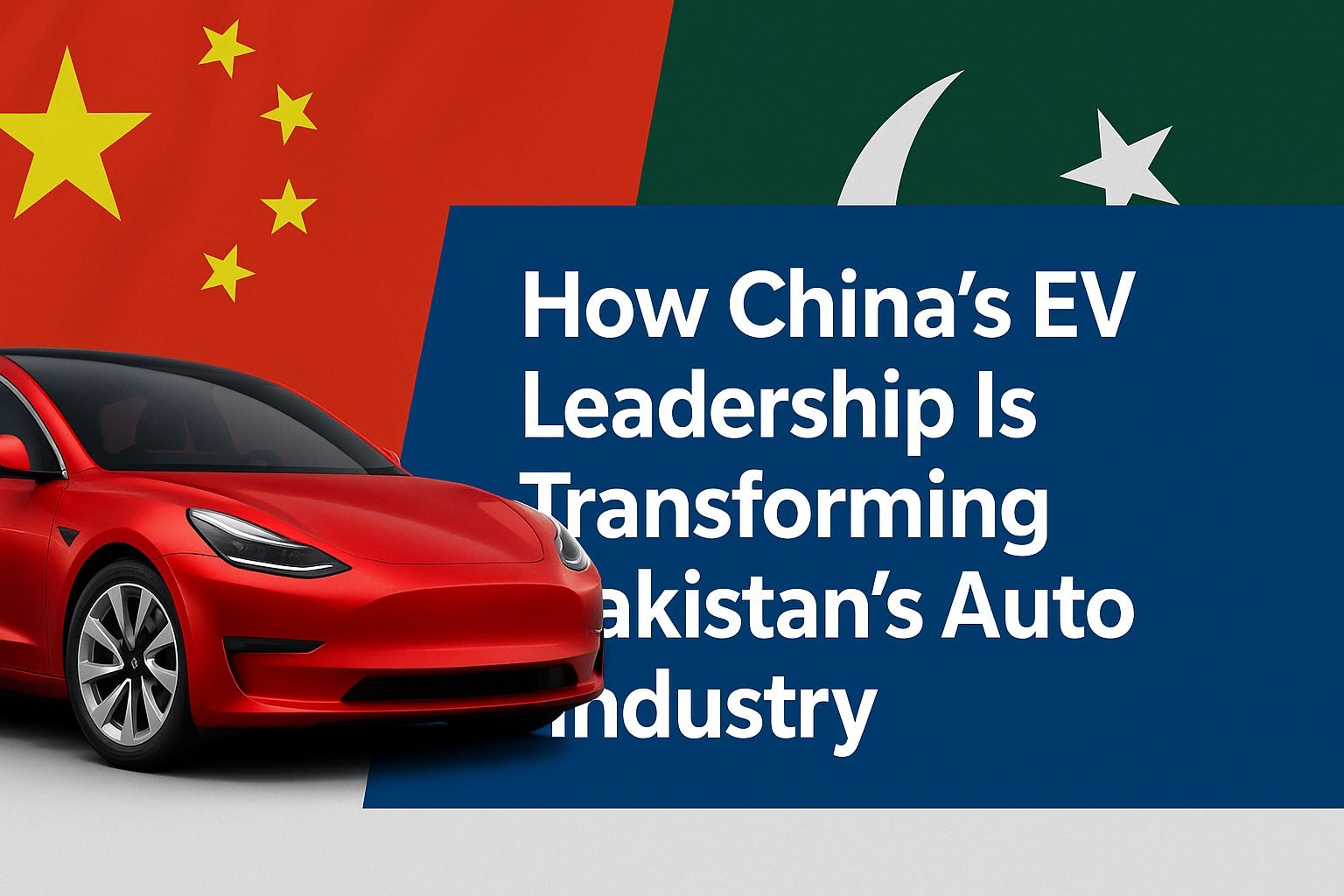
China has reclaimed its position as the world’s largest automotive market while solidifying its role as a global force in electric vehicles (EVs) and advanced automotive technology. The latest Roland Berger 14th Automotive Disruption Radar places China in a commanding lead with 87 points out of 130, ahead of South Korea (83) and the Netherlands (78).
This shift isn’t only reshaping global automotive strategies; it is directly influencing Pakistan’s auto sector. With strong bilateral cooperation and ongoing China-Pakistan Economic Corridor (CPEC) projects, Pakistan is emerging as a new frontier for Chinese EV innovation, investments, and manufacturing expansion.
China’s Rise in EV and Technology Leadership
China’s leadership position is grounded in an aggressive electrification policy, rapid product development cycles, and deep integration of digital technologies.
Global Performance Indicators
| Metric | China | Europe |
|---|---|---|
| Battery EV Share of Sales | 25% | 12% (flat) |
| Consumer Readiness | 95% would consider EVs | – |
| OEM Development Cycle | 24–40 months | 48–60 months |
What Drives This Lead
- High-efficiency development cycles that significantly outperform European automakers
- Extensive charging infrastructure, enabling rapid adoption
- Advanced AI-based ADAS systems, a core component of Chinese EV technology
- Battery innovations supported by global leaders like CATL
China’s automotive industry is operating with speed, scale, and technological depth unmatched in the current global market.
How China’s EV Momentum Is Re-shaping Pakistan’s Auto Industry
Pakistan, long dependent on older internal combustion engine imports, is now integrating more modern vehicle technologies due to Chinese market dominance and supportive bilateral frameworks.
CPEC as a Strategic Catalyst
Through CPEC and related strategic partnerships:
- Chinese automakers gain a stable entry point into Pakistan
- Pakistan accesses advanced EV platforms and manufacturing knowledge
- Local industry shifts from low-tech assembly to modernized mobility solutions
This is accelerating Pakistan’s EV transition faster than domestic policy alone could achieve.
Major Chinese Players Driving Change in Pakistan
Chinese automotive brands are reshaping market competition by expanding local assembly, introducing EVs, and directly challenging Japanese manufacturers that have dominated Pakistan for decades.
Key Automakers and Their Local Footprint
Changan Automobile
A leading performer with fast-growing market share, expanding both combustion and EV portfolios.
MG (SAIC Motor)
Introducing multiple EVs and hybrids, increasing Pakistan’s exposure to modern platforms.
Chery and JAC Motors
Strengthening their presence through SUVs, crossovers, and commercial vehicles.
FAW
Previously laid groundwork for China-Pakistan automotive collaboration.
BYD’s Ambitious Arrival
BYD, the world’s largest EV manufacturer, is finalizing a joint venture in Pakistan with plans to:
- Establish an assembly plant
- Introduce at least three fully electric models by 2026
- Target the mid-to-premium EV segment
This marks one of the most significant potential shifts in Pakistan’s automotive landscape.
GWM and Sazgar: Targeted EV and Hybrid Expansion
Great Wall Motors (GWM), in partnership with Sazgar Engineering, is introducing EVs such as the:
- ORA 3
- Additional hybrid and electric options under evaluation
Sazgar continues to expand its assembly footprint, demonstrating deepening Chinese investment in Pakistan’s automotive manufacturing capabilities.
The Rapid Rise of Chinese Electric Two-Wheelers
One of the fastest-growing segments is the low-cost urban mobility market, dominated by electric scooters and lightweight EVs.
Why This Segment Is Growing Fast
- High fuel prices
- Cheap maintenance
- Swappable battery systems
- Urban congestion
Brands such as Yadea and Road Prince are leading this growth.
According to Development Policy Advisor Zubair Faisal Abbasi, the government has issued 55 out of 57 new manufacturing licenses for electric two-wheelers—an unprecedented expansion that reflects market confidence.
Strategic Investment and Infrastructure Development
China’s role in Pakistan’s EV sector goes beyond product launches. It includes multi-layered investment in infrastructure, supply chains, and ecosystem building.
Key Components of Chinese Investment
Foreign Direct Investment (FDI)
Over $340 million committed for EV plants, charging stations, and battery-related infrastructure.
Policy Alignment With Pakistan’s NEV Vision
China’s investment supports Pakistan’s goal of 30% electric vehicle sales by 2030, offering a pathway toward sustainable mobility.
Export Hub Potential
Pakistan is being positioned as a potential manufacturing and export base for right-hand-drive EVs destined for:
- Sri Lanka
- Bangladesh
- Middle Eastern markets
This could reshape Pakistan’s role in the regional automotive supply chain.
Market Impact on Japanese Auto Dominance
China’s rapid expansion poses a direct challenge to long-standing Japanese players.
Key Areas of Disruption
- Price competitiveness
- More features at the same price point
- Faster product cycles
- Local assembly advantages
- Strong EV technology ecosystems
While Japanese brands have relied on legacy combustion platforms, Chinese manufacturers are entering with modern EV architectures and aggressive pricing strategies.
Implications for Pakistani Consumers
Immediate Effects
- More modern EV and hybrid options
- Competitive prices due to localization
- Better feature sets and safety technology
- Increased availability of compact EV solutions
Long-Term Benefits
- Stronger local supply chains
- Improved charging infrastructure
- Potential export-driven job creation
- Greater consumer access to global automotive technology
The shift ultimately supports a more modern, diversified automotive market.
Practical Mobility Note for Local Readers
For residents of Rawalpindi and Islamabad needing reliable travel while infrastructure upgrades and EV-related disruptions take place, a consistent transport solution is available: Al Farooq Rent a Car
External Authoritative Source
Government EV policy framework (Ministry of Climate Change):
https://mocc.gov.pk/
FAQs
Why is China leading the global EV market?
China’s leadership is driven by rapid electrification policies, large-scale battery production, AI-integrated safety systems, and a highly efficient automotive development ecosystem.
How does China’s EV dominance affect Pakistan?
It accelerates Pakistan’s EV adoption, increases local assembly opportunities, and introduces advanced vehicle technology at competitive prices.
Which Chinese brands are investing in Pakistan?
Key brands include Changan, MG, JAC, Chery, GWM (Sazgar), and BYD.
Will Pakistan benefit from EV manufacturing?
Yes. It can gain new jobs, export potential, and better access to modern automotive platforms.
Why are Chinese scooters growing rapidly in Pakistan?
They offer low operating costs, swappable batteries, and ease of use for congested urban travel.