

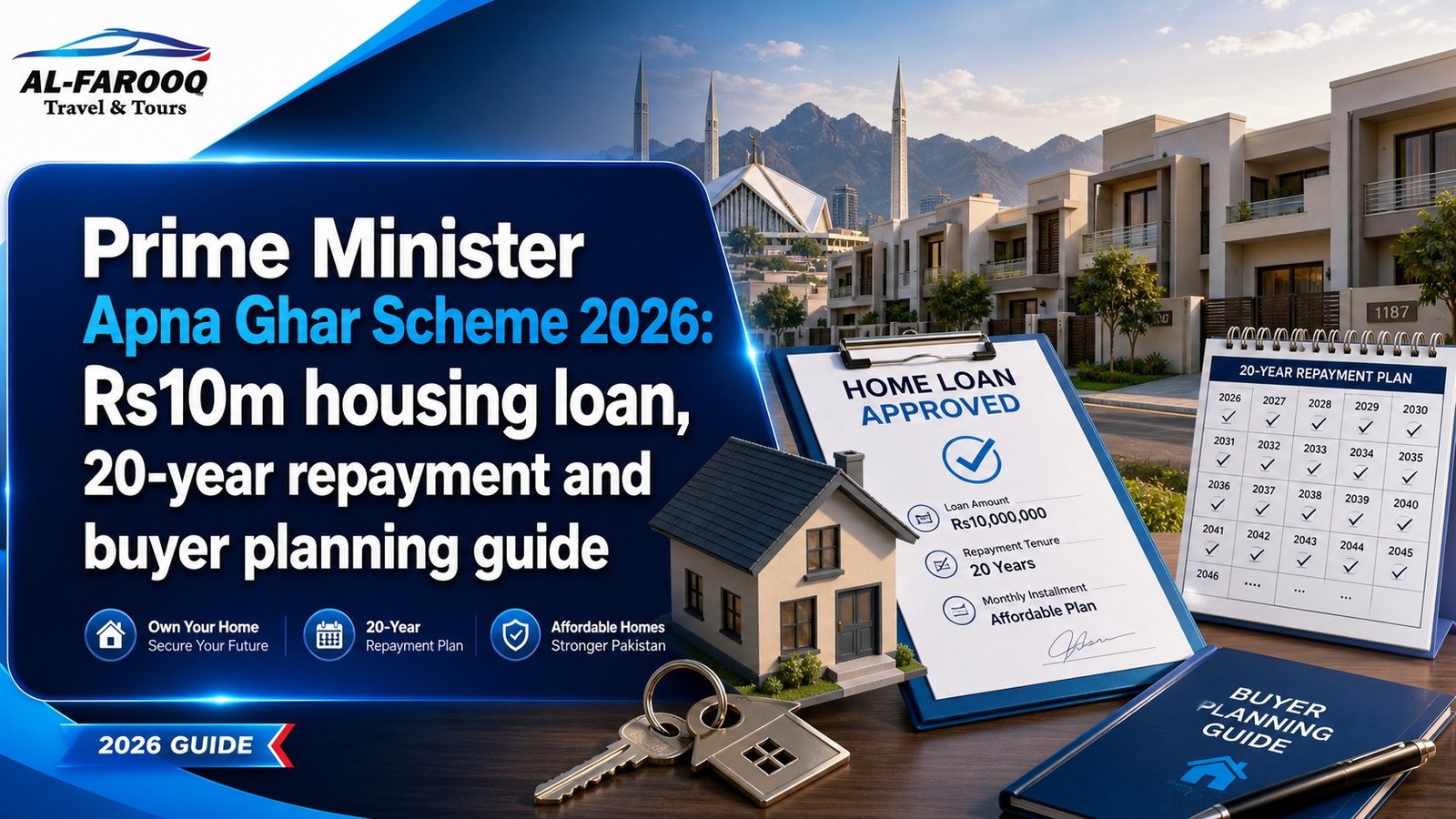
The Prime Minister Apna Ghar Scheme 2026 has been launched as a national housing finance programme for people who want to build a home but cannot arrange the full construction cost upfront. The programme offers housing loans of up to Rs10 million, with a 20-year repayment timeline. For the first 10 years, markup is set at 5%, while the next 10 years will follow the market rate applicable at that time. The programme target is 500,000 homes over five years, backed by a total financing allocation of Rs3.2 trillion. For the first year, the government has set a target of 50,000 houses, with Rs321 billion earmarked. The scheme applies across Islamabad, all provinces, Azad Jammu and Kashmir, and Gilgit-Baltistan. Applicants can construct houses on land measuring up to 10 marla under the announced terms.
Updated on: 5 May 2026
Note: Scheme details are based on the official national news service report from APP and should be verified again from the relevant bank or government portal before any financial commitment.
Prime Minister Apna Ghar Scheme 2026: key facts in one table
| Scheme detail | Announced information |
|---|---|
| Programme name | PM / Wazir-e-Azam Apna Ghar Programme |
| Maximum loan limit | Up to Rs10 million |
| Repayment period | 20 years |
| Markup for first 10 years | 5% |
| Markup after first 10 years | Market rate applicable at that time |
| First-year target | 50,000 houses |
| First-year allocation | Rs321 billion |
| Five-year target | 500,000 homes |
| Total allocation | Rs3.2 trillion |
| Eligible house size | Up to 10 marla |
| Coverage | Islamabad, provinces, AJK and GB |
The announced structure makes this one of the most significant housing finance initiatives in Pakistan because it connects subsidised markup, long repayment, construction activity, and low-income homeownership in one framework.
Why the Apna Ghar Programme matters for Pakistan’s housing market
Pakistan’s housing problem is not only about plots. Many families own small land, inherited land, or a partial structure, but they cannot arrange construction finance. Others live in rented homes for years because the upfront cost of building even a modest house keeps moving out of reach.
The Apna Ghar Programme tries to address that gap by focusing on construction loans rather than only plot ownership. This matters because a finished home creates immediate family value, while construction activity also supports labour, cement, steel, tiles, sanitary, electrical, transport, and small contractor work.
The Prime Minister described the programme as a five-year, Rs3.2 trillion initiative to fund construction of 500,000 homes, with the first-year target set at 50,000 houses.
For Islamabad and Rawalpindi families, the scheme can matter in three common cases:
- A family has land in Rawalpindi, Taxila, Gujar Khan, Kahuta, Murree Road side, Chakri Road, Adiala Road, or nearby areas but lacks construction finance.
- A salaried household wants a formal repayment schedule instead of informal borrowing.
- A lower or middle-income family wants to move from rent to ownership but needs structured financing.
Apna Ghar loan limit: what Rs10 million can realistically cover
A loan of up to Rs10 million can be useful, but it does not mean every applicant will receive the full limit. Banks usually assess income, repayment capacity, property documents, construction feasibility, and risk.
In Pakistan’s current construction market, Rs10 million can support different levels of work depending on city, plot size, grey structure cost, finishing quality, labour rate, and material choices.
Possible use cases for the loan
| Construction case | Where the loan may help |
|---|---|
| Small house grey structure | Boundary, foundation, structure, roof, plaster work |
| Partial construction | Completing one floor or adding rooms |
| Basic finishing | Flooring, doors, windows, washrooms, paint |
| Family home expansion | Adding rooms for a growing family |
| 5 marla to 10 marla construction | Depending on location and quality level |
The announced maximum eligible land size is up to 10 marla, which means the scheme is aimed at modest residential construction rather than luxury housing.
20-year repayment and 5% markup: what it means for applicants
The 20-year repayment timeline is the most attractive part for many families because it spreads the loan burden over a longer period. The first 10 years at 5% markup can reduce early payment pressure compared with normal market-based housing finance. After that, the remaining 10 years will be charged at the market rate at the time.
This creates two phases:
Phase 1: First 10 years
This is the subsidised phase. Monthly instalments are expected to be more manageable because markup is lower.
Phase 2: Next 10 years
This is the market-linked phase. Instalments can change depending on the rate environment at that time.
That second phase matters. Applicants should not judge affordability only on the first 10 years. A responsible applicant should also ask the bank for a sample repayment schedule under different market-rate assumptions.
Estimated repayment thinking: what applicants should ask the bank
The exact instalment will depend on bank calculation, loan amount, disbursement schedule, tenure, markup application, insurance, and processing charges. Still, applicants can prepare by asking the right questions.
| Question to ask | Reason |
|---|---|
| What will be the estimated monthly instalment for Rs3m, Rs5m, Rs7m and Rs10m? | Helps match loan amount with household income |
| Is the loan disbursed in stages or all at once? | Construction loans often work with progress-based disbursement |
| What documents are needed for land ownership? | Property documents can delay approval |
| What is the bank valuation process? | Determines approved amount |
| Are insurance, legal, valuation and processing fees separate? | These can affect total cost |
| What happens after the first 10 years? | Market-rate phase can raise instalments |
| Is early settlement allowed? | Useful if income improves later |
| What happens if an instalment is missed? | Risk clarity is necessary before signing |
Eligibility: who should prepare early
The official launch report gives the broad programme structure, but detailed eligibility will likely be implemented through banks and relevant government mechanisms. Applicants should prepare before visiting a bank.
Likely applicant categories
- Salaried individuals with stable income
- Self-employed applicants with verifiable income
- Families holding valid land/property documents
- Low and middle-income households needing construction finance
- Applicants planning construction up to 10 marla
Documents to prepare
| Document type | Purpose |
|---|---|
| CNIC | Identity verification |
| Income proof | Repayment capacity |
| Bank statement | Cashflow assessment |
| Property ownership document | Confirms land/property status |
| Approved map or construction plan | Supports loan purpose |
| Tax/filer details where applicable | Bank and tax documentation |
| Utility bills or residence proof | Address verification |
Applicants should also keep photocopies and scanned versions of all property papers. In Pakistan, housing finance often slows down because documents are incomplete or ownership records require verification.
The biggest benefit: formal finance instead of informal debt
Many families in Pakistan construct homes through informal borrowing from relatives, shopkeepers, committees, or private lenders. That creates social pressure and unclear repayment conditions.
The PM Apna Ghar Scheme can reduce that pressure if banks implement it efficiently. Formal finance gives:
- documented repayment terms
- clear tenure
- bank-supervised disbursement
- legal record
- lower early markup compared with normal market rates
However, formal finance also means strict documentation and repayment discipline. Missing instalments can affect credit history and create legal complications.
Construction impact: why the programme can affect jobs and materials
Housing finance is not limited to the borrower. When construction begins, money moves into many parts of the economy.
A single small house can involve:
- mason labour
- plumbers
- electricians
- steel suppliers
- cement dealers
- tile shops
- sanitary stores
- transporters
- painters
- carpenters
- aluminium/glass workers
The Prime Minister described the initiative as a programme that can support homeownership and act as an economic multiplier for industrial and commercial sectors.
This is why the scale of 500,000 homes over five years is significant. If implemented well, it can support construction-linked employment across Pakistan.
Decision section: who should apply, who should wait, and safer alternatives
Suitable for applicants who
- have clear land/property ownership documents
- have stable monthly income
- can afford instalments even after household expenses
- want to build up to 10 marla
- can manage construction through a reliable contractor
- have enough savings for fees, drawings, approvals, and extra costs
Applicants who should wait
It may be better to wait before applying if:
- land documents are disputed
- income is not stable
- monthly budget is already under pressure
- construction plan is not ready
- family has not calculated total cost beyond the loan
- repayment after the first 10 years has not been understood
Safer alternatives
If the full loan feels too heavy, consider:
- smaller loan amount
- phased construction
- grey structure first, finishing later
- one-floor construction before expansion
- lower-cost material plan with a contractor
- family contribution to reduce bank borrowing
The goal should not be maximum loan. The goal should be a house that your income can support without destroying household stability.
Islamabad and Rawalpindi angle: site visits, banks and construction travel
For families in Islamabad and Rawalpindi, construction planning often requires repeated travel between home, bank, plot site, contractor office, material shops, and government offices. If the plot is in Rawalpindi outskirts, Chakri Road, Adiala Road, Gujar Khan, Taxila, Bahria Town, DHA, or nearby areas, transport planning becomes part of the process.
For planned site visits, family movement, bank visits, or contractor meetings in the twin cities, Al Farooq Rent a Car can support travel through rent a car in Rawalpindi or rent a car in Islamabad. This is useful when families need a driver-led car for multiple stops and time-sensitive appointments.
Common mistakes applicants should avoid
- applying without complete property documents
- choosing the maximum loan without repayment calculation
- ignoring the market-rate phase after 10 years
- trusting verbal bank estimates without written schedule
- beginning construction without a cost buffer
- hiring a contractor without written scope
- not keeping receipts for construction spending
- using loan money for non-construction expenses
- ignoring legal approval/map requirements
- underestimating finishing cost
A housing loan can solve one problem and create another if cashflow is not planned correctly.
Practical applicant checklist
| Step | Action |
|---|---|
| 1 | Confirm property ownership and land size |
| 2 | Prepare CNIC, income proof, bank statements and property papers |
| 3 | Visit participating banks and request repayment schedules |
| 4 | Compare instalments for different loan amounts |
| 5 | Ask about fees, insurance, valuation and legal charges |
| 6 | Confirm disbursement method |
| 7 | Make construction cost estimate with a contractor |
| 8 | Keep 10–15% cost buffer where possible |
| 9 | Sign only after reading repayment and default clauses |
| 10 | Keep all receipts, approvals and loan documents safe |
FAQs
Prime Minister Apna Ghar Scheme 2026: what is the maximum loan amount?
The announced maximum loan amount under the Prime Minister Apna Ghar Scheme 2026 is up to Rs10 million. The actual approved amount will depend on bank assessment, income, repayment capacity, property documents, and scheme terms. Applicants should request a written repayment schedule before signing.
Apna Ghar Programme: what is the repayment period?
The repayment period announced for the Apna Ghar Programme is 20 years. For the first 10 years, markup is set at 5%, while the next 10 years will follow the market rate applicable at that time. Applicants should ask banks for instalment estimates for both phases.
PM Apna Ghar Scheme: how many houses will be financed?
The government target is 500,000 housing units over five years, supported by a total allocation of Rs3.2 trillion. For the first year, the target is 50,000 houses, with Rs321 billion earmarked.
Prime Minister Apna Ghar Scheme 2026: what house size is allowed?
The announced terms allow eligible applicants to construct houses on land measuring up to 10 marla. This indicates the scheme is focused on modest residential construction rather than high-end housing.
Apna Ghar loan: should applicants take the full Rs10 million?
Not always. The safer approach is to borrow only the amount your monthly income can support. A smaller loan may be better if household expenses are high or income is uncertain. Applicants should compare instalments for Rs3m, Rs5m, Rs7m and Rs10m before deciding.
PM Apna Ghar Scheme 2026: can self-employed people apply?
Detailed bank-level eligibility will decide final approval. Self-employed applicants should prepare bank statements, income records, business proof, tax documents where applicable, and property documents. A clean income trail improves the chance of smoother assessment.
Apna Ghar Programme: what should applicants ask before signing?
Applicants should ask about monthly instalment, processing fees, valuation charges, insurance, legal fees, disbursement method, early settlement rules, default penalty, and the market-rate phase after the first 10 years. Verbal estimates are not enough; a written schedule is better.
Is the Apna Ghar Scheme available only in Islamabad?
No. The launch report states that the scheme will cover the federal capital, all four provinces, Azad Jammu and Kashmir, and Gilgit-Baltistan. Applicants should confirm participating banks and local documentation requirements in their own city or region.
Disclaimer
This blog is for general information only. Housing loan rules, eligibility, bank documentation, markup terms, repayment schedules, disbursement methods, property requirements, taxes and fees can change through official updates and participating bank policies. Before applying, confirm the latest terms directly from the relevant bank or official government source and calculate affordability using your real household income and expenses.