
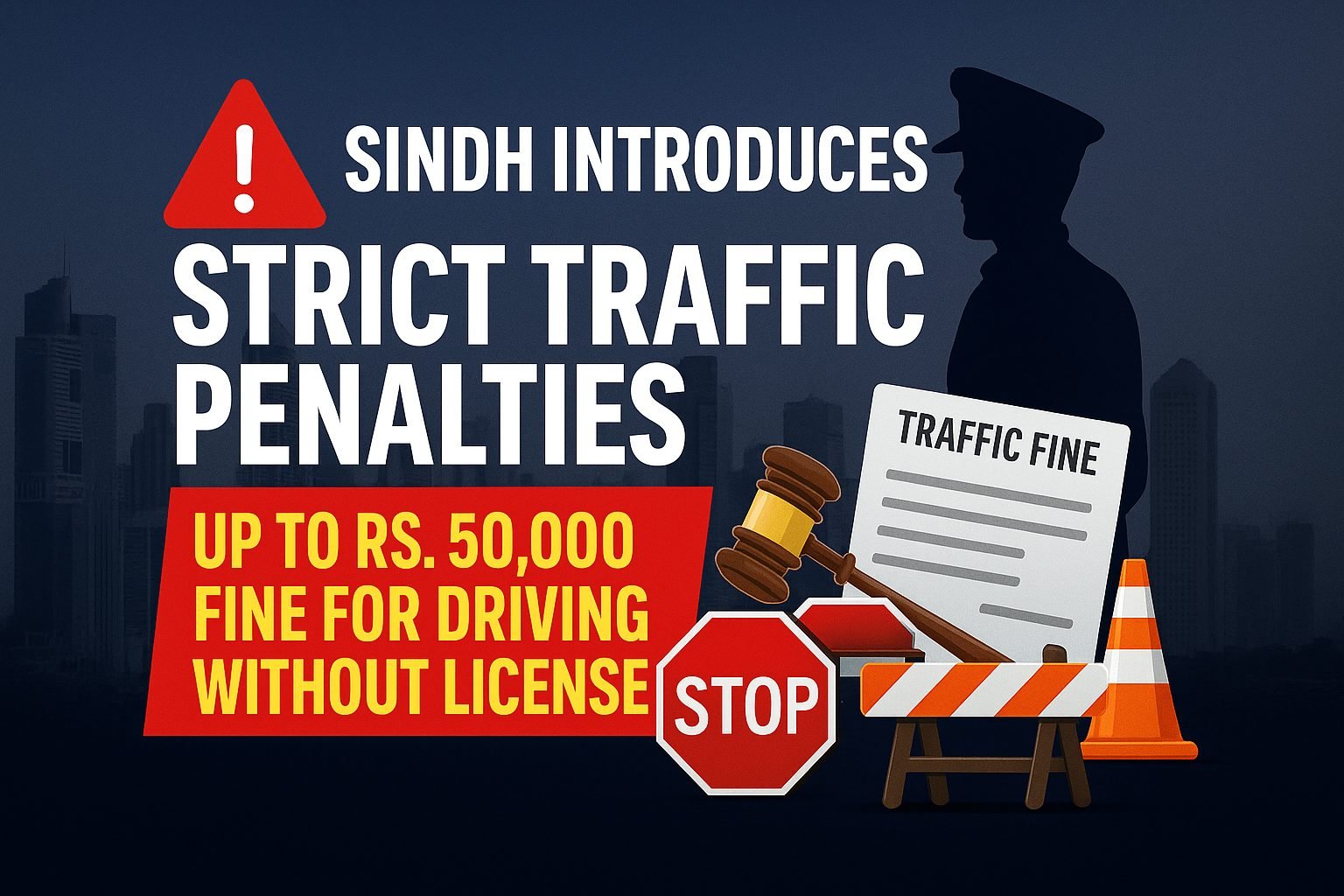
The Sindh Police has implemented comprehensive traffic enforcement measures with substantial financial penalties for motorists and riders operating vehicles without valid licenses. Inspector General Sindh Police, Ghulam Nabi Memon, announced these stringent regulations during a recent media briefing in Karachi, marking a significant shift in provincial traffic law enforcement.
These new penalties affect millions of vehicle operators across Sindh, including major urban centres like Karachi and extending to all districts within the province. While the regulations specifically target Sindh, they reflect broader national trends toward stricter traffic enforcement, with implications for drivers throughout Pakistan, including those in Islamabad and Rawalpindi.
Breakdown of New Fine Structure
The revised penalty framework establishes three distinct fine categories based on vehicle classification, creating graduated deterrents proportional to vehicle size and operational risk.
Motorcyclists Operating Without License
- Fine: Rs20,000
- Applies to all two-wheelers regardless of engine capacity
- Includes scooters, mopeds, and motorcycles
Light Transport Vehicle (LTV) Drivers Without License
- Fine: Rs30,000
- Covers cars, jeeps, vans, and pickup trucks
- Includes private and commercial light vehicles
Heavy Transport Vehicle (HTV) Drivers Without License
- Fine: Rs50,000
- Applies to trucks, buses, trailers, and heavy commercial vehicles
- Highest penalty reflecting greater public safety risk
These penalties represent dramatic increases from previous enforcement levels, where fines for unlicensed driving typically ranged from Rs500 to Rs2,000. The new structure aims to create genuine financial deterrents rather than nominal penalties easily absorbed as operating costs by habitual violators.
The Rationale Behind Increased Penalties
IG Memon explained the policy objective during his announcement, emphasizing prevention over punishment. The goal centers on creating compliance through meaningful consequences rather than generating revenue through ticket issuance.
Memon referenced international practices where driving without licenses is virtually unthinkable due to severe penalties. He noted that his initial proposal suggested fines exceeding Rs100,000 to establish even stronger deterrents. However, government deliberations resulted in the current structure, balancing deterrence effectiveness against economic realities facing Pakistani citizens.
The focus on prevention through compliance reflects modern traffic enforcement philosophy. Rather than viewing fines as punishment for past behavior, the approach treats penalties as incentives for future compliance. This shift recognizes that road safety improves when unlicensed drivers obtain proper training and certification rather than simply paying fines after violations.
Broader Traffic Violation Penalties in Sindh
The driving license enforcement forms part of comprehensive traffic violation reforms introducing demerit point systems alongside financial penalties. The provincial government has established penalties for numerous violations beyond unlicensed operation:
Overspeeding Violations
- Motorcycles: Rs5,000 plus demerit points
- Cars: Rs15,000 plus demerit points
- Heavy vehicles: Rs20,000 plus demerit points
Other Common Violations
- One-wheeling: Substantial fines and demerit points
- Riding without helmets: Financial penalties
- Tinted windows beyond legal limits: Fines and potential demerit points
- Wrong-lane driving: Graduated penalties
- Carrying passengers on vehicle rooftops: Significant fines
Parking Violations
- Motorcycles: Rs2,000 for illegal parking plus potential towing fees
- Heavy vehicles: Rs20,000 for parking violations
- Additional charges for sidewalk parking, bus stop blocking, and no-parking zone violations
The demerit point system accumulates violations over time, with license suspension or revocation possible after reaching specified thresholds. This creates long-term consequences beyond immediate financial penalties, incentivizing sustained compliance rather than sporadic adherence.
National Context: Traffic Enforcement Trends
While these specific penalties apply within Sindh, other provinces have implemented or proposed similar enforcement enhancements. Punjab authorities have discussed comparable fine structures, and Islamabad Traffic Police conducts periodic enforcement campaigns targeting unlicensed drivers.
This provincial variation creates complexities for drivers traveling across provincial boundaries. A driver licensed in Punjab faces Sindh penalties if caught operating without proper documentation in Karachi. Conversely, Sindh residents traveling to Islamabad or Lahore must maintain valid licenses to avoid penalties in those jurisdictions.
The variation underscores the importance of maintaining current, valid licenses regardless of home province. Interprovincial travel—whether for business, tourism, or family visits—requires proper documentation to avoid significant financial consequences under varying provincial regulations.
Impact on Motorcycle Riders
The Rs20,000 motorcycle penalty particularly affects Pakistan's large two-wheeler population. Motorcycles represent the primary transportation mode for millions of Pakistanis, especially in middle and lower-income brackets where vehicle affordability matters significantly.
Many motorcycle operators, particularly in rural areas and smaller towns, have historically operated without formal licenses. Contributing factors include limited access to testing facilities, bureaucratic hurdles, and insufficient awareness about licensing requirements. The new penalties create substantial financial pressure to formalize this historically informal sector.
The Rs20,000 fine represents a meaningful sum for most motorcycle riders. For context, entry-level motorcycles cost Rs100,000-150,000, making the penalty equivalent to 13-20% of the vehicle's value. This proportionality ensures the fine functions as a genuine deterrent rather than a minor inconvenience.
Commercial Transport Implications
The Rs30,000 and Rs50,000 fines for light and heavy commercial vehicles significantly impact professional drivers and transport operators. Companies operating vehicle fleets now face heightened compliance pressure, as a single violation can erase profit margins from multiple trips.
Transport associations have expressed concerns about the enforcement timeline and implementation procedures. Many operators work on thin margins where a single Rs50,000 fine can represent days or weeks of income. However, traffic authorities emphasize that compliance—obtaining proper licenses—eliminates all penalty risk.
The regulations create incentives for transport companies to verify driver credentials rigorously before employment. Previously, some operators overlooked licensing issues, accepting drivers based on experience rather than formal certification. The new financial risks make such practices economically untenable.
Obtaining a Driving License in Pakistan
The penalty structure assumes that obtaining licenses remains accessible and reasonably straightforward. Pakistani citizens can acquire driving licenses through provincial traffic authorities following standardized procedures:
Initial Steps
- Apply for a learner's permit through district traffic offices
- Complete required documentation including CNIC, photographs, and fee payment
- Pass written test covering traffic rules and road signs
- Receive learner's permit valid for specified practice period
Final License Acquisition
- Complete mandatory practice period with learner's permit
- Schedule practical driving test at designated testing facility
- Demonstrate vehicle operation competency to examining officer
- Upon passing, receive permanent license valid for five years
License categories include motorcycle, LTV (light transport vehicle), and HTV (heavy transport vehicle), with separate testing and experience requirements for each category. The process, while sometimes bureaucratic, remains fundamentally accessible to citizens meeting basic requirements.
Enforcement Mechanisms and Implementation
The success of increased penalties depends on consistent enforcement rather than penalty severity alone. Sindh Police has indicated plans for enhanced traffic checkpoints and patrol presence to verify license compliance systematically.
Modern technology including mobile applications, database connectivity, and digital verification systems enables officers to confirm license validity instantly. This reduces processing time at checkpoints while preventing fraudulent documentation that previously circumvented enforcement.
The implementation raises questions about warning periods versus immediate enforcement. Traffic authorities have indicated that the regulations are now active, meaning violations incur full penalties without grace periods. This immediate implementation aims to create urgency around compliance rather than allowing delayed adjustment.
Implications for Residents of Other Provinces
While these specific fines apply in Sindh, residents of Islamabad, Rawalpindi, Lahore, and other cities outside Sindh should note several important considerations:
Travel to Sindh: Anyone driving or riding into Sindh must carry valid licenses to avoid these substantial penalties. Business travelers, tourists, and family visitors all fall under these regulations when operating vehicles in the province.
Interprovincial Consistency: Although penalty amounts vary by province, all Pakistani provinces require valid driving licenses. The principle remains universal even when specific fine amounts differ.
License Validity: Pakistani driving licenses issued by any provincial authority remain valid nationwide. A license obtained in Islamabad functions legally in Karachi, and vice versa, eliminating the need for multiple provincial licenses.
Transportation Alternatives and Professional Services
The strict enforcement creates additional value for professional transportation services, particularly for visitors unfamiliar with local regulations or those without current licenses. Professional drivers carry proper credentials, eliminating passenger liability for driver documentation.
For residents of Islamabad and Rawalpindi planning travel to Karachi or other Sindh destinations, professional car rental services with drivers provide stress-free transportation without personal driving requirements. This proves particularly valuable for business trips where license verification, parking challenges, and navigation in unfamiliar cities create unnecessary complications.
Airport transfers represent another scenario where professional services excel. Islamabad airport car rental and similar services in other cities eliminate concerns about vehicle operation, parking, and regulatory compliance while ensuring reliable, comfortable transportation.
Al Farooq Rent a Car specializes in providing quality vehicles with professional drivers across Islamabad, Rawalpindi, and major Pakistani cities. Their services accommodate various needs, from corporate travel requiring executive sedans to family trips needing spacious SUVs. Professional drivers maintain current licenses and documentation, allowing passengers to travel confidently without regulatory concerns. Whether planning intercity journeys to Lahore, Faisalabad, or destinations within Sindh, their comprehensive service eliminates driving-related stress while ensuring compliance with all provincial regulations.
Road Safety Objectives Beyond Penalties
The underlying objective extends beyond fine collection to fundamental road safety improvement. Unlicensed drivers typically lack formal training in traffic rules, defensive driving techniques, and hazard recognition. This knowledge gap contributes to Pakistan's concerning road accident statistics.
Licensed drivers have demonstrated basic competency through testing requirements. While licensing alone doesn't guarantee safety, it establishes minimum standards that unlicensed operators never validated. The push toward universal licensing aims to raise these minimum competency levels across the entire driving population.
Pakistan experiences approximately 27,000 road fatalities annually according to World Health Organization estimates, with many more injuries creating medical costs and economic burdens. If stricter enforcement and increased licensing rates reduce accident frequency even modestly, the social benefits substantially exceed any enforcement costs or inconvenience.
Practical Compliance Recommendations
For current drivers and riders operating without licenses, compliance becomes financially imperative under the new penalty structure. The path forward involves straightforward steps:
Immediate Actions
- Determine current license status and expiration dates
- If unlicensed, apply for learner's permit immediately
- Complete required training and testing within permitted timeframes
- Maintain documentation during vehicle operation
For Expired Licenses
- Initiate renewal process before expiration when possible
- Understand that expired licenses provide no protection against penalties
- Complete renewal requirements promptly to restore legal operating status
Documentation Habits
- Carry physical license during all vehicle operation
- Maintain insurance documentation and vehicle registration alongside license
- Update license information following address changes or other relevant modifications
The Rs20,000-50,000 penalties make license acquisition financially compelling even when factoring application costs and testing time requirements. The one-time investment in proper licensing eliminates ongoing violation risk and provides long-term operating security.
Long-Term Policy Implications
These enforcement changes signal broader governmental commitment to traffic regulation modernization. The willingness to impose meaningful financial penalties indicates that authorities take road safety seriously enough to accept potential public resistance to increased enforcement.
Future policy evolution may include additional refinements such as:
- Point-based license suspension systems
- Graduated penalties for repeat offenders
- Integration with insurance rating systems
- Expansion to other violation categories currently under-enforced
The Sindh implementation may influence other provinces to adopt similar structures, creating more uniform national standards despite Pakistan's federal system that grants provinces primary traffic regulation authority.
Addressing Common Concerns
"The fines are too high for average citizens" Authorities counter that proper licensing eliminates all penalty risk, making the fine amount irrelevant for compliant operators. The penalty severity intentionally creates compliance incentives.
"Enforcement targets poor motorcycle riders disproportionately" While motorcycle riders constitute a large violation demographic, the penalty structure applies universally regardless of economic status. Proper licensing remains accessible to citizens across income levels through government facilities.
"Testing facilities are insufficient for demand" Provincial authorities have expanded testing capacity in response to increased demand. Online appointment systems and additional testing centers aim to reduce waiting periods and improve accessibility.
Frequently Asked Questions About Sindh Traffic Fines 2025
Q: Do these fines apply only in Karachi or throughout Sindh province?
A: The penalties apply across all of Sindh province, including Karachi, Hyderabad, Sukkur, Larkana, and all other districts. Any location within Sindh's boundaries falls under this enforcement regime.
Q: Can I use a learner's permit to avoid the Rs20,000 fine?
A: Learner's permits carry restrictions including supervision requirements and speed limitations. Operating outside these restrictions may still result in penalties. A valid permanent license provides full legal protection.
Q: What happens if I cannot pay the fine immediately?
A: Fine payment procedures vary, but unpaid fines typically accumulate penalties over time. Some jurisdictions double fines after specific periods. Unpaid violations may eventually result in vehicle impoundment or license suspension.
Q: Does a Punjab or Islamabad license protect me from fines in Sindh?
A: Yes, Pakistani driving licenses issued by any provincial authority remain valid nationwide. A valid license from Punjab, Islamabad, or any other province provides full legal protection when driving in Sindh.
Q: Are foreign nationals with international licenses exempt from these fines?
A: Foreign nationals must carry valid international driving permits or Pakistani licenses. International permits provide temporary legal authorization but must remain current and properly documented.
Q: Can transport companies face additional penalties if their drivers lack licenses?
A: While the primary penalty applies to the driver, companies may face separate violations under commercial transport regulations. Many insurers also void coverage when unlicensed drivers operate vehicles, creating additional liability.
Q: Will Islamabad or Punjab implement similar fine structures?
A: Other provinces have discussed comparable enforcement measures. While specific amounts and timelines remain uncertain, the trend toward stricter enforcement appears nationwide. Maintaining valid licenses protects against penalties regardless of provincial variations.
Q: For intercity travel from Islamabad to Karachi, should I drive or use professional services?
A: This depends on personal circumstances. If you hold a valid license and prefer driving, the regulations don't prevent this. However, professional car rental services eliminate driving fatigue, navigation challenges, and vehicle maintenance concerns during extended journeys.
Q: Can I contest a fine if I believe it was issued incorrectly?
A: Yes, traffic violation appeals processes exist through designated traffic courts. However, appeals require documentation supporting your position and may involve administrative procedures. Maintaining proper licensing prevents disputes entirely.
Q: What happens to riders under 18 who cannot legally obtain licenses?
A: Minimum age requirements for licenses reflect legal judgments about operator maturity and capability. Individuals below minimum age cannot legally operate vehicles on public roads regardless of supervision or circumstances. Parents and guardians face liability for underage operation.